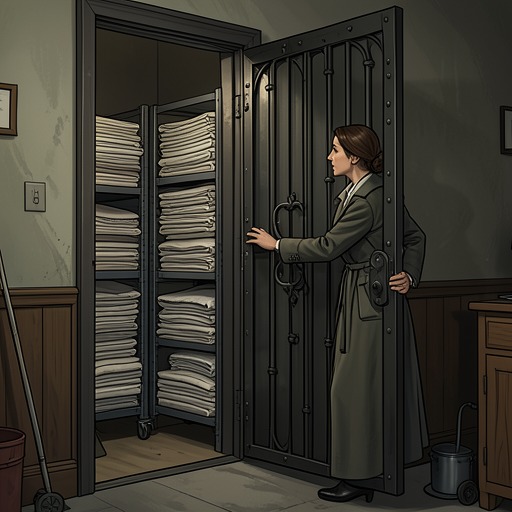
Sophie
PossessionSophie, Christabel LaMotte’s sister, helps arrange the secret birth of Christabel’s daughter in Brittany and raises the child as her own in England. Her protection gives the girl a secure family life, but also preserves the concealment of her parentage for nearly thirty years, shaping the later revelation of Maud Bailey’s descent from both Christabel and Randolph Henry Ash.
Identity and Family Role
Sophie enters the story chiefly through Christabel’s final account of the secret surrounding her daughter. She is Christabel’s sister and the one family member Christabel considers able to help after the two women part, aware that the consequences of their separation may include a child. Christabel turns to her not merely for practical assistance, but as the person whose cooperation can make a concealed life possible.
That role links Sophie to two generations of women and to the transmission of family papers. After Christabel’s death in 1890, Sophie sends a package of her sister’s papers and poems to her own daughter, May, who is Maud Bailey’s great-great-grandmother. In the covering letter, as Maud later recalls it, Sophie says Christabel had wished May to receive her papers and had believed in handing things on through the female line. The family inheritance of documents thus parallels the earlier, more intimate act of taking in Christabel’s child.
The Secret Birth and Adoption
Christabel says that, after parting from Randolph Henry Ash, she made arrangements to go somewhere she could take responsibility for the consequences of their relationship. She then consulted Sophie, who agreed to help her sustain a lie that Christabel describes as more appropriate to romance than to her previously quiet life. Their daughter was born in Brittany, in a convent, and was carried to England; Sophie took her and brought her up as her own, according to the plan the sisters had made.
Christabel’s account emphasizes not only the concealment but the quality of Sophie’s care. She says Sophie loved and cherished the child as well as anyone who was not her true mother could. The girl grew up in English fields, loved her adoptive parents, and later married a cousin in Norfolk. Sophie’s part in the arrangement therefore has a double consequence: she helps hide the child’s origins, while providing the loving upbringing that allows the child to live without knowing the secret.
A Long-Term Promise
Christabel understands the arrangement as dependent on Sophie’s goodwill. She says she made secrecy a condition of Sophie’s kindness, and that without Sophie’s support the child would have had neither a home nor material security. Her account also explains why the secret endured: Christabel feared that telling her daughter the truth might make the girl recoil from her, and feared losing the family protection on which the child’s upbringing depended.
For almost thirty years, Christabel imagines herself as a distant, unloved presence in her daughter’s life, while the daughter remains happy within Sophie’s family. The account makes no suggestion that Sophie later disclosed the truth. Instead, the adoption’s success depends on its apparent permanence: the child loves the parents who raised her, and Christabel accepts silence rather than risk disrupting that life.
Papers, Inheritance, and Narrative Significance
Sophie’s actions acquire a further significance when the family history is reconstructed. The papers she sends to May preserve Christabel’s work and help establish a female line of transmission, while the child she raises carries a concealed biological connection between Christabel and Ash. The later explanation that children born outside marriage could not inherit at the time clarifies why such a child might be hidden within a legitimate family. The concealment protects the girl’s prospects, but also prevents her descendants from immediately recognizing their connection to the poets whose lives and papers they investigate.
Sophie is therefore central despite appearing chiefly in other people’s recollections and letters. Her choice combines affection with practical intervention: she accepts the child, raises her as her own, and keeps the arrangement intact. The same act that gives the child a stable home also prolongs the silence around her origins, until the family’s buried history can be read in both the inherited documents and the descendants themselves.