Val
PossessionVal is Roland Michell’s partner from their student days, his companion and financial support through the precarious years of his academic career, and eventually a figure who builds a life beyond their relationship. Her trajectory moves from an apparently settled togetherness toward a hard-won independence: while Roland’s attention is drawn into the papers of Randolph Henry Ash, Val sees realities he neglects, and their shared habits of silence fail to preserve their intimacy. Her later marriage to Euan MacIntyre makes the change in their relationship explicit.
Identity and Early Relationship
Val meets Roland at a Freshers’ tea party in the Student Union when he is eighteen. He remembers her alone with a teacup, looking out of the window, and recalls being drawn to her quiet composure. He believes she may have been the first person he spoke to socially as an undergraduate, although he recognizes that memory may have smoothed the past into a story of origins. From the meeting onward, the two share courses and societies, sit together in seminars, visit the National Film Theatre, and make a life together. Roland’s recollection that they had never not been together conveys the relationship’s long duration, but also the ease with which he treats its continuity as a given.
Their partnership includes intellectual companionship, domestic intimacy, and economic dependence. When Roland’s grant runs out, Val becomes the principal wage-earner while he completes his PhD. She types academic work at home on an IBM golfball typewriter and takes temporary jobs in a range of settings, including the City, teaching hospitals, shipping firms, and art galleries. She resists pressure to specialize and rarely discusses her work without calling it menial. The sound of the typewriter disturbs Roland as he works at night; the detail makes visible how her labor supports his scholarly life even as he experiences it as an interruption.
Work, Perception, and Unequal Speech
Val’s description of her work as menial is not a measure of what she notices. Moving through workplaces that Roland does not inhabit, she encounters evidence of cruelty and suffering, including disturbing photographs in an office and a medical record concerning a teenager whose serious illness is worsening. She tells Roland that these things do not fit together or make sense. Her account sets the unconnected facts of ordinary working life against his concentrated fascination with a dead poet: Roland can devote himself to Ash, while Val’s work exposes her to troubling fragments of the living world.
The imbalance also enters their conversations. When Roland begins to speak in one encounter, Val puts a hand over his mouth. As Roland gains academic successes, she says less; in arguments, she increasingly offers versions of his own ideas. She writes a required essay on “Male Ventriloquism: The Women of Randolph Henry Ash,” a title that resonates with this pattern of one person’s voice seeming to speak through another. Roland says he does not want her to disappear into his opinions and urges her to speak up, but Val calls his insistence taunting. Their disagreements often end in silence, a form of aggression used by both, and can continue for days. His wish that she should become more independent does not undo the relationship’s accumulated asymmetry.
Strain and Separation
As Roland becomes absorbed in Ash, Val recognizes that his scholarly preoccupation has displaced other parts of his life. She remarks that he can do what excites him and that his attachment to the dead poet is acceptable, but not everyone shares it. Her own perspective comes from the jobs he treats as peripheral, where she has encountered facts that are difficult to reconcile with one another. Her challenge is not simply a complaint about his work; it exposes the different worlds their daily lives have brought them into.
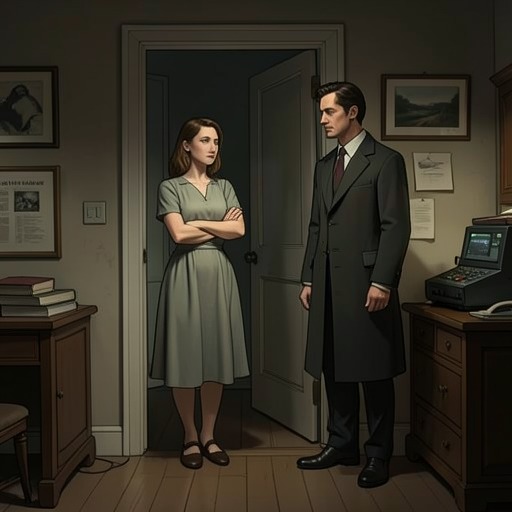
Their domestic relationship becomes visibly unsettled. At one point Roland sees Val and a well-dressed man in a tense exchange at the basement entrance, with the man pressing toward the stairs as Val resists. Val explains that the man is attracted to her. Later, she asks what has happened to them. In a subsequent confrontation, she suggests that staying out late should suit Roland, while he wonders whether he could have prevented matters from reaching this point if he had been able to raise his voice and object. The scene does not make either partner’s motives wholly transparent: Roland fears that the Val he knew has become lost or changed, but he also recognizes his own failure to respond. When Val says that things are not as he seems to think, the distance between them is underscored rather than resolved.
Even amid their estrangement, the history of shared dependence remains. Roland tells Maud Bailey that he has lived with Val since university, that she is the breadwinner, and that he owes her a great deal. He has no secure job, relying on occasional teaching and piecework on an edition, and he depends on James Blackadder professionally as well. He finds it difficult to talk about Val, feeling that he should not. The admission reveals both gratitude and constraint: the relationship has materially sustained Roland, yet his inability to speak openly about it mirrors the silence that has long governed their conflicts.
A Life Beyond Roland
The narrative later shows Val at Newmarket, watching a race and its brief passage from anticipation to release. Her attention rests on the track and the animals’ momentary movement, a scene distinct from Roland’s scholarly world. In conversation, she refers to herself as someone who used to live with an Ash scholar, and is disconcerted by her own use of the past tense. The phrase registers separation before it is presented as a settled explanation; her habitual description of the relationship has changed, and she hears that change as it happens.
When Roland sees Val again, her appearance and composure suggest a new happiness. She tells him, “I’m going to marry Euan.” Euan MacIntyre says that he had asked Val what she knew, linking the new relationship to events surrounding Roland’s circle without reducing her decision to those events. Val’s announcement marks a decisive change: the woman who had supported Roland through his studies and shared his life since university now intends to marry someone else. The novel does not give her later marriage the same extended interior account it gives Roland’s uncertainty, but her own declaration makes the ending of their former arrangement unmistakable.
Narrative Role and Significance
Val’s part in the novel complicates the image of the scholar whose work appears to occupy the center of the story. She enables Roland’s academic progress through paid work, yet her life and observations are not reducible to that support. Her jobs expose her to unsettling facts outside the archive, and her challenge to Roland’s fixation draws attention to what scholarship can leave unseen. The contrast is especially sharp because her own labor is described as menial while his uncertain academic career commands his sustained attention.
The relationship also gives the novel a present-day counterpoint to its histories of literary authorship and gendered speech. Val’s essay title, the gradual echoing of Roland’s ideas, and the silences that both use in conflict make voice and recognition intimate matters rather than abstract topics. Roland’s concern that she should speak for herself is complicated by his failure to notice what her perspective already contains. Val’s eventual departure from their shared future does not erase the debt between them; it shows that gratitude, long companionship, and material dependence cannot by themselves keep a relationship unchanged.