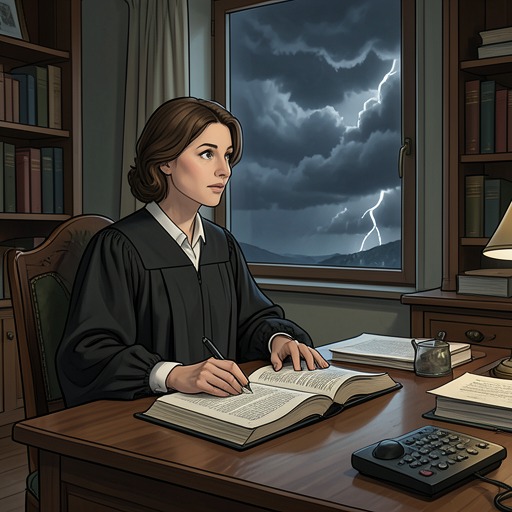
Professor Bengtsson
PossessionProfessor Bengtsson is Beatrice Nest’s teacher and academic mentor at Prince Albert College, a formidable scholar of the Eddas and ancient Norse mythology whose guidance shapes the course of her career. He introduces her to Randolph Henry Ash’s poetry, then channels her scholarly ambitions toward a safer project: editing Ellen Ash’s journal. His influence is both enabling and restrictive; he helps Beatrice enter academic life, but his cautious standards also redirect her from the work she most wants to pursue.
Identity and Background
Bengtsson rules the English Department at Prince Albert College. Beatrice studies Norse mythology, philology, Anglo-Saxon, runes, and medieval Latin under his authority, alongside reading Masefield, Christina Rossetti, and de la Mare. His chief scholarly passion is the Eddas and ancient Norse mythology, and he recommends Ash’s Ragnarök. Ash is regarded as a scholar of consequence as well as a precursor of modern poetry.
The account gives Bengtsson a sharply divided daily presence. Tall, gangling, and bearded, with fierce eyes and an energy poorly matched to teaching young women the niceties of Nordic roots, he spends his evenings drinking with male peers at the Arundel Arms. In the morning he is pale beneath his blond hair; by afternoon he is ruddy, slurred, and breathing beer in his stuffy office. The portrait sets his intellectual authority beside his habitual dissipation without suggesting that the latter diminishes his command of the department.
Influence on Beatrice Nest
Beatrice reads Ragnarök and Ask to Embla, takes a First, and falls in love with Ash. Her examination writing identifies what she values in his poetry: not a distant woman praised or blamed, but a thinking, feeling addressee engaged in conversation. She sees the poems as presenting intimacy, opposition, and failures of communication while still granting the woman addressed an intellectual presence. This response makes Ash’s poetry more than an academic topic for her; it gives form to a kind of mutual conversation she finds absent from her small social world.
When Beatrice proposes a doctoral dissertation on Ask to Embla, Bengtsson doubts that she can make a secure contribution to knowledge in so uncertain a field. He considers an edition the safest kind of doctorate and advises against making Ash the subject. Through a friend who knows Lord Ash, he learns that Ash’s papers are in the British Museum and that Ellen Ash kept a journal. He recommends editing that journal instead: the undertaking would be new, useful, manageable, and related to Ash, with the possibility of branching into further work later.
Career and Academic Legacy
The journal project places Beatrice among boxes of papers—letters, laundry lists, receipt books, daily journals, and smaller volumes of private writing. She had hoped for intimacy with the poet’s mind and passionate nature, but the work draws her into Ellen Ash’s ordinary life and its guarded privacy. Bengtsson’s proposed subject therefore redirects her attention from direct access to the poet toward the domestic records surrounding him.
Bengtsson also makes professional advancement conditional on publication. He asks Beatrice to compare Ellen Ash’s wifely qualities with those of Jane Carlyle, Lady Tennyson, and Mrs Humphry Ward, and tells her that she must publish before he can give her work. Beatrice writes Helpmeets, a small book about the daily lives of wives of genius, over two years. Bengtsson then offers her an assistant lectureship, which brings her both pleasure and fear, though pleasure predominates.
In that role Beatrice teaches successive generations of mostly female students about the sonnet, lyric poetry, and changing images of women. Bengtsson’s mentorship thus connects her initial training in older scholarship to a long teaching career attentive to literary form and women’s representation. He retires in 1970 and dies in 1978; by 1986 Beatrice has taken early retirement, and she no longer crosses the threshold of her old college.