Arwen Undómiel
Arwen Undómiel, called the Evenstar of her people, is one of the most significant yet most elusive presences in The Lord of the Rings. She is the daughter of Elrond, the half-elven Lord of Rivendell, and in her, it is said, the likeness of Lúthien had come on earth again. Her name Undómiel means Evenstar, a title that marks her as the last and fairest of the great Elven women of the Elder Days, the final flowering of a lineage that reaches back to the First Age. Though she appears in only a handful of scenes, her role is decisive: she is the anchor of Aragorn's hope, the symbol of the Elvish world that is passing, and the bride whose wedding to the restored King of Gondor seals the new age that follows the War of the Ring.
Identity and Introduction
Arwen is first seen through the eyes of Frodo Baggins at the feast in Rivendell, where she sits in the middle of the table under a canopy, a lady fair to look upon and so like in form of womanhood to Elrond that Frodo guesses she is one of his close kindred. She is young and yet not so: the braids of her dark hair are touched by no frost, her white arms and clear face are flawless and smooth, and the light of stars is in her bright eyes, grey as a cloudless night. Above her brow she wears a cap of silver lace netted with small gems, glittering white, and her soft grey raiment has no ornament save a girdle of leaves wrought in silver. Queenly she looks, and thought and knowledge are in her glance, as of one who has known many things that the years bring. The narrative notes that few mortals had yet seen her, and that she had long been in the land of her mother's kin, in Lórien beyond the mountains, and was but lately returned to Rivendell to her father's house. Her brothers, Elladan and Elrohir, are out upon errantry, riding often far afield with the Rangers of the North, forgetting never their mother's torment in the dens of the orcs. This introduction establishes Arwen as a figure of almost inaccessible beauty and ancient lineage, set apart from the mortal world that Frodo inhabits.
The Evenstar and the King
The central relationship of Arwen's life is with Aragorn, and the evidence of their bond is shown in two key moments. The first occurs in the Hall of Fire at Rivendell, when Frodo, leaving the feast, looks back and sees Elrond in his chair with the fire on his face like summer-light upon the trees, and near him the Lady Arwen. To his surprise, Frodo sees that Aragorn stands beside her, his dark cloak thrown back, clad in elven-mail, with a star shining on his breast. They speak together, and then suddenly it seems to Frodo that Arwen turns towards him, and the light of her eyes falls on him from afar and pierces his heart. This moment, witnessed by the hobbit, reveals the hidden bond between the mortal Ranger and the Elven lady, a bond that is not yet public knowledge. The second moment comes in Lothlórien, at the hill of Cerin Amroth, where Frodo finds Aragorn standing still and silent as a tree, holding in his hand a small golden bloom of elanor, with a light in his eyes. He is wrapped in some fair memory, and as Frodo looks at him he knows that he beholds things as they once had been in this same place. The grim years are removed from the face of Aragorn, and he seems clothed in white, a young lord tall and fair, speaking words in the Elvish tongue to one whom Frodo cannot see. He says, "Arwen vanimelda, namárië!" and then draws a breath, returning out of his thought, and looks at Frodo and smiles. Aragorn then declares, "Here is the heart of Elvendom on earth," and says that here his heart dwells ever, unless there be a light beyond the dark roads that they still must tread. He takes Frodo's hand and leaves the hill of Cerin Amroth, coming there never again as living man. This scene reveals that Arwen is not merely a distant figure but the very reason for Aragorn's hope and endurance through the long years of his exile and wandering.
The Fulfillment at Minas Tirith
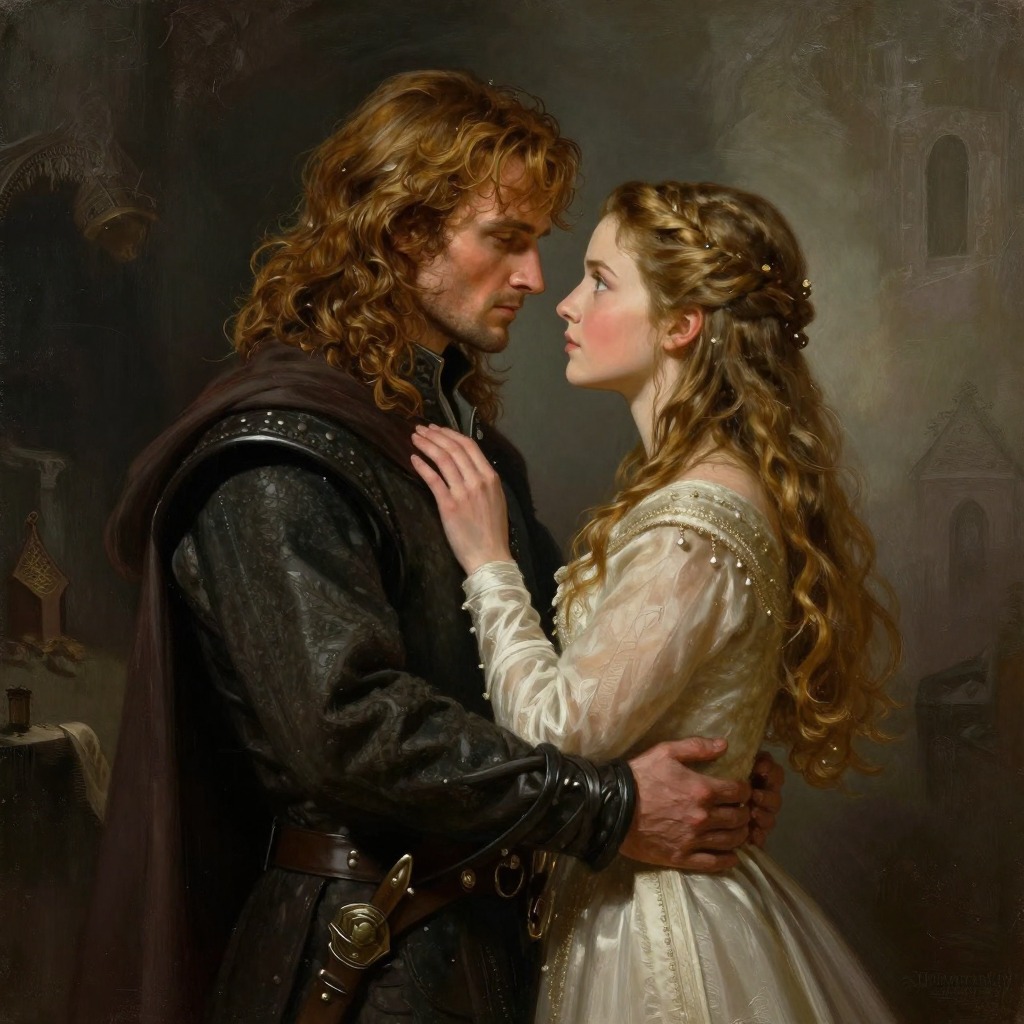
The culmination of Arwen's story comes at the end of the War of the Ring, when the victory over Sauron has been won and the King has returned to his city. Upon the very Eve of Midsummer, when the sky is blue as sapphire and white stars open in the East while the West is still golden, and the air is cool and fragrant, the riders come down the North-way to the gates of Minas Tirith. First ride Elrohir and Elladan with a banner of silver, and then come Glorfindel and Erestor and all the household of Rivendell, and after them the Lady Galadriel and Celeborn, Lord of Lothlórien, riding upon white steeds with many fair folk of their land, grey-cloaked with white gems in their hair. Last comes Master Elrond, mighty among Elves and Men, bearing the sceptre of Annúminas, and beside him upon a grey palfrey rides Arwen his daughter, Evenstar of her people. When Frodo sees her come glimmering in the evening, with stars on her brow and a sweet fragrance about her, he is moved with great wonder, and he says to Gandalf: "At last I understand why we have waited! This is the ending. Now not day only shall be beloved, but night too shall be beautiful and blessed and all its fear pass away!" Then the King welcomes his guests, and they alight, and Elrond surrenders the sceptre and lays the hand of his daughter in the hand of the King, and together they go up into the High City, and all the stars flower in the sky. Aragorn the King Elessar weds Arwen Undómiel in the City of the Kings upon the day of Midsummer, and the tale of their long waiting and labours is come to fulfilment. This wedding is the symbolic heart of the new age: the union of the Elven Evenstar with the mortal King represents the reconciliation of the two kindreds and the beginning of the Dominion of Men, even as it marks the fading of the Elves from Middle-earth.
Narrative Role and Significance
Arwen's role in the narrative is that of a distant, almost mythic figure whose presence shapes the story even when she is absent. She is the object of Aragorn's devotion, the reason he endures the long years of hardship, and the reward that awaits him at the end of his quest. Her appearance at the feast in Rivendell, her remembered presence at Cerin Amroth, and her final arrival at Minas Tirith form a triptych that frames the entire War of the Ring. She is also a figure of transition: the Evenstar of her people, the last of the great Elven ladies, whose marriage to a mortal King signals the end of the Elven age and the beginning of the age of Men. The narrative emphasizes her likeness to Lúthien, the Elven maiden who chose mortality for love, and this parallel underscores the choice that Arwen herself makes in wedding Aragorn. Her story is told almost entirely through the eyes of others, particularly Frodo, who is pierced by the light of her eyes and moved to wonder at her arrival, and through Aragorn, whose memory of her sustains him. She is thus both a character and a symbol, a living embodiment of the beauty and sorrow of the Elven world that is passing away, and the promise of a new beginning for the world of Men.