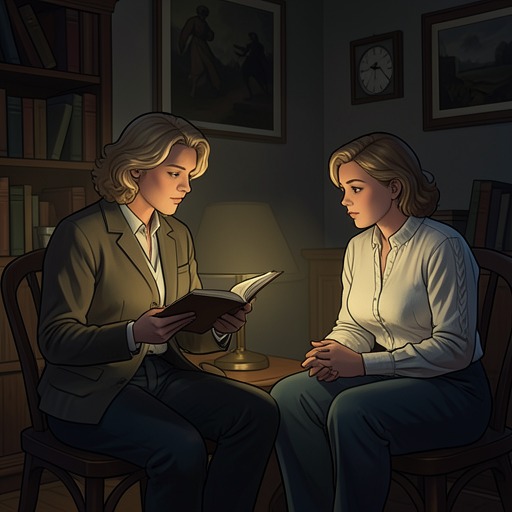
Esther
BlondeEsther is Il Drammaturgo’s wife, a partner in a long marriage whose affection survives even as conversation, desire, and attention have withered. Seen chiefly through his inward account, she is neither simply a forsaken spouse nor a secure presence: her anger and resentment coexist with the possibility that she still loves him, while his own guilt makes their estrangement newly visible.
Identity and Domestic Life
After being away, Esther returns from Miami to the apartment she shares with Il Drammaturgo on West 72nd Street. The handsome apartment is made cramped by shelves overflowing with books, an apt setting for a household crowded with the evidence of his intellectual and professional life. He works intensely among words and theatrical business, while the marriage appears to have little room left for mutual attention.
The couple have children, now grown and distant. Esther’s place in the family is therefore not only that of a wife but of a mother whose children have passed beyond the closeness of childhood. The account offers no separate history of her life away from her husband; her return is registered instead through the emotional charge on his face and in his eyes, marked by sadness and guilt.
The Marriage and the Blonde Actress
Il Drammaturgo recalls that he has been tempted by other women, sometimes in response to boredom, loneliness, and dissatisfaction with his work, but maintains that he never betrayed Esther. He treats this fidelity as a certain fact that ought to mean something to her. His insistence is complicated by his recognition that the marriage has lost its reciprocal desire and, for years, even its mutual interest. He still loves Esther and believes she still loves him despite her anger and resentment, but love has not restored their intimacy.
That strained marriage forms the boundary around his developing attachment to a blonde actress. Their encounters take place in smoky jazz clubs where they hold hands and exchange a few kisses, but the meetings have not become passionate or led to sex. He explains that his life is not his alone: he has a wife, children, and a family who might be hurt, and he chooses to suffer rather than cause them pain. The actress smiles, sighs, and improvises an understanding response. Esther is absent from these meetings, yet the family life he invokes is the reason he gives for stopping the affair from becoming a betrayal.
A Conversation About Distance
In the apartment, Il Drammaturgo hesitates before telling Esther that the two of them no longer talk much. Her answer turns his complaint back on him: when, she asks in effect, did they ever talk much? He has always been the one who talked. The exchange gives Esther a precise, understated challenge to his account of their estrangement. His sense of their silence has only now become explicit to him; she suggests it has long been the condition of their marriage.
When Esther asks whether he missed her, his brief assurance fails to convince her. Her skeptical response makes the gap between an answer and the feeling it is meant to express unmistakable. Even a simple reunion becomes a test of whether he has noticed her absence, and his reply cannot repair the distance that question exposes.
Narrative Significance
Esther’s characterization emerges through this contrast between Il Drammaturgo’s elaborate inner life and the sparse, pointed exchanges he has with his wife. He spends his days composing and revising words, yet Esther identifies the imbalance in their marriage with a plain observation: he has always been the talker. The scene does not resolve their relationship; it makes visible the difference between his belief that love remains and the daily absence of attention and desire. Esther’s return brings that contradiction into the shared apartment, where fidelity has preserved a boundary but has not made the marriage intimate.