Mr. Eddy
BlondeMr. Eddy is a wealthy Los Angeles businessman whose presence in Norma Jeane Baker’s early life is conveyed through a few sharply specific memories: an intimate bathing episode involving Gladys Mortensen and the baby, a green silk kimono, and a talent for hiding twenty-dollar bills as practical jokes. These details make him an unusually vivid figure in a fragmentary family history, but they do not establish him as Norma Jeane’s father; the narrative treats her father as absent and distinct from the men around Gladys.
Identity and Background
Mr. Eddy is described as rich and as the owner of three fashionable Los Angeles establishments where movie stars went to eat and dance. His business places him close to the city’s entertainment world, though the account does not say that he was a film-industry figure or describe him socializing with the stars who patronized his venues. His wealth is made concrete not through business dealings but through the casual abundance of the twenty-dollar bills he left around for others to discover.
His characterization comes in snapshots rather than a continuous biography. He is associated with radio, joking, money, and the domestic world of Gladys and her child. The remembered details suggest an adult man who could be playful and familiar within that household, but they do not supply a clear account of his history, his feelings, or the duration and terms of his relationship with Gladys.
Presence in Gladys’s Household
One memory describes an occasion when a man helped Gladys bathe the baby; afterward, Gladys helped him. The scene is recalled through its physical particulars—white tiles, water pooled on the floor, and scented bath salts—and its reciprocal action gives their interaction a quality of ease and intimacy. Mr. Eddy is named immediately afterward, as the recollection turns to his wealth and habits. The sequence associates him with this household scene, but it does not clarify the arrangement between him and Gladys or define the nature of their relationship.
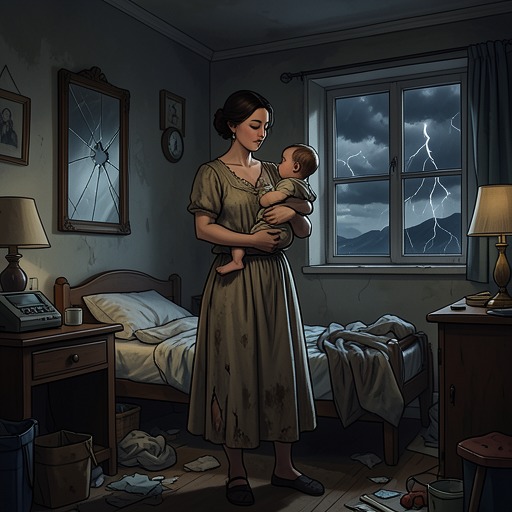
A separate detail makes that connection tangible years later. When Gladys hurried Norma Jeane out of their bungalow during the wildfire emergency, she wore a worn green silk kimono that Mr. Eddy had given her years before. The garment was still part of her life at a moment of acute danger: dressed in a nightgown and kimono, barefoot, and driving through the dark canyon with her daughter. Mr. Eddy is not present in the escape, but his gift remains on Gladys’s body, carrying the trace of an earlier closeness into the crisis.
Wealth and Practical Jokes
Mr. Eddy’s money becomes a recurring comic image. He hid twenty-dollar bills in places designed to surprise whoever found them: inside a block of ice in the icebox, tucked into a window blind, taped beneath a toilet seat, or concealed between the pages of a battered anthology of American poetry. The hiding places range from household fixtures to a book, turning money into the instrument of a private game rather than simply a sign of status.
The contrast between his considerable wealth and the mischievous way he distributed small sums gives the detail its force. He is remembered not as a distant businessman but as someone whose money entered ordinary domestic spaces and provoked a response. Gladys’s laugh is described nearby as sharp and penetrating, but the narrative does not explicitly assign that laughter to any single joke or make Mr. Eddy its cause.
Narrative Significance and Limits
Mr. Eddy matters chiefly as a figure glimpsed through material traces and scenes of remembered intimacy. The kimono connects him to Gladys across years; the bathing episode places him near the young Norma Jeane; the hidden bills turn his wealth into an eccentric household presence. Together, these fragments offer a partial picture of a man who had access to Gladys’s domestic life, without resolving what their relationship meant beyond that evidence.
The distinction between Mr. Eddy and Norma Jeane’s absent father is important. In a later conversation, Gladys speaks tenderly of the father when explaining his name for Los Angeles, while the narrative emphasizes that he is absent. Elsewhere, Norma Jeane hopes that her father might follow her career and write to her, but no letter arrives. Mr. Eddy’s connection to Gladys, including his old gift, does not fill that absence: the account never identifies him as the father or claims that he assumed that role. His limited, vivid appearances instead deepen the sense that Norma Jeane’s early family world contained adult intimacies whose meanings were never fully made secure.