I. E. Shinn
BlondeI. E. Shinn is Norma Jeane Baker’s agent, advocate, and would-be husband, a small, vivid presence whose belief in her talent outlasts the Studio’s confidence. He helps create opportunities for Marilyn Monroe while insisting that the frightened young woman behind the public identity is an actress worth taking seriously. Their bond combines professional loyalty, affection, and an unequal claim of possession: Shinn sees himself as the person who made her, while Norma Jeane loves him without being able to love him as a husband.
Identity and Hollywood standing
Shinn is portrayed as a compact, physically distinctive man whose force of personality exceeds his size. He sweats easily and tugs at the collar of a freshly tailored white silk shirt; his knotted fingers crack as he paces across his office. The narration describes him as a controversial but generally respected Hollywood figure, forty-five years old, with a reputation for making more money at the racetrack than as an agent. His customary red carnation and explosive laugh complete the image of a man who knows how to make himself noticed.
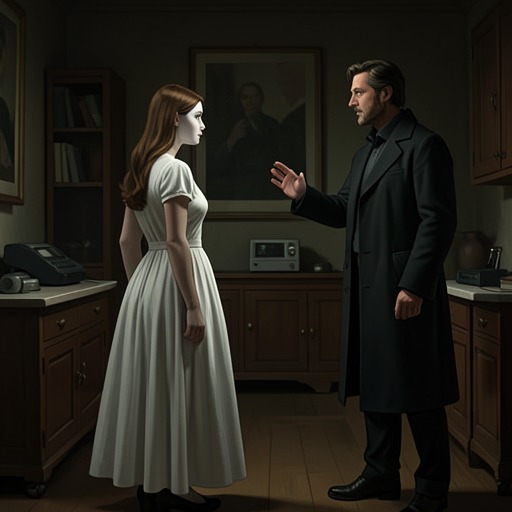
His political commitments also place him uneasily within Hollywood’s climate of suspicion. He had been among the early members of the left-leaning Committee for the Protection of Individual Liberty. When Norma Jeane speaks as though the danger of blacklisting were remote, Shinn urges her to stop performing the scatterbrained blonde and to keep quiet. He raises the possibility that the office could contain hidden microphones and that someone might carry her words to the authorities. The warning is not proof that the office is bugged; it shows how seriously he takes the political risks around them, and how quickly he turns anxiety into practical advice.
Shinn is not presented as a disinterested patron. His professional pride is tangled with personal attachment and with the language of ownership. He calls Norma Jeane his creation, and she gradually comes to imagine him as the magical little man responsible for the wonders in her life. That belief registers both the force of his support and the narrowing of her perspective: the agent who opens doors can come to seem like the sole source of her success.
Advocacy and the making of an actress
Shinn believes that Norma Jeane’s hesitation and occasional stammer do not mean she is stupid. He understands that she judges herself harshly and sees an actress whose ability is not yet visible to those who dismiss her. When Otto öse suggests that the Studio’s rejection might return her to a safer, more ordinary life, Shinn objects. He believes abandoning film would be the worst mistake she could make and insists that her youth, beauty, and talent still matter, even after the Studio has given up on Marilyn Monroe.
His advocacy takes the form of timing as well as encouragement. Convinced that a director critical of Hollywood’s establishment might look favorably on an actress discarded by the Studio, Shinn waits until the day before auditions begin to telephone him. He presents Norma Jeane not as a pretty girl but as an extraordinary actress. The next day, at four o’clock, he brings her to the appointment. She arrives in a white rayon dress, carrying a large script; her hands tremble, her voice is almost too faint to hear, and she has read the entire screenplay. The director initially regards her as a decorative possibility rather than a serious performer. Shinn’s intervention gets her into the room, but the scene also makes clear that she must speak for her own reading of the story.
The career Shinn helps sustain is not a simple movement from obscurity to ease. At Schwab’s, Norma Jeane internally rehearses the role of an actress as she enters in a carefully pressed white satin dress and a new hairstyle. She watches people look, smile, and turn away when they realize she is only a fledgling performer, not yet someone influential. The imagined stage of public attention makes her more self-conscious, not less. Shinn’s faith gives her a counterweight to this dismissive gaze, but it cannot remove the insecurity that attends her work.
He also gives her cautionary stories about the costs of a public name and a public career. In discussing her name, he tells her about Norma Talmadge, whose career, he says, ended amid addiction and decline. The anecdote places ambition beside the possibility of professional and personal ruin. Shinn is not merely selling the dream of stardom; he is alert to what can happen when a woman’s reputation and private life become part of the industry’s currency.
Intimacy, dependence, and the rejected proposal
Norma Jeane experiences Shinn as unusually capable of recognizing her beneath Marilyn Monroe. After a dance lesson, with her ankles and thighs aching, she visits his office and explains that the director calls her Norma rather than Marilyn, making him the only person who understands her. The distinction matters to her because the stage identity is becoming a public product, while Shinn’s private use of her name seems to acknowledge the person who existed before it. His response is not detached: their relationship binds emotional recognition to professional dependence.
That closeness repeatedly approaches marriage. The novel describes a proposal as familiar enough to be the usual one, but this time Shinn adds an unsettling financial arrangement. He wants a prenuptial contract naming Norma Jeane Baker, also known as Marilyn Monroe, as heir to his entire estate and excluding his children and other current heirs. I.E. Shinn Inc. is said to be worth millions. The offer would make her financially secure, but it also gives the proposal the scale of a transfer of power and property, not just a declaration of affection.
Norma Jeane laughs when she feels cornered, then blushes and tells him she loves him but is not in love with him. Her refusal preserves an important distinction: gratitude, tenderness, and dependence do not become romantic consent simply because Shinn has supported her or offers her wealth. The account of her earlier rejection of his offers confirms that her answer is not a sudden reversal. She has declined him while she was still hoping to make a film career, when she was new to the business and Shinn regarded her as his discovery.
The fantasy of rescue elsewhere in her life gives the proposal a further edge. She imagines that neither the Mysterious Prince nor V, her secret love, has begged her to marry him; instead, it is the dwarf Rumpelstiltskin. Shinn’s fairy-tale association makes his role both affectionate and faintly comic, but it also exposes the limits of his wish. He can offer protection, a fortune, and a place beside him; he cannot make himself the prince she longs for.
Work, illness, and the last remembered conversation
Shinn continues to visit the set of La tua bocca brucia to watch Norma Jeane play Nell. He notices that she has become absorbed in the role: she scarcely registers his presence or that of the other observers, disappears between takes, avoids interviews, and leaves the other actors unsure how to approach her. The change gives him evidence of her developing seriousness as a performer, but it also shows how the work can draw her away from ordinary social contact. His concern for her career is sharpened by the very intensity that makes him believe in her.
Their last remembered conversation combines care about her health with news of work. Shinn asks whether she has taken pills or analgesics and whether she is menstruating; she denies taking anything and objects to the questions. In the same conversation, he tells her that the Studio is considering her for a part in Niagara, a film with Joseph Cotten set at Niagara Falls. The recollection later becomes precious to her as the last time she heard Shinn sound both worried and affectionate. Even a practical discussion of symptoms remains attached to the professional future he is trying to preserve for her.
When she subsequently hears that he is gone, Norma Jeane finds the loss hard to reconcile with the continuing presence of the other people around her. She imagines how he would have helped her endure unfamiliar company: he would have drawn her aside and made her laugh with sarcasm and sharp comments. At a gathering, she feels nervous beneath the compliments, drinks to steady herself, and wishes instead for the reprimand she believes she needs when she has not done her best. Shinn’s imagined presence is defined less by public praise than by his capacity to challenge her without reducing her to a star.
She also imagines his reaction to her pregnancy. She expects him first to be angry because he disliked Cass Chaplin and especially Eddy G. Robinson Jr., then to become glad for her within days. This imagined response is affectionate but not neutral: it retains Shinn’s judgments of the men in her life and assumes that his care would eventually bend toward her wishes. The scene makes clear that she still measures new events against the counsel of someone no longer available to give it.
Retrospective guilt and narrative role
At Bullock’s, on the exclusive fifth floor with its pink carpet and designer clothes, Norma Jeane remembers having modeled for Shinn there. He bought the white dress she wore to a premiere, when Marilyn Monroe was not yet under the pressure that later accompanied the name. She recalls that he alone had believed in her, and interprets her refusal of his marriage proposal as having broken his heart and, in her guilt, as having killed him. The novel presents this as her painful retrospective conviction, not as an established cause of his death. Her insistence that she refused both the proposal and the money underscores what she feels she did and did not owe him.
Shinn’s importance therefore exceeds the practical work of an agent. He is an early witness to the difference between Norma Jeane and Marilyn Monroe, a career strategist who insists on the word actress, and a figure whose affection offers recognition while also carrying possessive claims. The novel sets his confidence against the Studio’s rejection, his private knowledge against the public persona, and his remembered criticism against the empty flattery surrounding a famous woman. After his death, Norma Jeane can still summon the jokes, warnings, and attention she associated with him; she cannot recover the person who once joined belief in her future to a sense of being personally known.