Cherie
BlondeCherie is the aspiring singer Norma Jeane plays in Bus Stop, a character whose longing for stardom is inseparable from poverty, family responsibility, and the fear of being sent back to the life she escaped. Norma Jeane initially believes she knows Cherie intimately, but the role unsettles that confidence: Cherie’s comic innocence risks becoming an object of laughter, and the actress must learn to leave room for what she does not understand. The performance ultimately becomes one of the most inspired of her career.
Background and aspiration
Cherie comes from a precarious rural childhood. Her family lived in a battered trailer on barren, abandoned land, beside a sandbank, a muddy stream, and a solitary, spindly tree whose knotted roots showed above the earth. She helped raise her younger brothers and sisters, playing with them and singing them nursery rhymes. She left school at fifteen to care for them, made cloth toys, and mended clothes for the family. Her own cheap, makeshift singer’s costumes carry the marks of that life: they are not the polished trappings of a star, but a poor girl’s attempt to look the part.
The prospect of returning to this past frightens Cherie. Her hope of becoming a star is not simply vanity; it stands against the fear of being trapped again in poverty and responsibility. She may have loved an older young man who broke her heart, but the remembered possibility does not erase her pride or spirit. The character’s vulnerability therefore coexists with a capacity to endure: she is frightened, yet she continues to imagine a different future.
The role and Norma Jeane’s identification
Norma Jeane adores Cherie and sees her as courageous. In her understanding of the character, Cherie does not drink or take pills to fight fear; she knows what she is undertaking and where it will lead. That certainty differs sharply from the actress’s own dependence on medication and struggle with fear. Cherie seems to possess a clarity about her actions that Norma Jeane cannot consistently claim for herself.
At first, the actress believes she knows Cherie down to the stitches in her costumes. She connects the singer’s background to her own past as a succession of modeling contestants and promotional faces, trained to smile in the hope of being noticed and hired. This recognition gives the role a personal charge: Norma Jeane sees in Cherie another young woman asking to be seen and chosen. Yet the identification is not simple. When asked what frightens her, Norma Jeane says she is afraid of Cherie. The character’s exposure of the actress’s own hopes and vulnerabilities makes close identification intimidating as well as sustaining.
Cherie’s ambition also creates an ethical problem for the performer. Cherie does not know that she is funny; she believes she can become a star. That unawareness is the source of her comedy, but it also risks making the audience laugh at her rather than with her. Norma Jeane worries that the laughter may be cruel. She is reminded that, as the interpreter, she has some control over the character and the audience’s response. Still, taking responsibility for Cherie does not mean merely making her admirable: the tension between her innocence, ambition, and the audience’s judgment is part of the role.
Learning to leave Cherie unknown
During the initial work on Bus Stop, Norma Jeane feels that Cherie fits her completely. She approaches the character through Method training learned at the New York Ensemble of Theatre Artists and the principle associated in the novel with Stanislavskij: the actor works from a self tempered in the furnace of memory. Her familiarity with Cherie’s poor clothes and early life appears to promise a complete, personal understanding. For once, she is satisfied with a film role she has chosen rather than one assigned to her by the studio. She wants the audience to love Cherie and to have its heart broken by her.
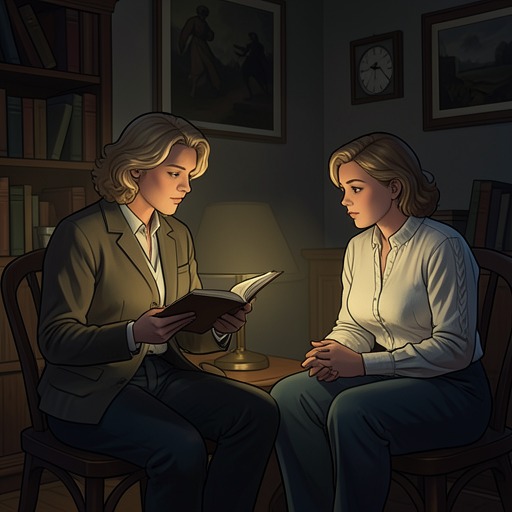
Il Drammaturgo challenges the assumption that intimacy means mastery. He argues that Cherie may still be mysterious to Norma Jeane, just as Magda had proved more complex than he had imagined. Instead of treating Cherie as someone already fully known, the actress should let the character breathe and allow her to surprise her on set. The advice redirects performance away from perfect control. Norma Jeane accepts it, and the next morning’s work begins with a renewed openness to discovery rather than a finished interpretation imposed in advance.
Embodiment and apology on set
Cherie’s costume makes the transformation visible: a black lace blouse, a tight black silk skirt with a high belt, fishnet stockings, black high heels, heavily lined eyes, and a vivid red mouth. But the performance is not only its appearance. Norma Jeane arrives pale and blond, nervously biting her nails, dragging a filthy feather boa, and speaking in a low, rough Ozark accent. Her posture and manner make her seem less like a distant star and more like an ordinary young woman who knows she has behaved badly and expects to be reprimanded.
She apologizes to the company for having acted irresponsibly and given in to desperation, acknowledging the disrespect she has shown them and expressing shame. The words and gestures resemble Cherie’s humility without reducing the character to imitation: the actress’s own apology becomes part of the difficult passage back into collaborative work. The crew, which had been frustrated and angry, responds by applauding. Its affection for Marilyn returns alongside its recognition of the performance taking shape.
Performance and reception
Norma Jeane throws herself into Cherie instinctively, acting with an optimism that the evidence presents as both committed and partly blind. She does not see Bus Stop in its entirety until the studio preview in early September, months after the difficult period in Arizona. By then she is married and sits beside her husband, subdued by Dom Pérignon and Miltown. Watching the film, she is astonished by how well it has turned out and recognizes Cherie as the most inspired performance of her career.
That achievement is not presented as an effortless triumph. The story compares it to a swimmer who struggles across dangerous water, reaches the bank exhausted, and is applauded by spectators who risked nothing. The preview audience does applaud, but its response cannot cancel the distance between the performer’s ordeal and the spectators’ safe admiration. Cherie matters, finally, both as a character Norma Jeane recognizes in her own history and as someone who remains other than her. The role’s success comes not from making that difference disappear, but from allowing the character to breathe beyond the actress’s first certainty.