Mr. Z
BlondeMr. Z is a Hollywood studio pioneer who turns the manufacture of public attention into a source of power. He helps open a path into the film industry for Norma Jeane Baker, but that professional influence also places her in a vulnerable position before him. The contrast between the stars and spectacles he creates and the private authority he wields over an aspiring actress defines his role in her early career.
Identity and Public Power
In Norma Jeane’s account, Mr. Z’s rise begins with an immigrant childhood and an early gift for attracting an audience. Born in a small Polish village, he came to the United States with his parents; his father worked as a street vendor in New York. By the age of twenty, Mr. Z had built and was managing the Coney Island Amusement Park, where he presented unusual attractions, from a fire-eater and a performer who walked on hot coals to a dancing dog and a giant. The range of these acts establishes his instinct for turning novelty into public spectacle.
At twenty-two, he was already a millionaire. He began making silent films in a Lower East Side warehouse and moved to Hollywood in 1928, where he founded a company to establish a studio. His success depended not only on producing films but on creating recognizable attractions and stars. The names associated with his enterprise include the skating champion Sonja Henie, the Dionne Quintuplets, Rin Tin Tin, Myrna Loy, Alice Faye, Nelson Eddy, Jeanette MacDonald, and June Haver. In Norma Jeane’s view, stories about Mr. Z and other Hollywood pioneers acquire the shape of legends: he is presented as someone who can make audiences desire things they had not previously imagined.
That power reaches Norma Jeane while she is still seeking a foothold. She has an audition for a film with June Haver and is due to visit Mr. Z’s celebrated aviary beforehand. He is a distant, consequential figure at The Studio, and the invitation itself feels like a rare privilege. His office, filled with velvet curtains, teak furniture, and crystal, stages authority as carefully as one of his public attractions. When he summons Norma Jeane inside, she tries to understand the encounter as if it were a scene, though no script tells her what will happen next.
The aviary extends this tension between spectacle and control. Norma Jeane expects to see living birds, but finds hundreds of dead, mounted specimens displayed in constructed habitats. The careful settings make them appear lifelike even as they remain enclosed and motionless. Her fascination with the collection complicates its initial shock: Mr. Z’s taste for preserving beauty becomes an image of display that anticipates the way his power will shape her experience of being seen.
Private Access and Abuse
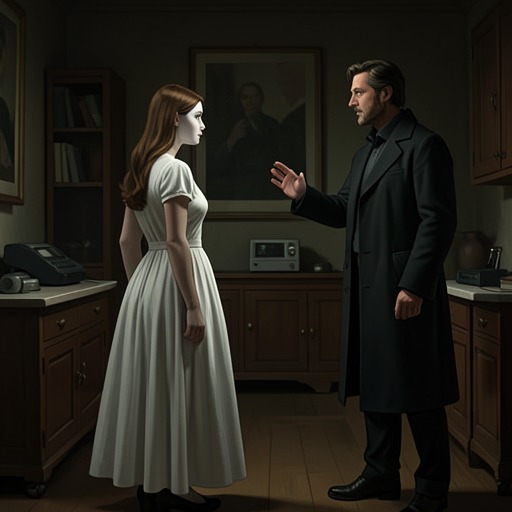
Behind the aviary was an apartment reserved for a small circle of visitors. Once there, Mr. Z shifted from displaying his collection to judging Norma Jeane Baker’s appearance and dismissing her as unintelligent. She silently rehearsed the care she had taken over her grooming and clothes, but did not challenge him. When he pushed her toward a fur rug and ordered her to lie down, she wondered whether he might be her father—the secret attached to Gladys Mortensen’s past and, in Norma Jeane’s imagination, a possible source of happiness as well as pain.
Mr. Z then sexually assaulted her. The narration presents her response as a dissociative retreat: she tries to become mentally absent from what is happening, while time seems both dreamlike and distorted. The assault is also set against her professional and material insecurity. Her weekly studio contract was modest, and losing it could mean losing her room at the Studio Club; the account does not describe an explicit threat from Mr. Z, but it makes clear how little security Norma Jeane felt she had.
Afterward, she leaves his office in pain and with her makeup disturbed, passing his secretary, who quietly directs her to a bathroom. Norma Jeane cannot later recall how long she remains there. The encounter does not end her pursuit of the audition: soon afterward, as menstrual cramps begin unexpectedly, she asks another woman for codeine. Her fear of painkillers, shaped by warnings about addiction and by her belief that pain should not be treated with medication, collides with the immediate pressure to keep working. Mr. Z’s invitation, initially framed as professional access, has exposed the personal danger concealed within his authority.
Career Access and the Business of Images
Mr. Z’s importance to Norma Jeane’s career is real but not straightforward: his invitation to the private aviary marks her as someone admitted unusually close to the center of studio power, yet the evidence does not make him the person who secured her agent, contract, or first film part. That distinction matters. The same industry that could display her as a promising new face also kept her employment precarious, while access to powerful men carried risks that professional opportunity alone could not explain away.
The business around her image soon made the imbalance more visible. For three years, Norma Jeane politely refused Otto Öse’s proposals that she pose nude for magazines. Later, after the studio had dropped her and she was behind on rent, she returned to Otto for work; he paid her fifty dollars for a calendar sitting, while he received nine hundred and kept the negatives. The photographs would become among the world’s most famous nude images, enriching others far beyond the model’s fee. Mr. Z is not identified as the person who arranged that sitting or profited from it, but his earlier treatment of Norma Jeane belongs to the same system in which a woman’s appearance was made commercially valuable while control and returns remained elsewhere.
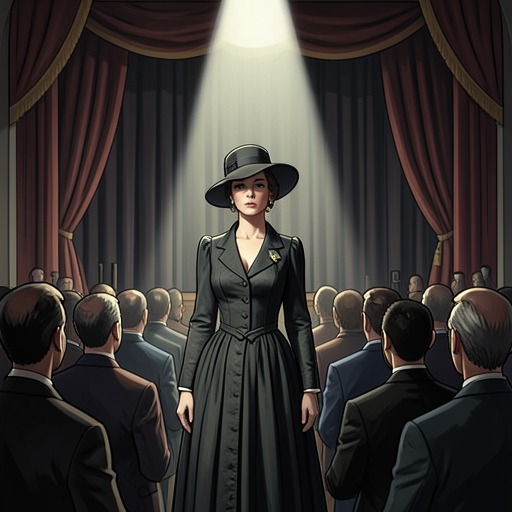
Years later, the aviary reappears in public conversation at a lavish gathering hosted by Mr. Z at his Bel Air villa. Now a celebrated star, Marilyn trades barbed remarks with him before attentive guests: she asks after the dead birds, and later recalls that he had been an embalmer and that many people feared his hands. Mr. Z answers by presenting himself as a collector of ancient art and as her former mentor. The exchange converts a private history into polished social theater. Its wit gives Marilyn a way to name what had happened without openly recounting it, while his answer tries to restore the relationship to the respectable story of a powerful pioneer and his discovery.
That effort to manage appearances continues at the premiere of Gentlemen Prefer Blondes. Marilyn believes that a special visitor will be waiting in her hotel suite and imagines that Mr. Z, once hostile to her, has helped arrange the meeting with her absent father. The narrative does not confirm that Mr. Z knows the visitor’s identity or has actually arranged the encounter; it records Marilyn’s hope and her suspicion that the secret may be widely known. At the theater, he responds to her remark with a knowing smile and a finger to his lips. The gesture leaves her to wonder who else has been told, turning his old command of private access into a fresh source of uncertainty.
Rumor and the Making of a Star
Mr. Z’s influence also survives in the stories told about how Marilyn Monroe advanced. A hostile account of her career places him among a succession of powerful men she was alleged to have slept with, alongside agents, directors, producers, and actors. The narrative presents this as gossip, not as a verified record of each allegation. Its significance lies in how quickly professional opportunity is recast as sexual access: the same industry that made Marilyn’s image desirable circulated stories that reduced her work and advancement to men’s supposed possession of her. Mr. Z therefore remains both a specific figure in Norma Jeane’s history and part of a larger machinery of rumor, in which public attention could magnify a woman’s fame while making the circumstances of her career harder to distinguish from speculation.