Edith Mittelstadt
BlondeEdith Mittelstadt, the director of the Los Angeles Orphans Home Society, is a pivotal figure in Norma Jeane Baker’s childhood: she helps navigate the uncertain prospect of adoption, offers a religious language of comfort, and promises another route to family when adoption stalls. Years later, Norma Jeane returns hoping to thank her, only to learn that Edith has died. Their relationship is shaped both by care and by an unanswered absence: after years of correspondence, Edith stopped writing without explanation.
Identity and Work at the Orphanage
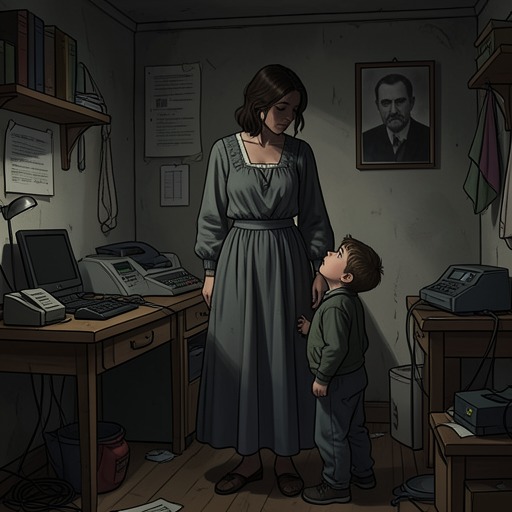
Edith is presented as a forceful, confident director whose presence sets the emotional tone of the orphanage. Norma Jeane notices her vigorous yet intimate voice and penetrating gaze, and reads her confidence as strength. The child also registers what the film-minded standards she has absorbed classify as imperfections: Edith’s lined, tired face, chin hairs, and liver spots. The contrast reveals as much about Norma Jeane’s way of looking as it does about Edith. She admires a woman who does not seem to care what people think, even as she evaluates her through the aesthetic judgments that have become part of her own outlook.
At the orphanage’s Christmas gift-giving event, Edith accepts a certificate from a visiting prince and princess while television cameras, photographers, lights, and carols turn the distribution into a public spectacle. Her flushed face and awkward smile contrast with the visitors’ practiced, dazzling expressions. The scene places her at the center of an occasion designed for display, but does not reduce her role in Norma Jeane’s life to that staged ceremony: elsewhere, she speaks privately with the girl, discusses her prospects, and offers sustained encouragement.
Norma Jeane’s Adoption Prospects
When Norma Jeane is eleven, Edith tells her that her mother, Gladys Mortensen, has asked for another day to consider the adoption proposal. It is the third time Norma Jeane has been proposed for adoption. Edith reports that the head physician at Norwalk State Hospital believes Gladys is no longer as consumed by a desire for revenge as before, and presents the change as a reason for hope. For Norma Jeane, however, another day means another interval in which her future depends on a mother she has not seen for years and on decisions made by adults elsewhere.
The wider circumstances make that hope fragile. Older children at the orphanage are rarely adopted; some have already experienced foster placements that failed and were returned to institutional care. Norma Jeane’s case is complicated by her age and by Gladys’s psychiatric hospitalization. The medical information available to prospective parents includes a diagnosis of chronic paranoid schizophrenia and possible neurological damage associated with alcohol and medication abuse. Against those obstacles, Edith recognizes that Norma Jeane’s prospects have depended on couples willing to consider an older child whose mother is still living.
Edith is a devout Christian Scientist and offers her faith selectively, with particular gentleness toward the children she favors. Four months before the adoption conversation, for Norma Jeane’s eleventh birthday, she gives her a copy of Mary Baker Eddy’s Science and Health. The inscription is in Edith’s careful handwriting and includes a verse from Psalm 23 about walking through the valley of the shadow of death without fear. The gift makes her religious belief tangible: a book presented not as a rule imposed on every child, but as a personal birthday offering to a girl confronting uncertainty and separation.
When Edith tells Norma Jeane that the adoption has not gone as hoped, she does not leave the girl with that disappointment alone. She says a foster family drawn from among the Christian Scientists can be found without Gladys’s permission, and promises to find one Norma Jeane will like. Norma Jeane answers with a quiet expression of thanks. The promise marks a practical change in the available path: where adoption remains subject to her mother’s consent, foster placement offers another possibility of leaving the orphanage.
Correspondence and the Return Visit
After leaving the orphanage, Norma Jeane corresponds with Edith for a couple of years. Edith sends Christian Science publications and birthday gifts. Then, for no clear reason given in the narrative, the letters stop. Norma Jeane wonders whether her marriage caused the silence, whether Edith has seen her in the newspapers under her screen identity, or whether she has failed to recognize her. The unanswered questions turn a caring relationship into a source of hurt: Norma Jeane comes to fear that another person who once mattered has left her behind.
As an adult, now a celebrated actress, Norma Jeane travels by limousine to the orphanage, excited by the prospect of visiting Edith and thanking the woman she believes changed the course of her life. She imagines that they might pray together privately in Edith’s office. She has prepared a personal check for five hundred dollars as a sign of gratitude, while privately wondering whether Edith’s failure to write might amount to a betrayal. The return is also a public event: reporters and photographers wait outside, and Norma Jeane hurries past them to meet the children and staff before addressing the press.
The visit does not reunite them. The orphanage has a new director, who gives no account of Edith’s whereabouts and says he does not comment on his predecessor. An older assistant recognizes Norma Jeane and remembers her as shy, affectionate, and one of Edith’s favorites. When Norma Jeane asks where Edith is, the assistant tells her that Edith has died. The expected private act of thanks becomes a belated encounter with the limits of what Norma Jeane can know about their separation.
Faith, Illness, and Legacy
The assistant explains that she and Edith were friends and had worked together for twenty-six years. Edith had become visibly ill, losing considerable weight and appearing pale, but resisted repeated suggestions that she see a doctor. According to the assistant, Edith was both stubborn and courageous, and plainly frightened while refusing to admit her fear. Her conviction that prayer was sufficient led her to believe she could fight cancer through faith alone; she avoided hospitalization until she was taken in against her will, and died after the illness had advanced.
The account complicates the comfort Edith once offered Norma Jeane through Christian Science. The same faith that supplied a birthday gift and a gentle form of reassurance also shaped Edith’s refusal of medical care. The assistant says Edith understood her illness as evidence of inadequate faith, and that Christian Scientists who do not believe in death may interpret it as their own failure when death comes. The novel therefore gives Edith both tenderness and vulnerability: she helps a child imagine a future beyond the orphanage, yet her own religious convictions cannot protect her from illness. Norma Jeane’s hoped-for reunion ends in grief, with gratitude left intact but no opportunity to ask Edith why the letters stopped.