Gladys Mortensen
BlondeGladys Mortensen is Norma Jeane Baker’s mother, both the object of an enduring longing and a person whose illness is managed by institutions that keep mother and daughter apart. The novel presents their bond through contrasting images: a glamorous woman in a black net glove reaching for her child, a patient unable to recognize that child, and a daughter who continues to return, care for her mother, and hope for a welcome. Gladys’s illness is never only a diagnosis in Norma Jeane’s life; it becomes part of the family history, the source of a childhood separation, and a fear that the daughter might inherit her mother’s fate.
Identity and Family Background
Gladys was born Gladys Pearl Monroe in Hawthorne, Los Angeles County, in 1902. At seventeen she married a man named Baker against the wishes of Della Monroe, her mother, and became known as Mrs. Baker. The novel later identifies Monroe as Gladys’s maiden name, a name that would also become part of her daughter’s identity. Family names thus carry more than a record of marriage: they mark the unstable line between the woman Gladys was, the mother she became, and the public identity her daughter would inherit.
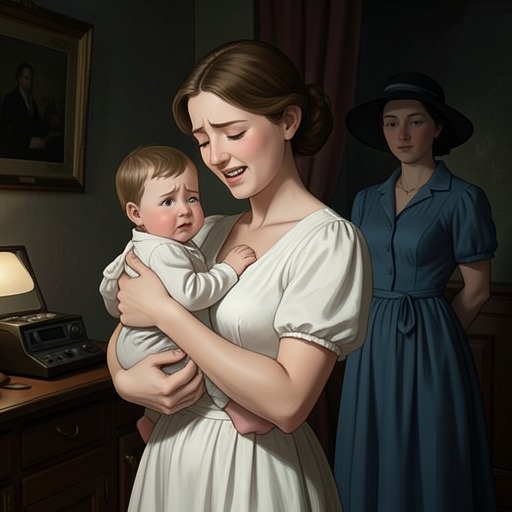
In a photograph dated December 1926, Gladys holds the infant Norma Jeane. The picture presents a young mother with a thin, ethereal face and carefully plucked eyebrows, while the baby is plump and conspicuous in her arms. The narrator reflects on the distance that can remain between spouses, and on the way being loved may involve creating an image for another person. The photograph therefore offers no simple proof of domestic intimacy. It preserves a moment of motherhood, but not an explanation of Gladys’s private life or of the absent father whose identity remains uncertain.
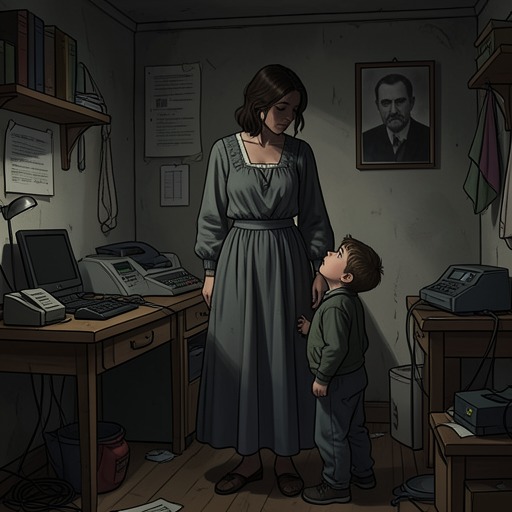
Gladys worked in a film laboratory, handling negatives and virulent chemicals. At one point she had been an assistant to Mr. X, who had once been in love with her and had asked her to marry him; he was then married with children. Gladys was later demoted because of illness, not because of any fault in her work. When a telephone call came for her at the laboratory, she was so frightened that colleagues had to help her to the phone. She experienced the coiled telephone cord as if it were alive, while her eyes watered from the chemicals and confusing voices seemed to crowd her hearing. The scene places her vulnerability inside an ordinary workplace, where illness is visible to others but remains difficult for Gladys to acknowledge.
Motherhood, Crisis, and Separation
Norma Jeane’s early memories make Gladys vivid and desirable before they make her frightening. A fresh breeze from the Pacific accompanies her arrival at the grandparents’ home on Venice Boulevard. Gladys calls for her daughter to run to her; the child catches her slender hand, fascinated by the strange black net glove. The recollection gives their attachment a physical beginning: a mother’s invitation, a child’s movement toward her, and the touch of a hand. The narrative insists that Gladys was the child’s true mother and that, on this occasion, she would not surrender her claim to maternal love.
That tenderness exists beside episodes of danger. In one crisis, Gladys tries to put Norma Jeane, then older and stronger than the small child she seems to imagine, into a tub of boiling water. The girl resists, screams, and escapes to seek a neighbor’s help. Gladys locks the door and, in a destructive fury, sets the bedclothes alight. The fire consumes clothes, shoes, underwear, and torn photographs, including a picture of Norma Jeane’s father that the girl will never see again. The episode turns the home into a place where the child must oppose her mother in order to protect herself; it also destroys an image that might have offered an answer to the child’s questions about her father.
Norma Jeane’s memory of the separation is fractured. She recalls summer lightning over the Hollywood Hills, an explosion of light in the bed she shared with Gladys, singed hair and eyelashes, and then being alone in a place for which she has no name. Another memory identifies the day as the one when she expected to visit her mother in hospital, but was instead taken to a red-brick building on El Centro Avenue. The broken, sensory sequence conveys how little control a child has over the events that divide her from her mother: a promised visit becomes a transfer into an institution, and the institution’s name is first encountered without being fully understood.
Gladys’s hospitalization becomes a lasting legal and emotional obstacle to adoption. By the time Norma Jeane is nine, then ten, then eleven, three couples have sought to adopt her. The prospective parents are told that her mother is neither dead nor unknown, but confined at Norwalk State Hospital for Gladys with a diagnosis of chronic paranoid schizophrenia and probable neurological damage attributed to alcohol and drugs. On a third adoption proposal, Edith Mittelstadt reports that Gladys is no longer as consumed by thoughts of revenge as before, raising a possibility that consent might now be obtained. The possibility does not erase the years in which Norma Jeane has remained tied to a mother who cannot care for her and whose legal authority still shapes the child’s future.
When Gladys prevents an adoption, Norma Jeane responds with anger and tears, asking why a hospitalized, cruel and sick mother is allowed to ruin her life. She sees the law as absurd and the decision as unfair, especially because she believes Gladys is jealous of Mr. and Mrs. Mount and hates her. The anguish is sharpened by the failure of prayer: Norma Jeane says she followed Edith Mittelstadt’s advice and prayed repeatedly, yet the hoped-for change did not come. Her distress does not cancel her attachment. Rather, it shows how love and resentment are forced to occupy the same relationship when the child cannot leave the mother’s power behind.
Institutionalization and the Daughter’s Visits
When Norma Jeane is earning money as a model for the Preene Agency and beginning work as an actress at The Studio, she decides to visit Gladys at Norwalk. A doctor tells her that her mother is near the highest level of recovery considered possible in her case. Gladys has been hospitalized for ten years, has undergone several courses of electroshock that reduced her crises, and now receives an intensive medication regimen to prevent depressive and manic episodes. Hospital records indicate that for years she has not tried to harm herself or others. The clinical account gives Norma Jeane a basis for hope, but it also defines the limits within which the visit will take place.
Gladys is thin and worn, dressed in a faded green gown. Norma Jeane recognizes her immediately and greets her as her mother. Later, Norma Jeane remembers them both crying, but the account corrects the memory: only the daughter cries. Gladys neither returns the awkward embrace nor pulls away from it. In the visiting room, among strangers, Norma Jeane smiles at her mother again and again. She later associates the encounter with learning to cry on cue in acting lessons, a painful overlap between a real emotion that breaks through and an emotion she must learn to produce for work.
Recognition proves unreliable. Gladys asks where her daughter is and insists that she does not know who the visitor is. In another visit, she appears to recognize Norma Jeane only with difficulty, remaining sunk into a broken sofa in a dim, unpleasant room. Norma Jeane kisses her, tries to contain her own breath, and is met with an insult and a question about whether they know each other. The exchange is especially painful because it turns the daughter into a stranger in front of nurses who can hear. Gladys’s failure to recognize her is not a single dramatic reversal but a recurring uncertainty that makes every visit an occasion for hope and possible rejection.
Norma Jeane observes Gladys’s injured hands: fingers rubbing incessantly against one another, nails broken, bitten, and bloodied. At the end of one visit she escorts her mother back to the ward at Norwalk, dries her own tears, and takes the thin black scarf from Gladys’s shoulders to wear around her own neck. She tells her mother that she loves her and asks forgiveness. The gesture is at once intimate and sorrowful: Norma Jeane leaves with an object that belonged to Gladys, while returning Gladys to the care of the institution.
Lakewood: Care, Refusal, and Repeated Loss
Later, Gladys is at Lakewood Home. Norma Jeane visits her there and is careful not to embrace or kiss her too warmly, knowing that Gladys may stiffen. On a good day, Gladys has freshly washed hair and wears a pink dressing gown and matching slippers Norma Jeane bought at Bullock’s. The collar is stained, but Norma Jeane pretends not to notice; a picture of Jesus has appeared behind the writing desk. Such details make care practical rather than abstract: the daughter chooses the clothes, notices their condition, and quietly spares her mother the embarrassment of correction.
Their conversation reaches the loss of Norma Jeane’s pregnancy. Gladys knows that the expected child has died and asks whether it was a boy or a girl. Norma Jeane tells her she miscarried at six weeks. Gladys then speaks of her own sentence: she believes she can never become a grandmother because she gave away her beautiful daughters. Her words connect the daughter’s reproductive grief to Gladys’s own history of separation and regret. Yet the conversation does not produce reconciliation. At the end, Gladys does not answer her daughter’s farewell or look at her; she turns toward the image of the Sacred Heart of Jesus as Norma Jeane leaves.
The question of treatment makes Norma Jeane’s role as Gladys’s only close relative concrete. Doctors ask her permission for a lobotomy, explaining that it may help patients who experience hallucinations. Norma Jeane refuses. She insists that her mother is intelligent and complicated, a tragic woman rather than a damaged brain to be corrected, and says she will not consent to an operation on Gladys. The doctors continue with electroshock instead. The episode places a consequential decision in the daughter’s hands, but does not make her an uncomplicated rescuer: Gladys remains subject to institutional treatment, and the novel later distinguishes the earlier electroshock at Norwalk from the comparatively more humane Lakewood clinic.
When Gladys disappears from the Lakewood clinic, she is found asleep in a Catholic church pew on Bellflower Boulevard, less than five kilometres away. Confused and disoriented, she is returned by Lakewood police without resistance. Norma Jeane arrives and breaks down, embracing the woman who smells of wet fabric and urine. She helps Gladys wash and carefully shampoos and combs her tangled hair, speaking brightly and sometimes humming as one might to a child. Gladys asks to go home. When she suddenly opens her eyes and asks what year it is and what year the Machine has brought them to, her disorientation interrupts the daughter’s effort to restore ordinary intimacy. A clinic director’s excitement at meeting a film actress further exposes the gap between the public figure he sees and the daughter standing beside his patient.
In a later visit, Norma Jeane brings a white spinet to Lakewood Home, to be placed in the visitors’ lounge as a gift from Gladys. She has little time and promises to call and stay longer next time. Gladys allows her daughter to embrace and kiss her, and smiles, though Norma Jeane suspects the medication may account for the response. She puts on sunglasses to keep the people around her from seeing her eyes and leaves quickly. The piano gives Gladys a public, shared presence in the institution, but the visit ends in the familiar imbalance: Norma Jeane offers touch and promises, while Gladys’s response remains difficult to read.
The Mother’s Place in Norma Jeane’s Story
Gladys shapes the daughter’s understanding of love not only through illness and absence but through the model of marriage Norma Jeane constructs around her. At sixteen, Norma Jeane believes she has succeeded where Gladys failed: she has found a loving husband and become a wife. She thinks that Gladys became ill because she had no husband and was not loved in the only way that counted. This is Norma Jeane’s interpretation, not an explanation established by the narrative; its importance lies in what it reveals about the daughter’s fear that romantic attachment is the condition for safety and belonging. Later, she imagines that Gladys will one day come to live with her, while concealing from others that her mother is at Norwalk.
That hope persists alongside her career and her relationships. Norma Jeane fears abandoning Gladys, whom she sees as having only her, just as she fears failing on a film set and losing Cass Chaplin. Her mother’s institutional confinement becomes one of the obligations through which Norma Jeane measures whether she can leave, succeed, or build a life of her own. The two women’s distress is not identical, but the daughter recognizes a disturbing resemblance between Gladys’s blank, bewildered expression and the possibility of her own mental disintegration. The novel makes inheritance a fear as much as a family fact.
The public image of Marilyn Monroe further complicates the private bond. Norma Jeane keeps the fact of Gladys’s hospitalization from people around her, and at times imagines that her mother will eventually live with her. In a later recollection she describes the loneliness of having lost the girls from the orphanage, a mother who behaves as if she does not know her, and a father who writes but never appears. Men may claim to love her, she reflects, but she wonders whether they love the person or Marilyn. This catalogue of absences places Gladys at the center of a wider problem: the daughter is recognized as a star more readily than as a person seeking her mother’s recognition.
The novel finally returns to an imagined version of the past in which Gladys is young, smiling, fragrant, and happy to share a surprise with Norma Jeane. In that scene, mother and child laugh together in an apartment filled with film posters, and Gladys shows her daughter a photograph of the man she identifies as the child’s father. The scene does not undo the years of illness, separation, and failed recognition; its force comes from the contrast. It stages the childhood welcome and certainty that the actual relationship could not sustain. Gladys remains both the mother Norma Jeane repeatedly visits and the mother she continues to long for: present in memory, intermittently present in the institution, and never fully available to the daughter who cannot stop returning.