Norma Jeane Baker(Marilyn Monroe)
BlondeNorma Jeane Baker is the novel’s central figure: a child who fears abandonment, an actress whose performances can make invented people feel alive, and a woman whose public image never resolves her divided sense of self. Joyce Carol Oates reshapes Marilyn Monroe’s life as fiction, presenting its contradictions through shifting versions of Norma Jeane: the lonely adolescent, the celebrated blonde, the anxious patient, and the performer who can disappear into a role. Her life is not a steady passage from obscurity to fame. It is a repeated negotiation between being seen and being known, between the image that attracts attention and the person who fears she cannot keep anyone’s love.
Identity and Childhood
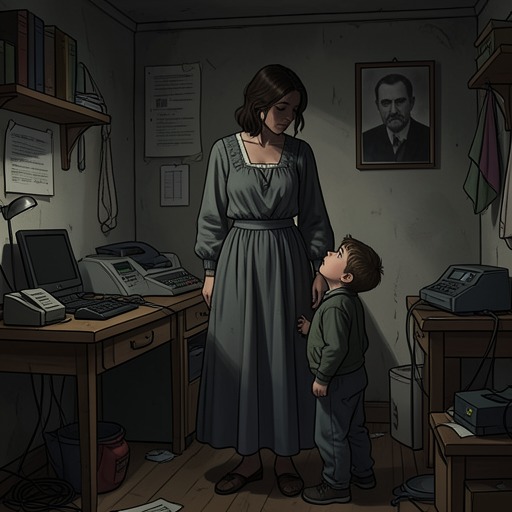
The novel first anchors Norma Jeane’s identity in the name entered on official records: Norma Jeane Baker. It also makes her birth and childhood legible through a disconcerting mismatch of dates. On what the narrative identifies as her sixth birthday, June 1, 1932, her mother, Gladys, visits her at Venice Beach, where she is living with her grandmother, Della. Later, the account of her placement in an orphanage gives her birth date as June 1, 1926, and describes her as eight years old. The contrast belongs to a childhood already shaped by unstable accounts of family, age, and belonging.
Gladys’s visit gives the child a moment of recognition and closeness, but the mother’s presence is conditional: she comes when she feels strong enough and when the demands of the Studio permit. Della disapproves as Gladys takes Norma Jeane away with her. The child’s attachment to her mother is therefore inseparable from the uncertainty of whether Gladys will be able to act as a mother at all. Later, Gladys insists that no one will adopt her daughter while she is alive to prevent it. The declaration offers a claim of maternal attachment, but it does not remove Norma Jeane’s fear of being left behind.
That fear becomes explicit when she is taken to the orphanage. She protests that she is not an orphan because she has a mother, and believes she also has a father living in a large house in Beverly Hills. The adults responsible for her placement leave her there, while Edith Mittelstadt tells her that the tears she is shedding may be needed later. Norma Jeane’s own imagined route out of abandonment depends on becoming pretty enough for her father to come and take her away. The fantasy links being wanted to being rescued, and beauty to the possibility of securing a place in a family.
Cinema, Performance, and the Mirror
Cinema enters Norma Jeane’s life before she can follow a film’s plot. Her mother first takes her to Grauman’s Egyptian Theatre on Hollywood Boulevard when she is two or three. What holds her is the motion on the screen and the recurring pattern of a good princess and a mysterious prince drawn together, separated, and drawn together again. She returns to the film in memory throughout her lost childhood and adolescence, recognizing it even as its title and performers change. The screen becomes both a refuge and a model of life as she experiences it: promises of union repeatedly interrupted by separation.
As a young woman, Norma Jeane can call up a radiant companion from the mirror; as a model, she follows the photographer’s directions and enters a kind of trance. Acting extends that transformation. On set, learning her lines and preparing for a part allow a new life to animate the body she experiences as borrowed. She becomes Nell, Rose, Lorelei Lee, and the Girl Upstairs. Even during the subway-grate scene, in which her former athlete husband watches her degradation, she manages to inhabit the Girl Upstairs fully. Performance is not merely the manufacture of an attractive image. It is a capacity to make a character vivid, and a temporary passage beyond the fear and uncertainty attached to her own identity.
Yet that passage is not always available. During the filming of Bus Stop, Norma Jeane is so afraid of seeing the rushes and discovering that Marilyn has betrayed her that she has little idea how her work appears to an impartial viewer. Her scenes are repeated many times, and she cannot judge whether the effort and anxiety visible to her will communicate to anyone else. She enters the role of Cherie by instinct, trusting the advice of the person she loves. Later, in what she considers the best role of her career and the beginning of a new one as a serious actress, she is overcome by doubt and struggles to get out of bed in time for morning filming. The contrast makes clear that professional ambition does not protect her from fear of her own performance.
Relationships and the Desire to Be Chosen
Norma Jeane’s longing for recognition shapes her relationships with both parents. Gladys is at once her mother and someone whose ability to care for her is repeatedly uncertain. Her absent father, by contrast, is known to the child chiefly through the hope that he might come for her. That hope turns appearance into an imagined means of return: if she becomes pretty, she thinks, her father will recognize and claim her. The novel thus connects the formation of Marilyn Monroe’s image to an earlier wish for personal rescue, without making fame an adequate substitute for the family security she lacks.
With the Playwright, Norma Jeane can describe the split between her given name and her famous one directly. He asks whether Marilyn is merely an artistic name; she offers Norma as her real name, and he doubts that it suits her. The exchange leaves the division unresolved. Marilyn is not simply a disguise that can be discarded, nor is Norma an uncomplicated self waiting untouched beneath it. The novel repeatedly shows how others address, shape, or respond to these identities, while Norma Jeane experiences the difficulty of deciding which one can speak for her.
Her relationship with the Playwright brings a period of renewed energy. He imagines a parallel life in which they are married with twelve children, and after he arrives she appears to revive within a day. Observers describe the change as if she had received a transfusion, while he too seems invigorated. The image conveys a mutual effect, not simply his rescue of her: his presence restores her sense of possibility, and her renewed life appears to affect him in turn. Her intense wish to marry him and fear that something will prevent it reveal how closely love, safety, and a hoped-for family remain joined in her imagination.
When she discovers that she is pregnant, she runs to tell her husband and embraces him in tears of joy and relief. He is startled but happy for her, though the narrative also records his creative blockage and his effort to appear as glad as she is because he knows how much she wants a child. Her pregnancy ends in miscarriage at fifteen weeks on August 10; the Playwright calls an ambulance, and she is taken to Brunswick General Hospital. The loss makes motherhood not an abstract hope but a devastatingly interrupted future, set against the domestic happiness the couple had begun to imagine.
Career, Crisis, and Narrative Significance
The novel holds public success beside private instability. Norma Jeane’s ability to make a role live becomes especially clear when she returns to a film set after an absence. It takes Whitey two hours to prepare the image of Marilyn, but the finished performance exceeds what the people around her expected. The Ballerina, a barely developed part, becomes a convincing person; even those who resented her during production come to recognize that her work has saved the film. Their change of judgment underlines the distance between the uncertain woman they encounter on set and the force of the performer they see on screen.
That achievement does not settle her relationship to the image. In a later crisis at Venice Beach, she denies having poisoned herself and presents herself to a stranger as Miss Sogni d’Oro, asking whether she is beautiful and whether she could be loved. The scene links the public promise of desirability to a private appeal for affection, while preserving uncertainty around what has happened. The name she adopts there sounds less like a secure identity than an invitation to be recognized and wanted.
As Sugar Kane in Some Like It Hot, Norma Jeane is again caught inside a part whose refrain becomes difficult to escape. The performance makes her the blonde ukulele player pursued by men, and her body and persona become inseparable from the character in the scene’s fractured narration. She worries whether Sugar Kane is funny and why audiences love her, even as the film becomes a major popular success and her performance is regarded as a defining achievement. The contrast is central to the novel’s portrait: public admiration confirms the power of Marilyn Monroe’s screen presence, but does not answer the private question of whether Norma Jeane herself is loved.
The character’s significance lies in that unresolved coexistence. The novel does not treat acting as either a false mask or a complete cure. Performance gives Norma Jeane real creative power, lets her inhabit other lives, and can transform the judgment of people who underestimate her. At the same time, the mirror-born companion and the recurring shift between Norma Jeane and Marilyn expose how fragile the boundary remains between self-creation and dependence on other people’s attention. Her trajectory is therefore not a simple triumph over abandonment: it is the story of a gifted performer repeatedly making herself visible, while the need to be chosen persists beneath the image.