General Peckem
General P. P. Peckem is the novel's supreme embodiment of bureaucratic vanity and institutionalized absurdity—a commander who cares more about the aesthetics of a bomb pattern than its tactical effect, who writes memoranda praising himself, and who treats the war as a stage for his own erudite performance. His relentless campaign to absorb combat operations into his Special Services command succeeds only to deliver him into the hands of a far more literal-minded superior, exposing the hollow core of his entire enterprise.
Identity and Ambition
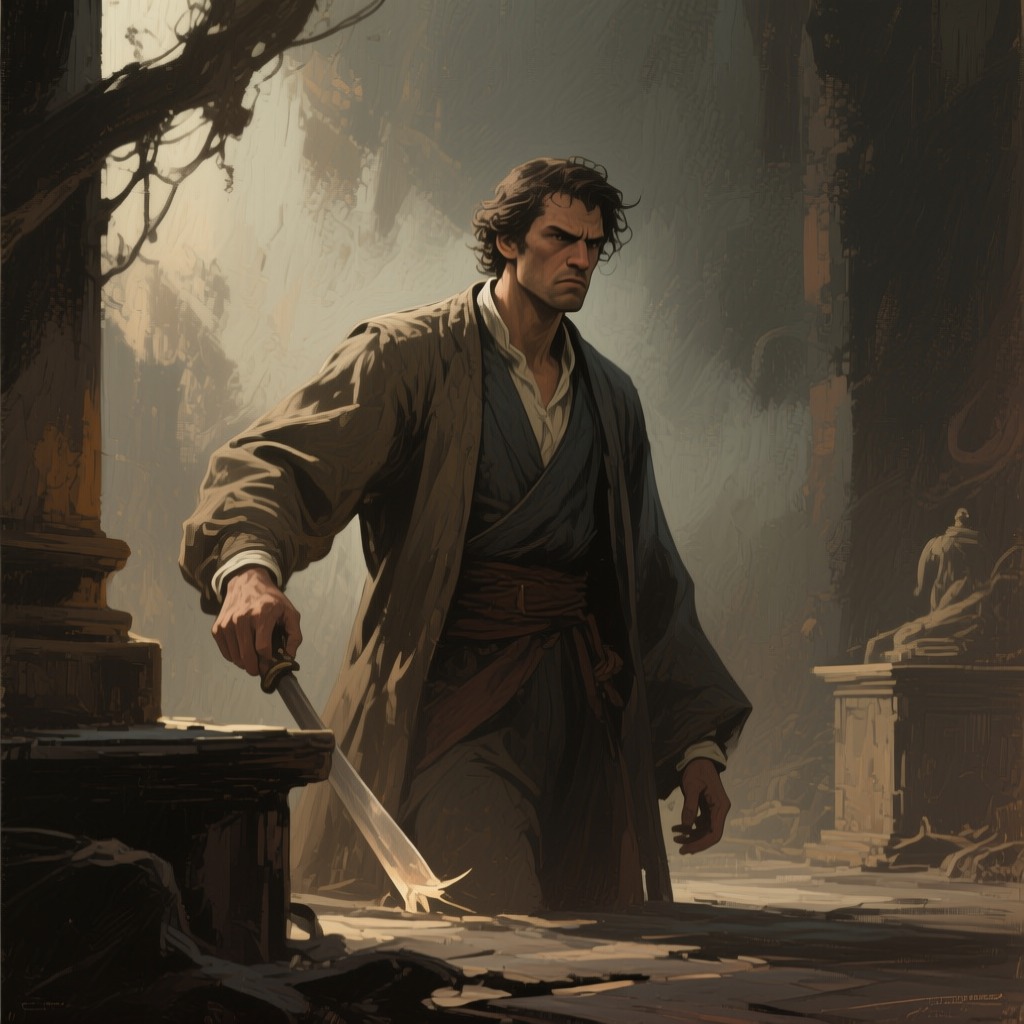
General Peckem is a handsome, pink-skinned man of fifty-three with silver-gray hair, slightly myopic eyes, and thin, overhanging sensual lips. His uniforms are custom-made, and his manner is always casual and relaxed. He is a perceptive, graceful, sophisticated man who is sensitive to everyone's weaknesses but his own and finds everyone absurd but himself. He lays great, fastidious stress on small matters of taste and style, and he is always augmenting things: approaching events are never coming but always "upcoming." He does not write memorandums praising himself; he writes memoranda. The prose of other officers is always "turgid, stilted, or ambiguous." He can quote glibly from Plato, Nietzsche, Montaigne, Theodore Roosevelt, the Marquis de Sade, and Warren G. Harding. His favorite self-description is a paradox: "My only fault is that I have no faults." He thinks of himself as aesthetic and intellectual, and when people disagree with him, he urges them to be objective.
Methods and Machinations
Peckem's primary weapon is the written word. From his headquarters in Rome, he issues prolix bulletins headed by cheery homilies such as "Procrastination is the Thief of Time" and "Cleanliness is Next to Godliness." He invents the term "bomb pattern"—a concept that means nothing but catches on rapidly—and convinces commanders like Colonel Cathcart that it is important for bombs to explode close together to make a neat aerial photograph. He uses this to interfere in combat operations, inspecting General Dreedle's installations and sending comments and criticisms that are really none of his business. When Dreedle accuses him of seeking to undermine him, Peckem answers innocently that his only purpose is to strengthen the war effort by eliminating inefficiency. He compares himself to Fortinbras from Shakespeare's Hamlet, circling the action until everything falls apart and then strolling in to pick up the pieces. His aide, Colonel Cargill, is a self-made man who owes his lack of success to nobody, and Peckem keeps his subordinates in line by setting them against each other.
The Campaign Against Dreedle
Peckem's central objective is to capture every bomber group in the U.S. Air Force by placing all combat units under the jurisdiction of the Special Service Corps. He argues that dropping bombs on the enemy is a special service, and he declines a combat post under General Dreedle, explaining that his most precious abilities are mainly administrative ones. He has a happy facility for getting different people to agree—or, as Colonel Cargill confides, for getting different people to agree what a prick he is. Peckem's machinations are aided by ex-P.F.C. Wintergreen, the mail clerk at Twenty-seventh Air Force Headquarters, who throws Peckem's prolix communications into the wastebasket but later becomes a key informant. When Dreedle is finally replaced, Peckem moves into his office, savoring his victory.
Downfall and Irony
Peckem's triumph is immediately undone. The very morning he takes command, he learns that Colonel Scheisskopf—the parade-obsessed officer he had dismissed as a blockhead—has been promoted to lieutenant general and placed in charge of all combat operations, which have been transferred to Special Services. Peckem's own memoranda advocating for that transfer have backfired: he had transferred out of Special Services, leaving Scheisskopf in charge. Now Scheisskopf is his superior. Peckem screams in horror, "Scheisskopf? The man's a moron! I walked all over that blockhead, and now he's my superior officer." Scheisskopf's first order is to make everyone march. Peckem, who had prided himself on his sophistication, is reduced to a panicked, sweating wreck, frantically trying to reach Wintergreen for help as his entire edifice of self-promotion collapses.
Narrative Role and Thematic Significance
Peckem functions as a satirical archetype of the military bureaucrat who mistakes self-advancement for service. His polished surface and intellectual pretensions are a mask for a mind that is, at bottom, as empty and self-serving as the system he inhabits. His defeat by Scheisskopf—a man of no wit, no style, and no ambition beyond marching—is the novel's final joke on the logic of careerism: the most absurd competitor wins not by outsmarting anyone but by being too literal-minded to be outmaneuvered. Peckem's fate proves that in the world of Catch-22, the only thing worse than being a pompous fool is being a fool who is not even pompous enough to recognize his own pomposity.