Snowden
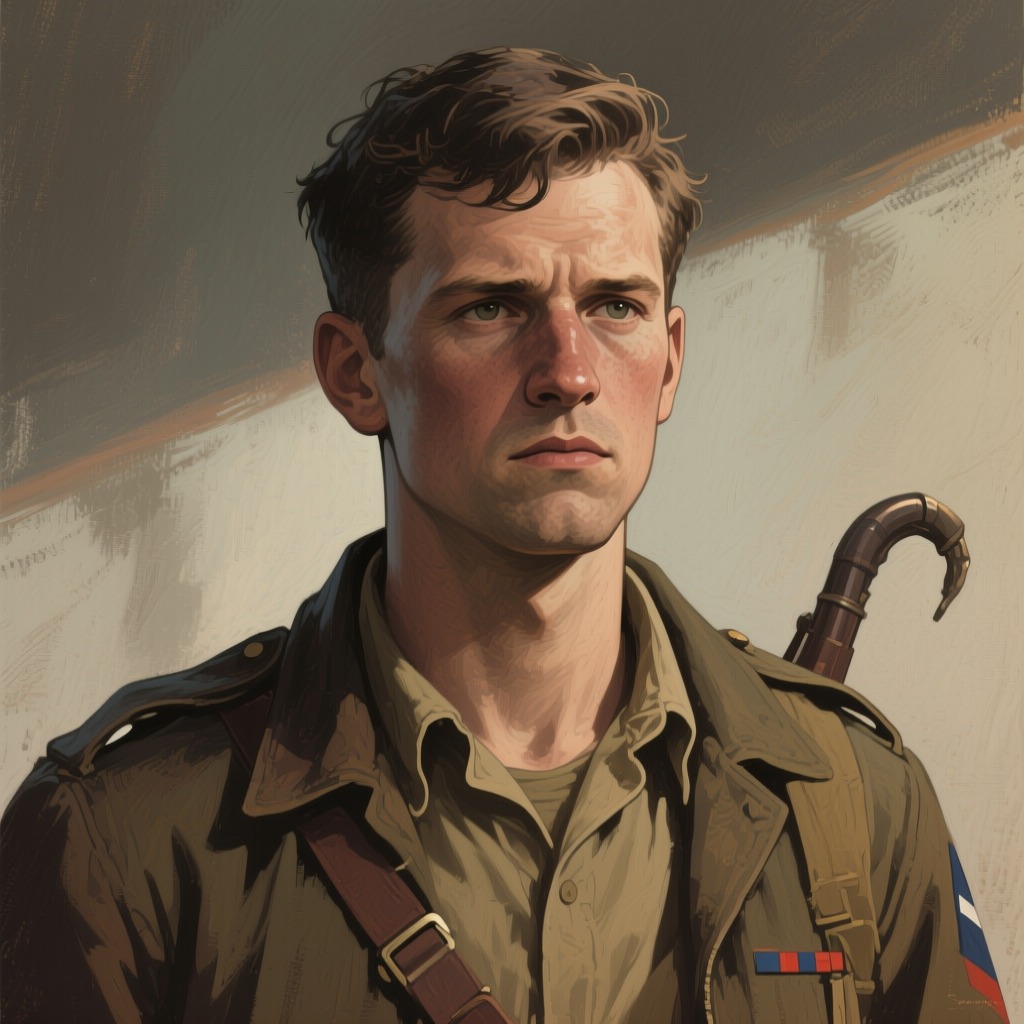
Snowden is the young radio-gunner whose death over Avignon is the novel's hidden sun, the event around which everything else orbits and from which all meaning drains. He appears in the text almost entirely as a dying voice and a corpse, yet his agony—and the secret it spills—constitutes the single most important revelation in Yossarian's life, the truth that makes a mockery of every patriotic speech, every medal, every raised mission count. He is the reason Yossarian will not wear a uniform, the reason he runs into the hospital, the reason he finally runs away. Snowden is barely a character; he is a wound that never heals.
Identity and the Mission
Snowden is a replacement radio-gunner, a vaguely familiar kid from a crew Yossarian barely knows. On the mission to Avignon, the plane is piloted by fifteen-year-old Huple with Dobbs as co-pilot. Over the target, Dobbs goes berserk, seizes the controls, and plunges the plane into a terrifying dive that tears Yossarian's headset loose. When Yossarian reconnects, Dobbs is sobbing for help, and Snowden's voice breaks in over the intercom: "I'm cold. Please help me. I'm cold." Yossarian crawls back through the crawlway to find Snowden lying on the floor, wounded and freezing to death in a yellow splash of sunlight. Beside him lies the tail-gunner, who keeps fainting each time he opens his eyes and sees Snowden dying.
The Wound and the First-Aid Kit
Yossarian sees a wound in the outside of Snowden's thigh, as large and deep as a football, raw muscle twitching inside like live hamburger meat. He works competently, cutting away the coveralls, applying sulfanilamide, bandaging the leg. He feels proud of his bandage. But Snowden keeps whimpering, "I'm cold," and Yossarian keeps saying, "There, there," because he does not know what else to say. When Yossarian searches the first-aid kit for morphine, he finds only a note: "What's good for M & M Enterprises is good for the country. Milo Minderbinder." The morphine has been stolen. Snowden must endure the pain without relief.
The Secret Spilled
Snowden points with his chin toward his armpit. Yossarian rips open the flak suit and sees a chunk of flak more than three inches big that has shot into Snowden's side under the arm and blasted all the way through, drawing whole mottled quarts of his insides out with it. Liver, lungs, kidneys, ribs, stomach, and bits of the stewed tomatoes Snowden ate for lunch slither down to the floor in a soggy pile. Yossarian screams, vomits, and understands. The secret Snowden spills all over the messy floor is this: man is matter. Drop him out a window and he'll fall. Set fire to him and he'll burn. Bury him and he'll rot, like other kinds of garbage. The spirit gone, man is garbage. That is Snowden's secret. Ripeness was all.
Aftermath and Recurrence
Snowden's death haunts every subsequent page. Yossarian sits naked in a tree at Snowden's funeral, refusing to wear a uniform because Snowden's blood was smeared all over his bare skin. The chaplain sees a naked man in a tree at the cemetery and cannot explain it. Yossarian's nightmares and waking thoughts return obsessively to Snowden freezing to death, to the wrong wound he bandaged, to the secret that changes everything. When he later lies in the hospital after being stabbed by Nately's whore, he thinks of Snowden again—"who had never been his pal but was a vaguely familiar kid who was badly wounded and freezing to death." The memory triggers the full, final, unflinching narration of the death scene, as if Yossarian must relive it one last time to understand what he has become.
Thematic Significance
Snowden's death is the novel's answer to every abstraction—country, duty, honor, glory—that the military uses to justify killing. His spilled entrails are the literal, material truth that all the rhetoric cannot hide. Yossarian's entire rebellion, his refusal to fly more missions, his deal with Colonel Korn, and his final escape to Sweden are all responses to what Snowden taught him: that he is made of matter that can be destroyed, and that no cause is worth that destruction. Snowden's secret is the novel's deepest conviction, the reason Catch-22 is not a war comedy but a tragedy wearing a clown's face.