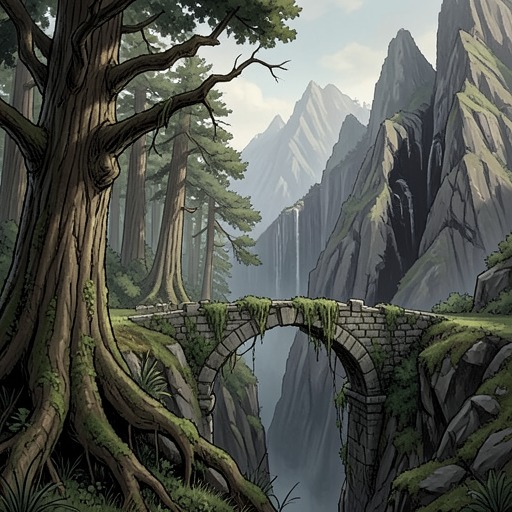
Alalea
EragonAlalea is the unknown homeland from which the elves came before their history in Alagaësia began. Brom identifies it as a place known by name to the elves but withheld from every other people, making it less a mapped destination than a guarded origin whose very inaccessibility preserves the elves’ otherness.
Definition and Location
Alalea is described as the place the elves themselves call home, but neither its position nor its nature is disclosed. When Eragon asks where the elves came from, Brom answers that they came from Alalea and adds that none but the elves knows what it is, or even where it lies. The statement establishes a hard boundary around elven knowledge: Alalea exists within the world’s geography, yet remains outside the geography available to humans.
The uncertainty is significant because the surrounding narrative repeatedly distinguishes known lands from territories that are blank, hidden, or difficult to enter. The Spine is an untamed mountain range feared for its stories and dangers; the Hadarac Desert is an immense barrier whose wells and oases are concealed; the Beor Mountains contain an ancient forest hostile to intruders; and Vroengard, once the ancestral home of the Dragon Riders, survives as a looted and haunted shell. Against these charted or partially charted spaces, Alalea is defined by the absence of reliable location. It is not merely remote. It is protected by the limits of other peoples’ understanding.
Connection with the Elves
Alalea belongs exclusively to the elves’ self-description. Brom explains that the elves are not legends and that they are called the fair folk because of their grace, while also presenting them as an ancient race already powerful in Magic when they first entered the history of Alagaësia. Their homeland therefore precedes their role as allies, enemies, and participants in the War Between Elves and Dragons. It is the concealed source of a people whose identity in Alagaësia is marked by refinement, age, and power.
The secrecy surrounding Alalea also contrasts with the way human communities understand their own origins. Eragon’s knowledge is local and practical: he knows the hunting grounds near Carvahall, tracks game deep into the Spine, and measures journeys by food, water, and the endurance of horses. Alalea belongs to another scale of memory. Its name reaches Eragon through a fireside history of peoples and primordial conflicts rather than through travel, trade, or a map.
Place in the World’s History
Alalea enters the narrative during Brom’s account of the ancient world, when Dragons, Dwarves, and a few other beings are presented as the true inhabitants of Alagaësia before the arrival of the elves. The elves sailed across the sea to a land whose earlier order was already shaped by dragons. Their arrival thus marks a major historical transition, even though the text gives no account of Alalea itself or of the voyage beyond that brief image.
The elves initially regarded dragons as mere animals, and that mistaken judgment led to the killing of a dragon, the retaliatory slaughter of an elf, and a five-year war between the two peoples. The conflict eventually ended when an elf named Eragon found a dragon egg, creating the possibility of communication and reconciliation. Alalea is therefore connected indirectly to the origin of the relationship between elves and Dragons: it is the homeland of the people whose error helped produce the war, and whose later intervention helped end it.
Narrative Function and Significance
Alalea’s narrative function lies in what remains unstated. Brom gives Eragon a precise name but refuses him a usable description, turning the location into a fragment of inaccessible cultural memory. The effect resembles the broader history of the Golden Age of the Riders: the past can be recalled, but only imperfectly, and what has been lost survives through partial testimony. Alalea belongs to that same pattern of remembered yet unrecoverable worlds.
Its remoteness also helps prevent the elves from becoming simply another settled nation within the political geography of the Empire. Their visible refuge, Du Weldenvarden, is itself mysterious and dangerous, while Alalea lies beyond even the knowledge available to the characters. The distinction suggests that the elves’ identity cannot be reduced to their present forest realm. They carry an older origin with them, one that remains outside human possession and outside the narrative’s immediate route of travel.
Alalea consequently works as both a geographical mystery and a symbol of cultural autonomy. The elves’ refusal, or inability, to disclose where it is preserves a boundary between human curiosity and elven self-knowledge. For Eragon, the name expands the world beyond the limits of his village and confirms that the history surrounding him is older, stranger, and less recoverable than local stories imply. The location matters not because the protagonists reach it, but because its unseen distance gives depth to the peoples and conflicts they do encounter.