Helgrind
EragonHelgrind, known as the Dark Gates, is a bare, jagged mountain near Dras-Leona whose immense form dominates the surrounding landscape. With spires and columns thrusting upward like the remains of a nightmare vessel, it is treated not merely as scenery but as a place of menace, ritual, secrecy, and predation. Its significance grows when Brom and Eragon identify it as the probable refuge of the Ra’zac, linking the mountain’s forbidding appearance to the political and supernatural dangers pursuing them.
Physical Form and Setting
Helgrind rises several miles east of Dras-Leona as a mountain of bare rock. Its sides are nearly vertical, and its spires and columns give it the appearance of a gigantic, unnatural structure rather than an ordinary geological formation. The landscape is described through images of darkness and exposed bone, making the mountain seem like an intrusion from another order of existence. Its scale and shape create an immediate impression of power that cannot be easily approached, understood, or controlled.
The mountain stands beside a city already marked by disorder and religious brutality. Dras-Leona sprawls along Leona Lake in crooked streets, while Helgrind towers beyond it as the landmark that originally drew the city into being. Brom explains that people remain fascinated by the mountain despite its unhealthy and malevolent character. That fascination gives Helgrind an unsettling double quality: it repels through its threat, yet attracts through the grandeur and mystery of its form.
Religious and Cultural Meaning
Helgrind is the object of worship for the dominant religion of Dras-Leona. The city’s cathedral deliberately resembles the mountain, repeating its arches and flanged spires within the urban walls and transforming the natural landmark into an architectural and institutional presence. The resemblance suggests that the city has not simply grown near Helgrind; it has reproduced the mountain’s image and allowed its values to shape public life.
The religion associated with Helgrind is explicitly cruel. Its adherents drink human blood and make offerings of flesh, while priests surrender parts of their own bodies in the belief that giving up bone and sinew loosens their attachment to the mortal world. Their disputes over which of Helgrind’s peaks deserves the greatest reverence further turn the mountain’s physical structure into a system of ritual hierarchy. The result is a grotesque fusion of landscape, worship, and bodily sacrifice: the rock’s peaks become sacred objects, and human bodies are treated as materials that can be pared away in pursuit of spiritual distance from mortality.
Hidden Routes and the Ra’zac
Helgrind becomes central to Brom and Eragon’s investigation after Jeod traces repeated shipments of Seithr oil to Dras-Leona. The regular deliveries, made at intervals and transported by the same merchant, cannot plausibly be explained by ordinary jewelry production. When Helgrind is remembered as the Dark Gates, its proximity to Dras-Leona provides the missing location that makes the shipments intelligible, and Brom concludes that the Ra’zac are likely based there or nearby.
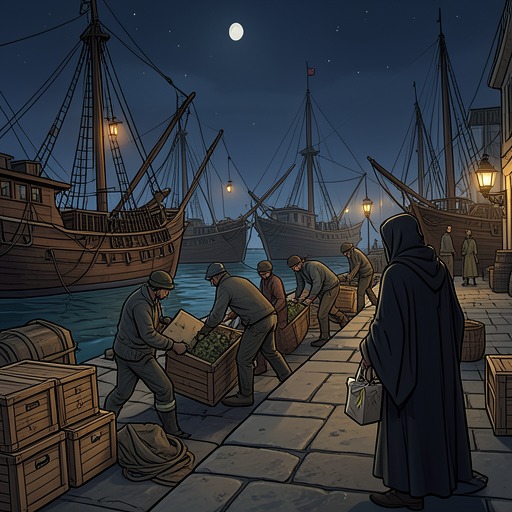
Brom’s later inquiries reveal a more direct supply route. On every full moon, two slaves are sent to the base of Helgrind with a month’s provisions. When Seithr oil reaches Dras-Leona, it is sent with those supplies. The slaves never return, and the sole known person who followed them also disappeared. This recurring movement turns the mountain into the endpoint of an organized chain of enslavement, concealment, and death. Helgrind is therefore not an isolated wilderness but a destination continually serviced by the city’s institutions.
The discovery gives Eragon and Brom a concrete strategy. If the Ra’zac occupy Helgrind, their shelter may lie at the bottom of the mountain behind a thick stone door, or high above the ground where only flying mounts can reach it. Either location would be defensible, and any obvious flight by Saphira around the mountain would expose the searchers to both the Ra’zac and the inhabitants of Dras-Leona. Eragon proposes taking the place of the two slaves when the next full moon arrives, turning the Empire’s supply ritual into an opportunity to penetrate the enemy’s concealment.
Narrative and Thematic Significance
Helgrind concentrates several oppositions that recur throughout the story: open landscape against sealed refuge, public religion against hidden atrocity, natural power against political exploitation, and the apparent order of ritual against the violence that sustains it. The mountain is visible from the road, yet the crucial truth about what occurs there remains concealed. Its enormous exposed surface hides doors, chambers, routes, and inhabitants that cannot be reached by ordinary movement. The physical structure thus becomes an image of suppressed history and protected evil.
It also stands in dark contrast to the legacy of the Dragon Riders. The Riders were formed to protect and guard, and under their rule the land prospered, but their order was destroyed through betrayal, forbidden knowledge, and the rise of Galbatorix. Helgrind belongs to the later world shaped by that fall: a place where slavery flourishes under the king’s reign, where blood and flesh are offered to a cruel power, and where the Ra’zac can operate through disappearance rather than open rule. The mountain’s permanence makes the contrast sharper. Civilizations and protective orders can collapse, while the rock remains, absorbing new rituals and new forms of violence.
Within the plot, Helgrind functions as both threshold and test. Approaching it requires Eragon to move beyond the ordinary roads of investigation and into a space governed by secrecy, vertical barriers, and lethal uncertainty. The planned substitution of the slaves reverses the mountain’s established pattern: instead of allowing victims and supplies to vanish into its shadow, Eragon and Brom intend to enter deliberately and expose what the recurring deliveries conceal. Helgrind’s decisive role is therefore not only that of a lair or landmark, but of a spatial embodiment of the story’s struggle to turn hidden evil into something that can be confronted.