Hadarac Desert
EragonThe Hadarac Desert is the central wilderness of Alagaësia: a vast, sparsely inhabited region whose dunes, heat, scarce water, and concealed routes make it one of the story’s most consequential geographical barriers. It is not merely empty space on a map. The desert determines political strategy, tests the limits of endurance and Magic, and turns the journey toward the Varden into an expedition whose survival depends on cooperation between Eragon, Saphira, Murtagh, and their animals.
Definition and Setting
The Hadarac Desert occupies the middle of the known map, with its eastern extent left blank. To the west lie the coast and the Spine, while Surda lies to the south and the Beor Mountains near Surda’s eastern border. Farther north are Du Weldenvarden and the lands of the Empire. This position makes the desert a geographical hinge: it divides regions controlled or watched by Galbatorix’s Empire from the uncertain territories where resistance may survive. The desert’s scale is emphasized through travel rather than measurement. The plains west of it are described as almost as uninhabited as the Hadarac Desert, and a crossing can take from two or three days to more than a fortnight depending on direction. The comparison presents the desert as the ultimate standard of remoteness: a place against which even a nearly empty plain is measured.
Landscape and Conditions
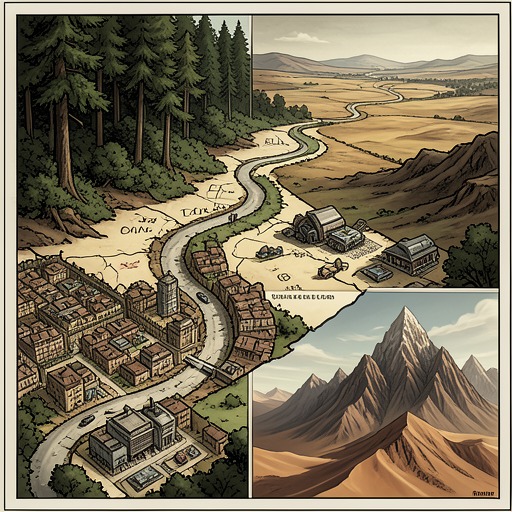
When Eragon, Murtagh, Saphira, Arya, and the horses reach the desert, the ground softens beneath their feet and they are forced to halt. Before them stretches an expanse of dunes reaching to the horizon, rippling like an ocean. Reddish-gold sand rises in twisting bursts under the wind, while scattered patches of solid ground support scraggly trees that any farmer would consider useless for crops. Purple crags stand in the distance, and a lone bird is the only animal visible across the imposing desolation. The environment immediately imposes physical costs. The hot, dry air stings Eragon’s throat and leaves him slurring his words. Food is uncertain, although Murtagh explains that short, tough grass grows around the distant crags and should be enough for the horses. The desert therefore offers no easy abundance: even its available nourishment is sparse, localized, and dependent on recognizing the landscape correctly. Water is the desert’s central danger. Before the crossing, Murtagh explains that the nomadic tribes conceal their wells and oases to prevent theft, while carrying more than a day’s supply is impractical. The problem is magnified by Saphira and the horses, which can consume more water at one time than the travelers use in a week. Eragon considers transforming sand into water, but understands that making rain or moving enough air would exceed his power. The desert thus exposes a concrete limit of Magic: ingenuity may offer a possible answer, but raw power cannot simply erase the environment’s demands.
Barrier, Route, and Political Geography
The desert becomes central to the group’s choice of destination after Arya is rescued and the companions must escape the Empire. Murtagh weighs every direction. The north offers Du Weldenvarden but would require returning past Gil’ead; the west contains the Empire and the sea; the south leads toward Surda but would require crossing much of imperial territory; and the east places the Hadarac Desert between the travelers and whatever lands lie beyond it. The Varden are believed to be somewhere across the desert, but without reliable directions the journey could take years. Eragon nevertheless favors the eastern route because the alternatives expose the group to towns, villages, and imperial pursuit. Murtagh initially resists, not because the desert’s political value is unclear, but because its logistics appear impossible. His objection is precise: hidden wells, concealed oases, and the water consumption of Saphira and the horses make ordinary travel unsustainable. The argument turns the desert into a threshold guarded by practical necessities rather than by a single enemy. The crossing is also shaped by pursuit. The travelers must move quickly while Urgals follow them, and they cannot simply choose the safest route or wait for ideal conditions. The Hadarac Desert therefore serves simultaneously as refuge and hazard. Its emptiness may conceal fugitives from the Empire, yet the same emptiness removes shelter, supplies, and reliable landmarks.
Historical and Narrative Significance
The desert’s position connects it to the lost history of the Dragon Riders. Brom’s account describes the Riders’ former golden age, their alliance with the elves, their friendship with the Dwarves, and their eventual destruction under Galbatorix and the Thirteen Forsworn. On the map, the Varden are hidden somewhere in the blankness beyond the Hadarac Desert, while Vroengard, the ancestral home of the Riders, appears as a looted and haunted remnant of their former glory. The desert consequently lies between a fallen past and a threatened future: behind the travelers is the world ruled by the legacy of the Riders’ collapse, and beyond it may be the organized resistance capable of challenging that rule. The crossing also contrasts with the other wild regions Eragon knows. He once tracked game deep into the Spine, a mountain range feared for its strange tales, but he did so as a hunter reading tracks, terrain, and the habits of animals. In the Hadarac Desert, those familiar forms of knowledge become insufficient. There are few animals, little vegetation, hidden water sources, and no ordinary settlement network. The landscape demands a different kind of expertise, one based on endurance, resource calculation, and trust in companions. The desert’s narrative function is therefore both physical and symbolic. It is the point at which the journey ceases to be a flight through known lands and becomes a passage into uncertainty. Its dunes conceal direction, its blank eastern map conceals political possibility, and its scarcity forces Eragon to confront the difference between wishing for a solution and possessing the strength to achieve it. By making survival itself a condition of reaching the Varden, the Hadarac Desert converts geography into plot: the road to resistance must be earned through passage across a landscape that cannot be commanded or sentimentalized.