Beor Mountains
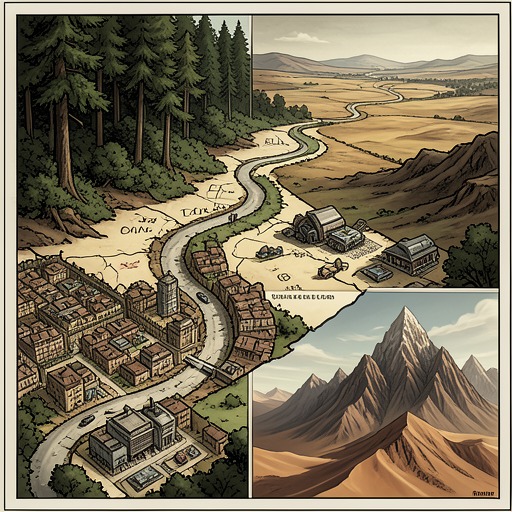
EragonThe Beor Mountains are an immense mountain range near the eastern border of Surda, one of the defining geographical features of Alagaësia. Eragon first knows them through stories and a map, but their physical appearance overturns his skepticism: they are not merely a distant landmark but a seemingly limitless wall of snow, ice, forest, and rock. Their scale makes them both a route toward the Varden’s refuge and a visual measure of the world’s vastness, reducing even Saphira to the feeling of a hatchling.
Position and Political Geography
On Jeod’s map, the Beor Mountains stand near Surda’s eastern border. Surda is a small country that seceded from the Empire after the fall of the Riders and is believed to support the Varden in secret. The map becomes blank to the east of the Beors, making the range more than a physical boundary: it marks the edge of Eragon’s reliable knowledge. Elsewhere, the Hadarac Desert fills the center of the map, while the Spine extends along the western coast; the Beor Mountains therefore help frame the major geographic divisions through which the struggle against Galbatorix’s Empire unfolds.
The range is also connected to the Varden’s concealed position. The Varden are a rebel organization that raids the Empire, accepts fugitives and enemies of Galbatorix, and has survived despite repeated efforts to destroy it. Their location is difficult to discover, and the map places their hiding place somewhere in the eastern blankness. The Beors thus belong to a landscape of concealment and resistance: they are associated with the political space in which opposition to the Empire can endure, even though the mountains themselves are not presented as the Varden’s settlement.
Eragon’s First Sight
Before seeing the mountains, Eragon has heard that they are ten times the height of the Spine, but he privately assumes that such accounts exaggerate. His first view begins as a visual puzzle. Broad, forest-covered forms rise ahead of the travelers, while the air above them appears as a pale, colorless band stretching across the horizon. The apparent whiteness initially seems like an illusion produced by the desert air.
The explanation is more extraordinary than the mistaken impression. The shapes are the bases of gigantic mountains, scores of miles wide, whose upper reaches are covered in snow and ice. Their peaks cannot be seen because they continue upward until they fade from sight. Narrow, jagged valleys cut between ridges that nearly touch, creating what Eragon perceives as a ragged wall linking Alagaësia with the heavens. The reveal converts hearsay into experience and forces him to acknowledge that the stories were accurate rather than fanciful.
Saphira shares the scale of the revelation from a different perspective. Even as a dragon, she feels small beside the range and describes the sensation as being like a hatchling again. The mountains therefore unsettle both human expectation and draconic self-assurance. Their size is not decorative background; it produces an encounter with a natural power that exceeds ordinary measures of distance, height, and control.
Relations with the Varden and Tronjheim
The Beor Mountains are connected to the political tensions surrounding refuge in Farthen Dûr and Tronjheim. The Varden live in Tronjheim and receive assistance from the dwarves, but Ajihad explains that the dwarves are not simply subordinate members of his organization. They remain loyal to their own king, Hrothgar, while the thirteen clans retain powerful chiefs whose opposition can restrict the king’s actions.
This arrangement makes the mountains’ eastern geography inseparable from contested authority. The Beors shelter the dwarf kingdom and the Varden’s stronghold, yet sanctuary there depends on negotiations among human rebels, dwarves, elves, and dragons. Hrothgar has had to oppose clan demands that Eragon be denied refuge and expelled from Farthen Dûr. His warning that “Beware, the rock changes” presents political instability through the language of the mountain itself: beneath the apparent permanence of stone, alliances and loyalties can shift quickly.
The range consequently represents protection without absolute security. The Varden can hide from the Empire, but their refuge is governed by local powers whose support is conditional. Ajihad must preserve cooperation with the elves while avoiding conflict with the dwarves, and Hrothgar must defend the Varden without losing the allegiance of the clans. The mountains provide the setting for resistance, but not a simple guarantee of unity.
Boundary, Scale, and Narrative Significance
The Beor Mountains function as a threshold between mapped knowledge and blank space. Their position beside Surda and near the hidden Varden makes them part of the route into the political heart of the resistance, while the empty map beyond them suggests that the world remains larger than the protagonists’ current understanding. They are therefore both a destination in the geography of the plot and a challenge to the assumptions with which Eragon interprets that geography.
Their introduction also establishes a recurring contrast between inherited report and direct perception. Eragon has been told that the mountains are impossibly large, dismisses the claim as embellishment, and then encounters a sight that exceeds even ordinary visual comprehension. The scene does not merely confirm a fact about the map; it changes his scale of imagination. The Beors teach him that the world contains powers whose reality cannot be safely judged from familiar experience.
At the same time, the range carries the political symbolism of a frontier. Beyond the Empire’s propaganda, beyond the isolated villages that debate rumors of the Varden, and beyond the ordinary roads traveled by Eragon and Brom, the Beor Mountains hold a region where alternative loyalties and older forms of authority survive. Their colossal wall gives physical form to the distance between imperial rule and the communities resisting it. When the coming battle threatens Farthen Dûr, Ajihad warns that defeat would mean the downfall of the dwarves, the death of the Varden, and eventual defeat for Surda and the elves. The mountains consequently stand behind a coalition whose survival is geographically sheltered but historically precarious.