Palancar Valley
EragonPalancar Valley is the secluded northern valley of Alagaësia in which Eragon’s life as a hunter and farm worker begins. Seen from the mountains, it appears as a contained human landscape—Carvahall, scattered farms, the Anora River, and the distant village of Therinsford—set within wilderness that is beautiful, difficult, and never entirely tame. The valley’s importance is therefore both geographical and narrative: it provides Eragon with a home, a family, and a demanding material existence before the wider conflict surrounding Galbatorix, the Dragon Riders, and the Varden reaches him.
Geography and Setting
From the Spine, the valley unfolds below the Igualda Falls like an open map. The falls mark its northernmost point, while the Anora River runs southward through the valley, passing Therinsford and the lonely mountain Utgard before eventually turning north toward the sea. Carvahall lies near the falls, surrounded by small square farms and land colored tan and sandy by dead grass. The river’s reflective course gives the valley a visible axis, linking its settlements while also emphasizing how enclosed they are by mountains and distance.
The valley is not an easy pastoral refuge. The Spine is an untamed range extending through Alagaësia, associated with strange tales, misfortune, and accidents. Even King Galbatorix cannot fully claim it; stories tell of half his army disappearing after entering its ancient forest. From the valley, however, the wilderness is also a source of food and livelihood. Eragon is the only hunter near Carvahall willing to track game deep into the mountains, and his hunt for a doe is driven by the approaching winter and his family’s inability to buy meat in the village. The valley’s human life thus depends on the very wildness that surrounds and threatens it.
Carvahall and the Farmsteads
Carvahall is the principal settlement of Palancar Valley, apart from Therinsford. Its stout log buildings have low roofs, some thatched and others shingled, with broad porches where residents gather to talk and conduct business. Chimney smoke gives the village a woody smell, and evening brings loud male voices, lit windows, and wives hurrying to retrieve husbands who have stayed out too late. These details present Carvahall as a close, practical community whose rhythms are governed by work, weather, trade, and personal familiarity.
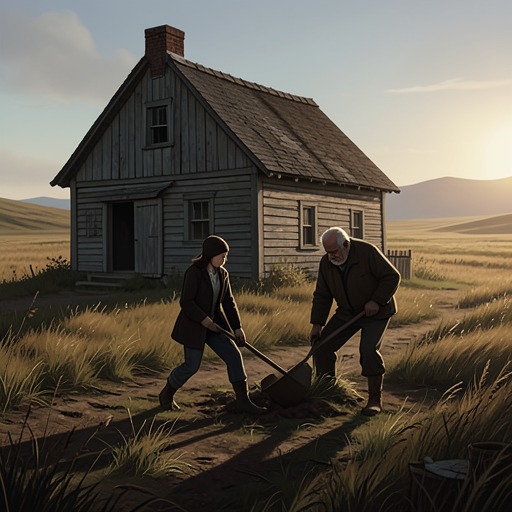
Eragon’s family home stands ten miles from Carvahall, farther from the village than any other household. The house has a shingled roof, brick chimney, whitewashed walls, and an enclosed porch divided between firewood and farm tools. A nearby barn shelters the horses Birka and Brugh, chickens, and a cow; a wagon is wedged between the stalls, while trees mark the edge of the fields along the Anora River. The property had been abandoned for half a century before Garrow and his family moved there after Garrow’s wife, Marian, died. Its distance from Carvahall is regarded as dangerous because the family cannot easily obtain help, but Garrow accepts the isolation. The farm consequently embodies both self-reliance and vulnerability.
Routes, Resources, and Boundaries
Palancar Valley is connected to the wider land by difficult natural routes. The Anora River is a powerful, rock-choked current, and the trail leading from the mountains is rough, faint, and sometimes nonexistent. Though it follows animal paths that backtrack and detour, it remains the fastest way out of the Spine. The valley’s apparent enclosure is therefore not absolute: paths, rivers, and roads permit movement, but each route requires effort and exposes travelers to the surrounding terrain.
The valley also functions as a resource base for journeys beyond it. When Eragon, Brom, and Saphira prepare to travel east, they fill their waterskins and drink from the Anora before crossing the plains toward Yazuac. Later, the logistical problem of reaching the Beor Mountains and crossing the Hadarac Desert is measured against the scarcity of water and the amount consumed by Saphira and the horses. Palancar Valley is remembered as the last dependable source of water before a much harsher passage, making its river significant not merely as scenery but as a condition of survival.
Place in the Wider World
Although Palancar Valley is remote, it is not outside the history of Alagaësia. Brom’s account of the Dragon Riders’ golden age, Galbatorix’s rebellion, the fall of the Riders, and the bloody war between elves and dragons places the valley’s modest farms within an immense historical frame. The valley’s apparent quiet is a local interval inside a world shaped by lost powers, ancient violence, and political domination.
Its distance from the centers of authority also gives it a particular relation to power. Carvahall is a small settlement surrounded by harsh land, visited mainly by merchants and trappers rather than by armies or officials. The Spine’s resistance to Galbatorix’s control reinforces the impression that the valley occupies a margin of the Empire, even though imperial violence eventually reaches the people living there. Palancar Valley is therefore both protected and exposed by its isolation: it preserves an ordinary rural existence, but offers little institutional protection when danger arrives.
Narrative Significance
Palancar Valley is the ordinary world from which Eragon crosses into legend. Its farms, hunting trails, village porches, and riverbanks establish the concrete needs that initially shape him: obtaining meat for winter, helping his family, and understanding the limits of the land around him. His confidence in the Spine is not abstract heroism but the result of years of vigilance, sharp reflexes, and familiarity with difficult terrain.
At the same time, the valley’s boundaries are repeatedly opened by forces larger than local life. The mountains contain rumors and danger; the river becomes a route toward distant conflict; and the surrounding wilderness leads Eragon toward discoveries that transform his identity. Later, when an unseen figure identifies himself as Osthato Chetowä, the Mourning Sage, and Togira Ikonoka, the Cripple Who Is Whole, and directs Eragon to trust Arya and travel to Ellesméra, the scale of Eragon’s world has expanded far beyond Palancar Valley. Yet the valley remains the essential point of contrast: the remembered home whose secluded human warmth makes the political and mythic world he enters legible, and whose loss of safety gives his departure its emotional force.