Therinsford
EragonTherinsford is one of only two villages in Palancar Valley and the larger counterpart to Carvahall. Set beyond the valley’s farms and along the Anora River, it is a remote settlement whose physical disorder and passing strangers make it an important threshold between Eragon’s isolated upbringing and the wider world of trade, war, literacy, and hidden history.
Setting and Appearance
Therinsford lies far south of the Igualda Falls, where the Anora River winds through Palancar Valley toward the sea. From the heights above the valley, Eragon can see the river flowing past Therinsford and the lonely mountain Utgard in the distance. The village is separated from Carvahall by the valley’s harsh, beautiful landscape, and the surrounding region is visited by relatively few people except merchants and trappers.
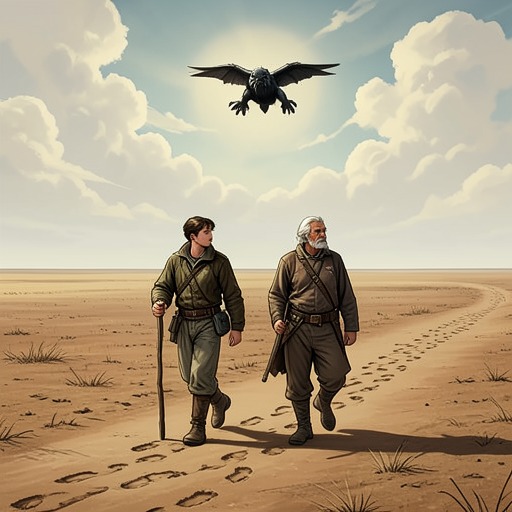
Although Therinsford is larger than Carvahall, it lacks the latter’s compact, settled character. Its houses were built haphazardly, with no consistent alignment, giving the village an improvised and untidy appearance. When Eragon reaches it, the deepening ruts in the road and the increasing number of footprints announce that he is approaching a more active settlement; farms along the route signal the transition from wilderness to habitation.
Strangers and Movement
Therinsford enters Eragon’s awareness through the movement of people between villages. A stranger named Dempton comes from Therinsford to have Horst forge sockets, and the news immediately attracts Eragon’s attention. Dempton’s visit shows that Therinsford is connected to Carvahall through practical exchange, while the unfamiliar visitor also introduces an element of uncertainty into the village community.
Later, Eragon travels toward Therinsford with Brom. The journey is not merely a change of scenery: the village is associated with the search for Roran and with Eragon’s reluctance to confront his cousin. As the road becomes more heavily traveled, Therinsford appears as a place where local concerns intersect with wider traffic and danger, even though its physical organization remains chaotic.
A Threshold of Knowledge
Therinsford’s significance extends beyond its buildings. The village belongs to the social landscape through which stories and information circulate, linking ordinary rural life to the history of the Dragon Riders and the Empire. Brom’s public performance for the people of Carvahall preserves the memory of the Riders through oral storytelling, presenting a past that official power has tried to suppress. His account describes the Riders’ mission to protect the land, their alliance with the elves and friendship with the dwarves, and the golden age that ended through their internal destruction.
The same historical inheritance is also preserved in written form. Brom later explains that The Domia abr Wyrda is a rare history of Alagaësia, beginning before the elves arrived and continuing to events only a few decades in the past. The Empire condemned the book as blasphemy and burned its author, Heslant the Monk. The contrast between Brom’s spoken history and this persecuted written record establishes a broader pattern: knowledge survives through performances, books, memories, and guarded archives even when governments attempt to control it.
Relation to Eragon’s Education
Therinsford is connected indirectly to Eragon’s awakening as a reader and historical subject. Eragon admits that he cannot read, revealing how thoroughly his rural life has excluded him from written knowledge. Brom reacts with disbelief because Garrow knew how to read but had never taught Eragon. The limitation is not simply personal; it marks the distance between Eragon and the records, poems, and histories that define Alagaësia.
That distance begins to close through Brom’s instruction and through encounters with books. In the library reached with Orik, Eragon enters a vast repository of human writings, royal records, songs, and stories. The library is described as the true legacy of the dwarves, while the elves’ writings remain largely inaccessible because they guard their secrets. Therinsford therefore stands at the rural edge of a narrative concerned with who may travel, who may read, and who may preserve the past: it is a modest settlement, but it belongs to the network through which Eragon gradually moves from local ignorance toward historical understanding.