Gil’ead
EragonGil’ead is presented as a provisional, hostile city on the Empire’s frontier, but its decisive narrative importance lies in the collision it produces between Eragon’s private journey and the Empire’s larger persecution of magical and nonhuman resistance. He enters its orbit seeking concealment and leaves it pursued, wounded, and committed to saving Arya.
Setting and Appearance
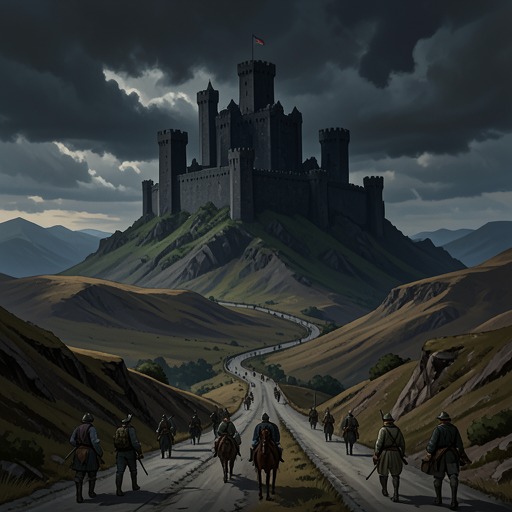
Gil’ead lies near Isenstar Lake and is reached only after Eragon and Murtagh have traveled for nearly a month. By then spring has begun to displace the remnants of winter, and Eragon has grown stronger and calmer during the journey. They stop on the city’s outskirts and observe it from a distance before deciding to camp two miles away for safety.
The city looks less like an established capital than a temporary trading post. Its streets are lined with log houses and filled with yapping dogs, while a rambling stone fortress dominates the center. Blue smoke hangs in the air, giving the settlement a hazy, unsettled appearance. The roughness of the place contrasts with its strategic importance: soldiers and military authority are firmly present beneath the improvised surface, and the nearby lake provides a recognizable geographical boundary for the fugitives’ approach.
Eragon’s Imprisonment
Gil’ead becomes a prison before it becomes a place of rescue. Eragon awakens in a cell warm enough to be dry but stripped of the protections and familiar possessions that ordinarily define him. His hands are unbound, yet the barred window, iron-bound door, and guarded setting make his lack of freedom unmistakable. Dried blood on his face belongs to someone else, while the blow to his head leaves him in pain and mentally confused.
The captors have apparently drugged him. He cannot concentrate sufficiently to remember the words of the ancient language or use magic, and even ordinary food is difficult to stomach. The missing weight of Zar’roc at his hip reinforces how completely the city has reduced him from armed traveler and Dragon Rider to incapacitated prisoner. Through the cell window he sees busy streets and rows of identical houses, an outwardly mundane scene that becomes disturbing because he cannot yet understand how he has been placed within it.
The Captive Elf
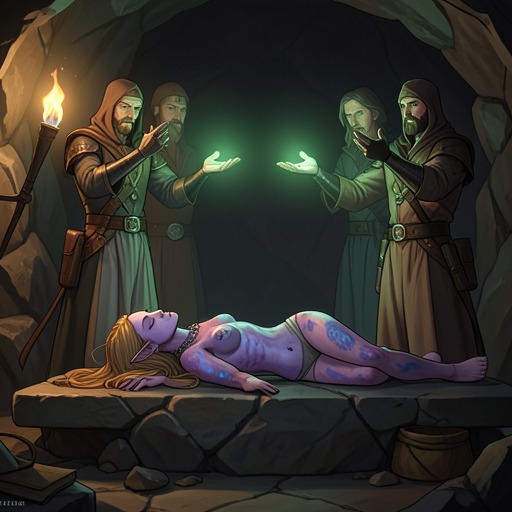
The city’s most consequential revelation arrives in the middle of a marching column. Eragon notices a gap among the soldiers and sees an unconscious woman being carried between two burly men. Her dark hair, leather clothing, empty sheath, and pointed ears identify her as an elf, but recognition comes before explanation: he realizes that she is the woman who has appeared in his dreams.
Her presence transforms Gil’ead from a place of personal danger into a center of political and supernatural crisis. Eragon reacts with an unprecedented, feverish intensity, while the scrape along her jaw and her unconscious state expose the violence behind the soldiers’ order. He knows that elves have long lives, speak the ancient language, and may wield magic, yet they have withdrawn from the Empire since the fall of the Riders. Her capture therefore raises immediate questions about how the Empire found her and how it managed to overcome her abilities.
Pursuit and Narrative Significance
Gil’ead is the threshold at which Eragon’s development becomes action directed toward another person. He and Murtagh flee after the rescue attempt, traveling through the night despite exhaustion, burning eyes, and increasingly clumsy movements. Behind them, torch-bearing horsemen search the area around the city for their trail. At dawn they finally stop by mutual agreement to make camp, while Saphira is summoned to join them.
The city thus produces a sharp reversal in the journey. Eragon arrives shaped by grief for Brom and by the need to survive; Gil’ead gives that grief a new outward purpose. The fortress, prison, soldiers, and searching horsemen represent the Empire’s power, but the city also becomes the place where that power fails to keep Arya in captivity. Its apparent disorder conceals an organized apparatus of imprisonment, while its military control cannot prevent a single captive from becoming the focus of a counter-movement.
Place in Eragon’s Journey
Gil’ead functions as both trap and departure point. Its streets and prison temporarily suppress Eragon’s magic, strength, and mobility, forcing him to experience the vulnerability of a captive rather than the initiative of a pursuer. Yet the same city reveals Arya and gives him the knowledge needed to redirect his mission. The journey away from Gil’ead is physically punishing and immediately dangerous, but it carries a new obligation: Arya is no longer an unknown figure from dreams but a living prisoner whose fate has become bound to Eragon’s choices.