Orthíad
EragonOrthíad is an ancient Dwarven settlement in the Beor Mountains, deserted after Tronjheim was completed. Once the greatest of the Dwarves’ cities, it survives in the present chiefly as a buried network of abandoned tunnels—and, under the name Ithrö Zhâda, as the concealed route through which the Urgals have entered the mountains and gained the power to threaten both the Varden and the Dwarves.
History and Identity
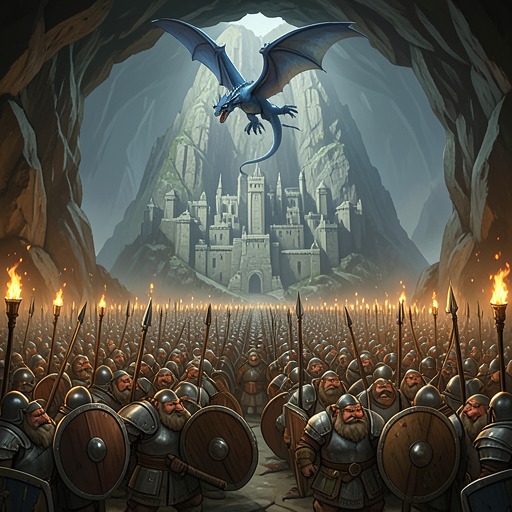
Orthíad belonged to an earlier era of Dwarven civilization. Orik identifies it as an ancient dwelling abandoned when Tronjheim, the later center of Dwarven power, was completed; during its own period of prominence, Orthíad had been the greatest of the Dwarves’ cities. No one has lived there for centuries, leaving its chambers and passages outside ordinary Dwarven life and memory.
Its abandonment also explains the condition of the surrounding tunnels. Some passages have collapsed with age, while others remain sufficiently open to connect distant parts of the Beor Mountains. The city is therefore both a historical remnant and a concealed piece of infrastructure: what once represented the height of Dwarven settlement has become useful precisely because it is no longer inhabited or routinely watched.
Discovery and the Name Ithrö Zhâda
The location returns to immediate importance when Ajihad examines a map of southern Alagaësia that shows the entire Beor Mountain range in detail. The map places Orthíad beside Surda’s eastern border, in the region from which a Dwarf reported emerging. This testimony gives the Varden the first concrete geographical indication of how the Urgals have reached the mountains.
Ajihad suspects that Orthíad is now being called Ithrö Zhâda. The two names thus mark a collision between Dwarven historical memory and the Urgals’ present military use of the same place. The ancient city has not simply been rediscovered; it has been absorbed into an enemy network and given a new operational identity.
Strategic Role in the Invasion
The tunnels beneath Orthíad provide the Urgals with access to routes that bypass the expected defenses of the mountains. Ajihad connects the site to the Urgal column that had been pursuing Eragon and Saphira, reasoning that the column was meant to reach Ithrö Zhâda and that Urgals had been migrating there throughout the year. From the city, they can travel wherever they choose in the Beor Mountains.
This mobility turns Orthíad into more than a hidden entrance. It becomes the center of a threat whose scale the Varden cannot yet measure. Jörmundur asks how many Urgals are present and whether Galbatorix’s troops accompany them, because the answer determines whether a defense is possible. If Galbatorix has reinforced the Urgals with his own soldiers, the Varden may have no chance; if he has not, perhaps because he wishes to conceal the alliance, victory remains possible.
The danger is intensified by the city’s neglect. Orik explains that hundreds of tunnels run throughout the Beor Mountains, many uninhabited since they were mined. Only eccentric Dwarves who prefer to avoid contact with others enter them, so the discovery of an approach through Orthíad could easily have gone unnoticed. The enemy’s advantage comes not only from numbers or force, but from a forgotten landscape that the defenders have failed to monitor.
Connection to the Wider War
Orthíad is also linked to the captured message taken from the leader of the Urgal host destroyed the previous night. The parchment, written in a script invented by Galbatorix for communication with his servants, orders a gatekeeper at Ithrö Zhâda to admit the bearer and his followers, house them with others of their kind, and prevent the two factions from fighting. Its damaged, bloodstained, partly charred condition reflects the violence through which the document was recovered, while its surviving words confirm that Ithrö Zhâda is organized as a controlled passage and staging point.
The message names Tarok, Gashz, Durza, and Ushnark the Mighty in the chain of command. Ajihad explains that Ushnark is Galbatorix and that the name means “father” in the Urgal tongue, an affectation intended to please him. Through this document, Orthíad’s importance extends beyond local geography: the abandoned city is evidence of a coordinated relationship between Galbatorix and the Urgal forces.
Narrative Significance
Orthíad embodies the way the past can return as a military danger. A city once celebrated as the greatest achievement of Dwarven settlement is now empty, obscure, and vulnerable to repurposing. Its ruins do not remain safely behind the characters as history; the unused passages carry the war into the heart of the Beor Mountains.
The location also concentrates the story’s uncertainty. The Varden know where the enemy may be coming from, but not how many enemies are waiting there or whether Galbatorix’s soldiers stand among them. Orthíad therefore functions as a threshold: an old Dwarven city, a hidden route, and a possible gateway through which the survival of the Varden and the Dwarves will be decided.