Carvahall
EragonCarvahall is a remote village at the northern end of Palancar Valley and the principal human settlement in the valley apart from Therinsford. Built amid harsh but beautiful wilderness, it is defined by physical isolation, close communal habits, and a precarious dependence on news and protection from outside. For Eragon, it is both the familiar center of his childhood world and the place where the Empire’s danger first becomes unmistakably present.
Setting and Appearance
Carvahall appears from above as a small cluster of brown buildings near the base of Igualda Falls. The falls mark the northernmost point of Palancar Valley, while the Anora River winds southward through the valley toward Therinsford and Utgard. Around the settlement, farms form small square patches amid tan or sandy ground and dead grass, making cultivation look fragile against the surrounding wilderness. White chimney smoke rises above the village, a modest sign of human persistence in an exposed landscape.
The village is secluded enough that few people visit except merchants and trappers. Its houses are stout log buildings with low roofs, some thatched and others shingled. Wide porches provide places for residents to gather, talk, and conduct business, while smoke from the chimneys gives the air a woody smell. Evening life is presented through ordinary communal activity: men talk loudly outside, wives hurry to find them and scold them for being late, and candles or lamps gradually brighten the windows. A broad, thick-beamed butcher’s shop is among the buildings Eragon passes through on his way into the settlement.
Isolation and the Eragon Household
Carvahall’s distance shapes the lives of the people who live near it. Eragon’s home lies ten miles from the village, farther away than any other household. The farmhouse had stood abandoned for half a century before Eragon’s uncle, Garrow, and Garrow’s family moved into it after Garrow’s wife, Marian, died. Villagers considered the distance dangerous because the family could not depend on help from Carvahall when trouble came, but Garrow refused to be persuaded otherwise.
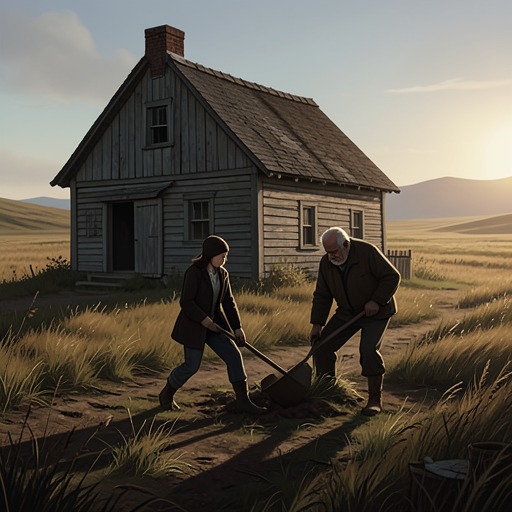
The farm itself is a small, self-contained world: a shingled house with whitewashed walls, a brick chimney, an enclosed porch stocked with split wood and farm tools, and a nearby barn containing the horses Birka and Brugh, chickens, and a cow. A wagon stands between the stalls, while trees line the edge of the fields beside the Anora River. The arrangement shows both the household’s independence and its vulnerability. It can sustain daily life at a distance from Carvahall, but that same distance leaves it exposed when threats arrive beyond the village’s ability to answer them.
The Village as a Threshold of Threat
Carvahall becomes the point at which Eragon’s private discovery begins to acquire public consequences. After Saphira’s egg has come into his possession and Saphira has hatched, two strange men arrive in the village dressed in black and carrying swords. Their appearance unsettles the residents, and they question people about a blue stone like the one Eragon found in the Spine. Horst warns Eragon that the men are still asking questions and urges him to get rid of the stone and leave Carvahall.
The episode transforms the village’s ordinary sociability into a danger. Carvahall’s residents understand that the strangers bring trouble, yet the settlement’s small size also means that not everyone can be trusted to remain silent. The warning forces Eragon to recognize that what began in the wilderness has reached the human community. Carvahall therefore functions as a threshold: beyond it lies the road, pursuit, and the larger political world; within it, the Empire’s search threatens the domestic life Eragon has treated as secure.
History Remembered in Carvahall
Carvahall is also a place where the distant past is made present through Brom’s storytelling. Around the fire, Brom recounts the history of the Dragon Riders, describing their mission to protect and guard, their unmatched battle prowess, and the thousands of years during which their powers were used for the good of the land. He remembers that cities and towers were built from living stone while the Riders kept peace, and that elves were allies, dwarves were friends, and human prosperity flourished during this golden age.
The story then turns toward collapse. Brom explains how Galbatorix, after the death of his dragon, came to blame the Riders, manipulated another Rider, and helped kill an elder before fleeing. He later persuaded Morzan to leave a gate unbolted at Ilirea, stole a dragon hatchling, mastered forbidden magic, and returned with the black dragon Shruikan. With the twelve Riders who joined them, Galbatorix and Morzan formed the Thirteen Forsworn and destroyed the Riders’ order; the elves were defeated and driven into secrecy. Within Carvahall’s humble domestic setting, this history gives the village a larger significance: its smoke-filled rooms preserve memories of a lost order whose return or restoration will determine the fate of the land.
Place in the Wider World
Although Carvahall is geographically small, its position connects it to the map Eragon studies. It lies at the top of Palancar Valley, opposite the vast forest Du Weldenvarden and far from the political centers of Galbatorix’s Empire. The map places the Empire’s capital, Urû’baen, in the center of the kingdom and identifies Vroengard, the ancestral home of the Riders, as a looted and abandoned island containing the ruined city of Dorú Areaba. It also shows Surda, the country that seceded from the Empire and secretly supports the Varden, as well as the unmapped reaches beyond the Beor Mountains and Du Weldenvarden.
This contrast between Carvahall and the old centers of power is central to its narrative role. Carvahall is not a city of towers, a fortress, or a legendary ruin; it is a village of log houses, porches, farms, and evening arguments. Yet its apparent insignificance is precisely what makes the arrival of danger so disruptive. The village anchors Eragon in an ordinary landscape while the history of the Dragon Riders, the search for Saphira, and the resistance to Galbatorix draw him toward a world far larger than Carvahall can contain.