Dras-Leona
EragonDras-Leona is a major city of Galbatorix’s Empire, situated beside Leona Lake and marked by disorder, commerce, and the looming presence of Helgrind. Its importance in the investigation of the Ra’zac grows from its position as a crossroads for imperial goods into something darker: a place where Seithr oil can disappear into official channels, slaves can be sent into the mountains, and the Empire’s violence remains hidden in plain sight.
Setting and Appearance
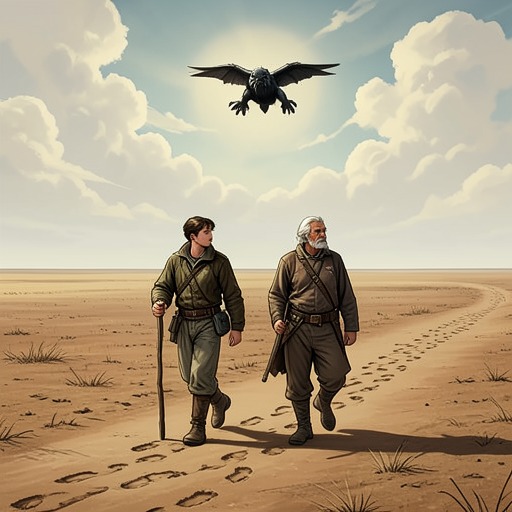
Dras-Leona appears as the antithesis of Teirm. Whereas Teirm is planned, Dras-Leona is a tangled settlement that sprawls beside Leona Lake. Its crooked streets and ramshackle buildings give the city an improvised, congested character, while the center is enclosed by a dirty, pale-yellow wall made of daubed mud. The road approaching it is equally burdened by ordinary economic life: farmers carry goods to market, and their wagons clog the route so thoroughly that Brom and Eragon must slow their horses and wait.
The city’s disorder is set against the stark image of Helgrind, several miles to the east. The mountain is bare rock, pierced by spires and columns, with near-vertical sides rising like a jagged fragment of the earth. Brom describes it as an unhealthy and malevolent presence, yet also explains that people remain fascinated by it. Dras-Leona was originally built because of Helgrind, so the city’s identity is bound to a landmark that attracts attention even as it inspires dread.
Strategic Importance
Dras-Leona becomes the leading suspect in Brom, Eragon, and Jeod’s search for the Ra’zac because the available records narrow the possible destinations of Seithr oil to Kuasta, Dras-Leona, Aroughs, and Belatona. Kuasta is considered unsuitable because it lies on the coast and is surrounded by mountains. Aroughs is isolated like Ceunon, despite being a center of trade. Between the remaining possibilities, Dras-Leona appears more likely than Belatona because it is larger and better situated.
Its commercial position makes that judgment persuasive. Jeod notes that nearly all goods belonging to the Empire pass through Dras-Leona at one time or another, including goods from Teirm. Such movement provides the Ra’zac with opportunities to conceal themselves among legitimate traffic and makes the city a natural place for suspicious cargo to vanish. The same network that sustains the city’s markets also offers cover for imperial secrets.
Helgrind and the Hidden Route
Brom’s investigation reveals that the Seithr oil does not remain in the city. After entering Dras-Leona, it is sent out with provisions to the base of Helgrind. Every full moon, two slaves are dispatched there carrying a month’s worth of supplies. The slaves are never seen again, and the one person known to have followed them also disappeared.
This recurring delivery transforms Helgrind from a striking landmark into the endpoint of a clandestine system. The regular timing of the journeys, the fixed number of slaves, and the provisions accompanying the oil suggest a controlled routine rather than an isolated crime. Dras-Leona functions as the visible urban stage of the process; Helgrind is the inaccessible destination where the evidence, the laborers, and possibly the Ra’zac themselves are removed from view.
Slavery and Imperial Violence
Dras-Leona also exposes the distance between the earlier order associated with the Riders and the world maintained under the king’s rule. When Eragon recalls that the Riders demolished the slave trade, Brom answers that slavery has unfortunately flourished under Galbatorix’s reign. The city’s trade therefore has a human cost concealed beneath its traffic in goods: enslaved people are used to support a secret route and then vanish at Helgrind.
The contrast between the busy market road and the disappearances beyond the city gives Dras-Leona a divided moral character. Farmers, wagons, and commercial exchange create the appearance of ordinary prosperity, while the same imperial infrastructure enables forced labor and concealment. The city is not merely a backdrop for the investigation; it is the point where everyday commerce and systemic brutality become visibly connected.
Narrative Significance
Dras-Leona marks a transition from deduction to danger. Before reaching it, the travelers reason among records, distances, and the movement of oil. Once the city comes into view, those abstractions acquire a physical setting: blocked roads, crooked streets, a mud wall, Leona Lake, and the monstrous silhouette of Helgrind. The investigation’s logic leads directly into a landscape whose architecture embodies secrecy and menace.
Its significance lies in this conjunction of visibility and concealment. Dras-Leona is crowded with people and goods, yet the crucial route leaves the city under the cover of a recurring delivery and ends where witnesses disappear. The city’s commercial prominence makes it an effective hiding place for the Ra’zac, while Helgrind gives the surrounding region an ominous center. Together they establish Dras-Leona as a place where imperial power turns movement, trade, and routine into instruments of disappearance.