Anora River
EragonThe Anora River is the major river running through Palancar Valley and one of the most persistent geographic presences in Eragon’s early travels. Fed by mountain streams and glaciers, it is at once a force of wilderness, a source of life for farms and villages, a route-finding landmark, and a measure of the distance separating settled communities from the dangerous regions beyond them.
Course and Setting
The river rises among the mountains of the Spine, where hundreds of small streams gather into a powerful current. From a ravine high in the mountains, Eragon sees it rushing far below toward Palancar Valley, its low rumble filling the air as it battles rocks and boulders in its path. The river’s force gives the surrounding landscape a physical violence that matches the reputation of the Spine, a place where accidents are common and few people remain for long.
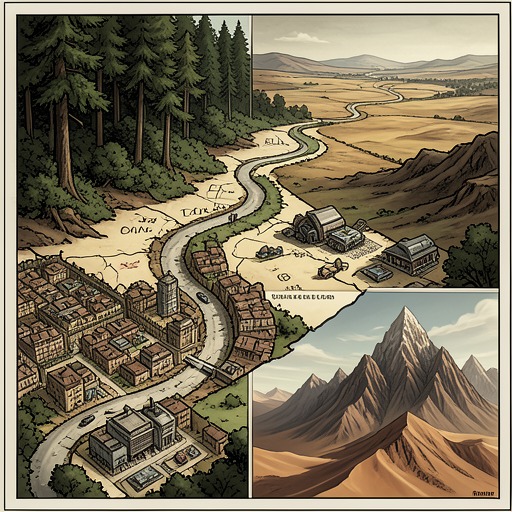
From the Igualda Falls, the Anora River winds southward through Palancar Valley. Seen from above, it reflects broad strips of sunlight as it crosses the tan and sandy land, passing farms and continuing toward the valley’s southern end. Farther away it runs past Therinsford and the lonely mountain Utgard; beyond that point, its course turns north toward the sea. This visible chain of water, settlements, and distant landmarks allows the valley to be understood as a connected landscape rather than a collection of isolated places.
Sustaining the Valley
The Anora is essential to the sparse agricultural life around Carvahall. A line of trees follows the river beside Garrow’s farm, distinguishing the cultivated fields from the harsher surrounding land. The farm itself lies ten miles from Carvahall, farther from help than any other local settlement, so the river is part of the household’s immediate environment and one of its dependable natural resources. Its presence does not make the farm secure, but it makes habitation possible in a region where winter, distance, and poverty continually threaten survival.
The river also supplies travelers. During the journey eastward, Eragon, Brom, Murtagh, and the horses refill their waterskins and drink from the Anora before attempting the dry plains leading toward Yazuac. Saphira drinks several gulps as well. Once they leave the river, wind, heat, chapped lips, parched tongues, and burning eyes become immediate problems, demonstrating how sharply the river’s presence separates manageable travel from exposure. Murtagh later emphasizes that the scarcity of water in the Hadarac Desert makes crossing it especially difficult, since Saphira and the horses consume more water at one time than the human travelers do in a week.
Landmark in Eragon’s Movements
The river repeatedly gives Eragon a spatial reference during journeys that would otherwise be difficult to navigate. From the Spine, he follows the rough game trail down toward the valley and recognizes the river far below. The view from the Igualda Falls places Carvahall, Therinsford, Utgard, and the valley’s farms in relation to one another through the Anora’s course. When Eragon later flies with Saphira, he glimpses the farm and the river beneath him as the ground falls away, making the sudden departure from home physically visible even while fear and urgency prevent him from returning to warn Garrow.
The river also clarifies the direction of travel. While discussing the route toward Yazuac, Brom identifies the Anora as their only available water supply and gestures toward the current as it streams north. They must replenish their stores before crossing the plains, because no other pool or stream lies between the river and Yazuac. The river therefore functions not merely as scenery but as a logistical threshold: departure from it commits the travelers to a stretch of country where survival depends on preparation.
Relation to Wider Landscapes
Although the Anora begins in the cold, elevated wilderness of the Spine, its course connects radically different environments. It descends from glaciers and snowpacks, passes the Igualda Falls, crosses the settled valley, and eventually reaches the sea. In the story’s geography, the river links mountain hunting grounds, farms, villages, trade routes, and distant maritime space. Its continuous movement contrasts with the political fragmentation of the region, where settlements are secluded and travel is dangerous.
The river’s importance becomes clearer by contrast with the Hadarac Desert. At the river, travelers can water themselves, the horses, and Saphira directly; beyond it, water must be carried or somehow produced. The desert’s dunes, sparse trees, and distant crags expose the cost of leaving a reliable watercourse. The Anora thus embodies an environmental condition on which human and draconic movement depends, while the desert reveals what happens when that condition disappears.
Narrative Significance
The Anora River gives the opening landscape a durable physical structure. Eragon’s hunt begins deep in the Spine, but the river leads him back toward Palancar Valley and the household whose survival depends on the land around it. Later, the same river lies beneath his first flight with Saphira and supplies the company before its eastward crossing. Its recurring appearances trace the widening of Eragon’s world: first as a distant natural force, then as the boundary of home, then as a resource that must be measured before a dangerous expedition.
The river also preserves a tension central to the narrative. It is beautiful and sustaining, yet its current is described as brute force, and its surrounding wilderness is never wholly safe. The Anora does not tame the land; it makes life possible within a landscape that remains stronger than the people living beside it. Its course therefore joins the domestic, the geographical, and the political dimensions of the story, carrying water from remote mountains through vulnerable settlements and onward toward regions controlled by trade, war, and imperial power.