Tronjheim
EragonTronjheim is the hidden city-mountain in the center of Farthen Dûr, discovered by Korgan while tunneling for gold and built by the dwarves from pure marble. It is at once a refuge, a political center, a monument to eight millennia of dwarf history, and the military heart of the Varden’s struggle against Galbatorix. Its concealed approaches and formidable architecture protect the resistance, while the tunnels beneath it create the danger that an enemy might attack from within.
Definition and Setting
Tronjheim stands at the center of a vast volcanic crater beneath Farthen Dûr. The approach leads through a tunnel cut into the crater wall, reached through two stone doors twelve feet thick and nearly thirty feet high. The passage is lit by flameless lamps that cast a pale sapphire glow, and its length helps conceal the city from the outside world. The route is so extensive that Eragon calculates it may already have carried the travelers a league through the mountain before the city comes into view.
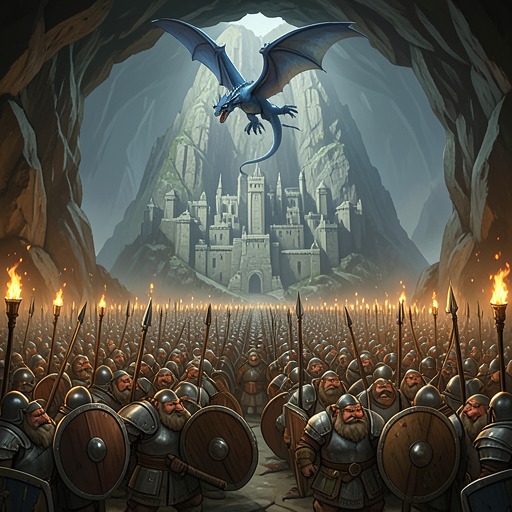
The entrance opens onto a crater of extraordinary scale. Its walls rise toward a small, ragged opening more than a dozen miles above the floor, while the opposite side appears nearly ten miles distant. Icicles hundreds of feet thick and thousands of feet long hang from the heights, and moss and lichen spread across the lower rock. A broad cobblestone road runs from the doors to the crater’s center, ending at the base of Tronjheim itself, a snowy-white mountain glittering with thousands of colored lights. Although it appears small beside the crater, the city-mountain rises slightly more than a mile.
Orik explains that Farthen Dûr was discovered thousands of years earlier by Korgan, the father of the dwarf race, and that Tronjheim represents the dwarves’ greatest achievement. The city is not merely built inside a mountain; it is itself a mountain shaped into a settlement of polished marble. Its flowing contours, countless carved windows, colored lanterns, gold detailing, and guarded timber gate make it appear less constructed than poured into existence. Eragon judges that even Urû’baen might not equal its wealth and grandeur.
Architecture and Arrival
Eragon’s arrival transforms Tronjheim from rumor into overwhelming physical fact. Saphira carries him along the road while hundreds or thousands of dwarves and humans gather in silence, every face fixed upon the dragon and her Rider. Dwarves greatly outnumber the humans, and many respond with resentment: some glare at Eragon, while others turn away rather than welcome him. The human inhabitants appear hardened by prolonged hardship, armed and prepared to defend the city, while women and children watch with a weariness that suggests the cost of the war has reached ordinary families.
The city’s defensive setting explains why the Varden have been able to survive. Farthen Dûr’s walls are too high for even a dragon to fly over, and an army could not force its way through the entrance even if it discovered the hidden doors. Concealment and geography therefore work together: the city is difficult to find, difficult to enter, and difficult to assault from outside. The same mountain that creates wonder also creates enclosure, making Tronjheim a sanctuary separated from the Empire by stone and secrecy.
Inside, the architecture becomes increasingly ceremonial. A massive gate guarded by two thirty-foot-high golden griffins leads into the city-mountain. The first great chamber forms a nexus for four hallways, with descending stairs opening into the underground quarters. Above the chamber hangs a dawn-red star sapphire twenty yards across and nearly as thick, carved like a blooming rose. Lanterns ring its edge, sending bands of red light across the floor, while the flashes within the gem give it the uncanny appearance of a giant eye watching the people below. For Eragon, the scale and craftsmanship are so far beyond his previous experience that Tronjheim seems almost impossible as the work of mortal hands.
Political and Historical Center
Tronjheim is also the seat of the Varden’s leadership. After Eragon, Saphira, and Murtagh are escorted through its guarded passages, they enter a two-story study lined with cedar bookshelves, furnished with an iron staircase, balcony, reading table, lanterns, and an elaborate oval rug. There Eragon meets Ajihad, the previously shadowy leader of the Varden. Ajihad’s welcome formally identifies Tronjheim as the headquarters from which the rebellion is organized, while the guarded conditions of the meeting reveal that refuge does not mean trust: the visitors are escorted, watched, and controlled from the moment they enter.
The city’s politics are inseparable from its history. Hrothgar, king of the dwarves, receives Eragon in a throne room that embodies an older authority. He sits on a severe black-marble throne, wearing a gold helm set with rubies and diamonds and holding the war hammer Volund, forged by Korgan. Behind him stand the carved thrones of forty-one predecessors, with Hrothgar as the forty-second ruler. He describes the dwarves as the bones of the land, older than the elves and dragons, and invokes the old warning, “Beware, the rock changes.” His words connect the physical mountain with a political order under pressure from both external war and internal disagreement.
Hrothgar has had to overcome opposition within the clans before allowing Eragon sanctuary. His enemies demanded that the Rider be expelled from Farthen Dûr, and he tells Eragon that persuading them otherwise required considerable effort. Tronjheim thus shelters the resistance without being politically unified. The city’s grandeur conceals debate over who may enter, whom the dwarves must protect, and whether the arrival of a human Dragon Rider will alter the balance among the clans.
Defensive Role and Wartime Danger
Tronjheim’s strength becomes most consequential when Ajihad prepares for the Urgals’ arrival. The city cannot safely serve as an open battlefield because it has too large a perimeter for the Varden to defend. Ajihad’s plan is to seal every passageway and gate leading into Tronjheim, forcing the Urgals onto the flats around the city where the Varden’s armies can maneuver. The objective is not simply to hold a gate; it is to prevent the enemy from gaining access to the city’s interior.
The underground network creates a second front. Because the Urgals can use the tunnels, they might quarry upward through Tronjheim’s floor and attack from inside. Too many weakened tunnels could also cause sections of the city to sink under their own weight. An extended battle would therefore threaten the city structurally as well as militarily. If the Urgals captured Tronjheim, Ajihad doubts that the Varden would possess enough strength to drive them out, making the city’s loss potentially irreversible.
The coming battle places more than one community at stake. Women and children are evacuated into the surrounding valleys, with guides prepared to lead them to Surda if the defenders are defeated. Ajihad declares that the Varden must hold Farthen Dûr: failure would mean the downfall of the dwarves, the death of the Varden, and eventual defeat for Surda and the elves. As people hurry through Tronjheim carrying belongings and messages, the magnificent city changes from a place of revelation into a mobilized fortress. Its polished marble and jewel-lit halls become the interior of an impending siege.
Narrative Significance
Tronjheim’s first effect is one of estrangement and wonder. Eragon enters expecting a hidden stronghold and encounters a civilization whose scale, wealth, and age challenge everything he has known in the Empire. The journey through darkness, the sudden opening of the doors, the flood of sunlight, and the sight of the crater and city-mountain create a threshold experience: the road does not merely bring him to another location but carries him into the concealed political world behind the rebellion.
That revelation also revises the meaning of the Varden. In Carvahall, grain traders spread the claim that the Varden have allied with the Urgals and are gathering an army, while Eragon knows only that the Varden are elusive rebels who accept fugitives and enemies of the Empire. Tronjheim gives that shadowy organization a material center: roads, guards, leaders, civilians, historical institutions, and a coordinated defense. The city makes resistance visible, yet its secrecy remains essential to survival.
Tronjheim consequently embodies both permanence and change. Its marble, ancestral thrones, and eight-thousand-year history suggest endurance, but Hrothgar’s warning that the rock changes and Ajihad’s urgent preparations show that no fortress is outside history. The city is protected by the mountain, threatened by the tunnels within it, and sustained by people who must decide what they are willing to defend. Its decisive significance lies in that tension: Tronjheim is the strongest refuge available to the Varden, but precisely because it concentrates their leadership, population, and hopes, its fall would carry consequences far beyond the loss of a city.