Daret
EragonDaret is a small village on the banks of the Ninor River, encountered by Eragon and Brom during their southward pursuit of the Ra’zac. Its decisive narrative importance lies in the reversal it produces: what first appears to be an abandoned settlement becomes a carefully prepared trap, yet the confrontation ends without bloodshed and sends the travelers onward with a clearer sense that unrest has spread far beyond the places they already know.
Setting and First Appearance
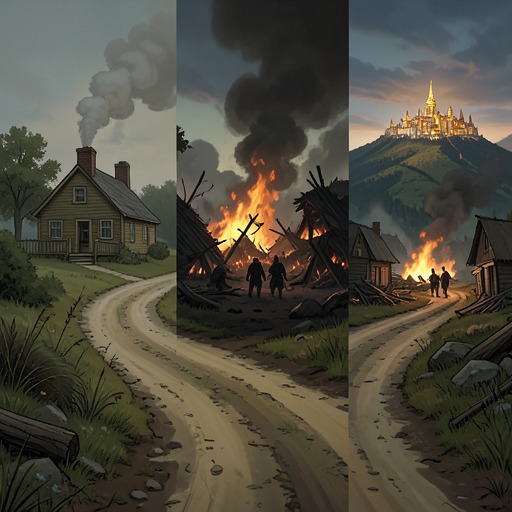
Daret survives because it stands beside the Ninor River, the waterway that sustains the settlement in an otherwise empty landscape. It is described as small and wild-looking, and there are no visible inhabitants when Eragon and Brom approach. The absence is disturbing rather than peaceful. The travelers have already passed through country without signs of habitation since Yazuac, so the village’s silence extends an established pattern of depopulation and uncertainty.
Eragon and Brom enter cautiously, while Saphira hides near the village rather than exposing herself. Her position allows her to reach them within seconds if trouble begins, but keeps her size and sparkling scales from immediately revealing the group’s presence. Brom grips his sword with his uninjured hand, and Eragon keeps his bow partly drawn as they move between the silent houses. Fresh footprints belonging to children offer the only sign that the village is not truly empty, making the stillness more ominous: life is present, but concealed.
The Ambush
The apparent emptiness is revealed as a tactical deception. After Brom finds Daret’s center deserted and decides that they should leave, wagons suddenly topple from behind the houses and block the road. A swarthy man steps over one of them with a broadsword at his side and a drawn bow in his hands. He orders Eragon and Brom to halt and surrender their weapons, declaring that sixty archers surround them; men then rise on the roofs of the nearby houses, confirming that the threat is real rather than rhetorical.
The trap places Eragon in an immediate conflict between self-preservation and the danger of exposing Saphira. He tells her to stay away because too many archers would be able to shoot her from the sky. At the same time, he prepares to use Magic to stop the arrows before they can strike him or Brom. Daret therefore compresses the travelers’ larger predicament into a single tense moment: concealment protects Saphira, but concealment also leaves Eragon and Brom facing an armed force without their strongest ally visibly present.
The encounter does not become a battle. Brom responds calmly by asking what the villagers want, and the confrontation shifts from threatened violence to negotiation. The armed group is not presented as a formal Imperial detachment; its organization instead reflects local resistance and self-protection. The wagons are eventually pulled aside, allowing Eragon and Brom to continue their journey. The village’s defensive strength thus produces a temporary restraint rather than a massacre.
Consequences and Wider Disorder
Once they leave Daret, Eragon reports to Saphira that everything has turned out well, but her response is simmering anger. Her anger registers the danger of the scene and the strain of being deliberately held back while Eragon and Brom faced the archers. The episode therefore affects the bond between the travelers and Saphira even though no one is wounded in the confrontation.
Daret also changes Brom’s understanding of the political situation. As the three companions ride into the trees along the Ninor River, Brom concludes that the Empire is in worse condition than he had imagined. Reports of unrest had reached Carvahall through traders, but the armed defense at Daret suggests that the disturbance is widespread rather than local. The presence of Urgals throughout the region makes the crisis appear even larger: the Empire seems to be under attack from within or across its borders, while no troops or soldiers have been sent to defend it.
Brom finds the absence of Imperial protection especially strange, almost as if Galbatorix does not care to defend his own domain. Eragon agrees that the situation is strange, but the significance of Daret lies in how concretely the village embodies that contradiction. Its people must organize their own surveillance, weapons, rooftops, and barricades, while the ruling power appears absent. The deserted streets are therefore not evidence of helplessness; beneath them is a community alert enough to surround passing riders with sixty archers.
Narrative Significance
Daret functions as a threshold location in the travelers’ southward movement. The companions arrive expecting another silent settlement and instead encounter a hidden collective prepared to control access to the village. The value at stake shifts from threatened life to conditional safety: the road seems to promise danger, then negotiation restores passage, but the travelers leave with their assumptions overturned.
The village’s scene is narrated in ordinary chronological sequence, with suspense built through delayed recognition. Fresh children’s footprints first contradict the apparent abandonment; the empty center then deepens the unease; finally, the wagons and archers reveal that the silence itself has been part of the defense. Daret consequently becomes more than a stop along the route to the Ra’zac. It is a compact image of a country in which ordinary settlements have been forced to become watch posts, and in which the absence of central authority is made visible through the vigilance of local people.