Teirm
EragonTeirm is a major port city on the coast of Alagaësia and the first great urban threshold in Eragon and Brom’s investigation of the Ra’zac. Its apparent prosperity rests on walls, shipping, merchant records, and ocean trade, yet those same commercial structures reveal a darker reality: targeted attacks on ships, the circulation of Seithr oil, and the Empire’s ability to punish merchants who support the Varden. Teirm therefore functions not merely as a destination but as an information hub where geography, commerce, literacy, and resistance intersect.
Setting and Defenses
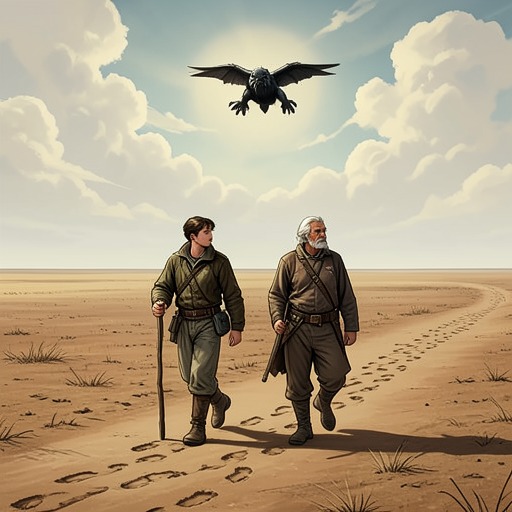
After two days of travel north toward the ocean, Saphira sights Teirm through heavy fog. A western breeze suddenly clears the mist, revealing the city beside the shimmering sea, with proud ships at anchor and furled sails. The first impression is one of scale and enclosure: Teirm stands behind a white wall one hundred feet high and thirty feet thick, pierced by rows of rectangular arrow slits and topped by a walkway for soldiers and watchmen. Two iron portcullises control access, one facing the western sea and the other opening south toward the road. The city’s citadel rises above the northeastern section of the fortifications, built from enormous stones and crowned with turrets. A lighthouse lantern shines from its highest tower, while the castle is the only structure visible over the walls. This arrangement makes Teirm both a harbor and a fortress, a place whose wealth arrives by sea but whose security depends on controlled passage, surveillance, and official custody of information. At the southern gate, soldiers guard the entrance, though their careless handling of their pikes gives Brom and Eragon reason to hope that the authorities have not yet received reports from the Empire.
Commerce and the Seithr Oil Trail
Teirm’s maritime economy has been destabilized by attacks that do not resemble ordinary piracy. Martin explains that, for several months, someone has been attacking ships carrying goods belonging to particular merchants, including Jeod. No captain will accept those merchants’ cargoes, forcing them to send goods overland at greatly increased cost; even those caravans frequently fail to arrive. The attacks are especially damaging because some of the targeted merchants operate among the largest shipping businesses in the Empire. Ships disappear without survivors, leaving no witnesses and encouraging sailors to attribute the violence to magic. This selective destruction turns Teirm’s trade network into evidence. Brom and Eragon have found a flask bearing the Ra’zac’s silver insignia. It contains Seithr oil, a clear, shiny liquid powerful enough to burn through Eragon’s skin, and Brom brings the flask to Jeod as proof that the Ra’zac are connected to a dangerous supply chain. Brom’s plan is to inspect Teirm’s shipping records and trace the Empire’s purchases of the oil, reasoning that the destination of those shipments may disclose the Ra’zac’s lair. The records are not freely available. They are held in Teirm’s castle, where Brand, Risthart’s administrator of trade, has regular access. Merchants such as Jeod are excluded because the authorities fear that they might falsify the figures to evade the Empire’s taxes. The restriction illustrates how commercial knowledge is concentrated in the castle: the same bureaucracy that protects revenue also prevents an independent trader from examining the evidence.
A City of Archives and Investigation
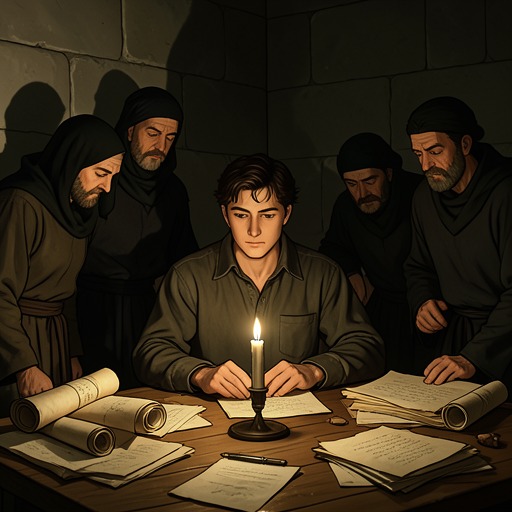
Jeod’s house provides a second, more private center of knowledge. Its shelves contain business records and an exceptional historical volume, The Domia abr Wyrda, known in translation as The Dominance of Fate. Brom identifies it as a rare, comprehensive history of Alagaësia, beginning before the elves arrived and ending only a few decades earlier. The Empire condemned the book as blasphemous and burned its author, Heslant the Monk, so its survival in Teirm gives the city a connection to suppressed history as well as to official trade documentation. Eragon’s inability to read becomes significant in this setting. When he admits that he cannot read, Brom reacts with disbelief and the discovery exposes how much knowledge has been withheld from him, despite Garrow’s ability to read. The city’s investigative purpose thus becomes educational as well as strategic: the pursuit of the Ra’zac is bound to books, records, and the skills required to interpret them. The contrast between oral and written knowledge is emphasized by Brom’s earlier account of the Dragon Riders. At Carvahall, he performs history before a village audience as an old storyteller, using music, narration, costume, and acted scenes to preserve memories of the Riders’ golden age and Galbatorix’s rise. In Teirm, by contrast, history survives in a rare book, ancient-language writing, and commercial archives. The city gathers these competing forms of memory—performance, manuscript, and bureaucratic record—while Eragon moves from being an excluded nonreader toward participation in the written world.
Political Geography and Resistance
Once Jeod obtains the trade information, the investigation becomes a matter of geographical deduction. Shipments of Seithr oil have gone to every major city in the Empire during the preceding five years, apparently ordered by wealthy jewelers. The evidence initially seems too broad to identify a single destination. Brom narrows the possibilities by reasoning that the Ra’zac must be able to travel wherever Galbatorix commands, while remaining inconspicuous and supplied with unusual provisions. A large crossroads with extensive trade would best serve them. That reasoning eliminates Teirm as the likely refuge, even though Teirm is large and commercially important. Brom and Jeod conclude that Teirm is not the Ra’zac’s base, while Gil’ead remains the strongest candidate among the northern cities. Teirm’s importance therefore lies partly in what it rules out: the city is an investigative waypoint whose records redirect the search inland rather than ending it at the port. Teirm is also linked directly to the Varden’s clandestine economy. Jeod smuggles supplies to the Varden through Surda, and Ajihad later explains that Jeod’s business has been nearly destroyed because merchants who support the Varden suffer the same fate as the targeted ships. Every vessel associated with the resistance disappears, while the Empire somehow learns which merchants are helping its enemies. Teirm’s sea trade consequently becomes a battlefield without an open army: economic pressure, selective violence, and intercepted messages expose a suspected traitor or traitors within the Varden’s wider network.
Narrative Significance
Teirm marks a decisive transition in Eragon’s journey from local danger to systemic conflict. The Ra’zac are no longer only the killers who destroyed Garrow’s home; their movements can be pursued through a flask, a commodity, warehouses, palaces, shipping ledgers, and the political geography of the Empire. The city makes the enemy legible through infrastructure. Its walls show the visible face of authority, while its records reveal the hidden circulation of power. The city also joins the book’s recurring concern with how the past and the present are preserved. Brom’s storytelling gives fragmented memory a living audience; The Domia abr Wyrda preserves a history the Empire tried to erase; and the trade records convert routine transactions into clues about state violence. Teirm stands where these forms of knowledge meet. Its harbor promises movement, its fortifications impose control, and its archives allow resistance to transform scattered signs into a coherent pursuit.