Du Weldenvarden
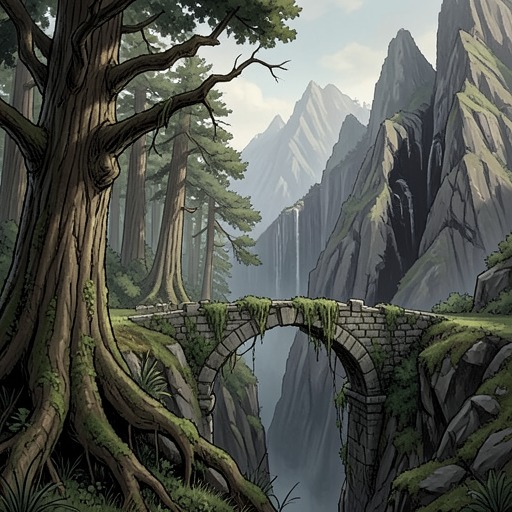
EragonDu Weldenvarden is an immense forest in Alagaësia and the hidden homeland of the elves. Its mapped western edge lies across the plains from Carvahall and Palancar Valley, while its eastern reaches remain unknown. The forest is not merely a geographical setting: it represents the elves’ withdrawal from the wider world, preserves knowledge unavailable to humans and dwarves, and becomes central to the political and military balance between the Varden and Galbatorix’s Empire.
Setting and Boundaries
Du Weldenvarden extends across a region so large that its eastern end is unmapped. Its western edge has seen some settlement, but its heart remains mysterious and unexplored. Eragon’s map places it level with Carvahall, across the plains from the village at the northern end of Palancar Valley, making the forest both geographically close to his home and culturally remote from it.
The forest is described as wilder than the Spine. The few people who venture into its depths may return raving mad, or may never return at all. This reputation gives Du Weldenvarden a double character: it is a real territory with identifiable edges, yet its interior exceeds the knowledge and control of the societies that surround it. The blank spaces on the map are therefore part of its meaning. They show not an empty land but a domain whose depth has resisted outside exploration.
The Elves’ Hidden Realm
The deepest reaches of Du Weldenvarden contain the cities of the elves. Ajihad explains that these cities lie far to the north, within the endless forest, and that the elves guard their location jealously. He does not even know how to find Ellesméra, the principal elven city named in his account. The secrecy surrounding the cities reflects the elves’ deliberate separation from humans and dwarves rather than simple geographical isolation.
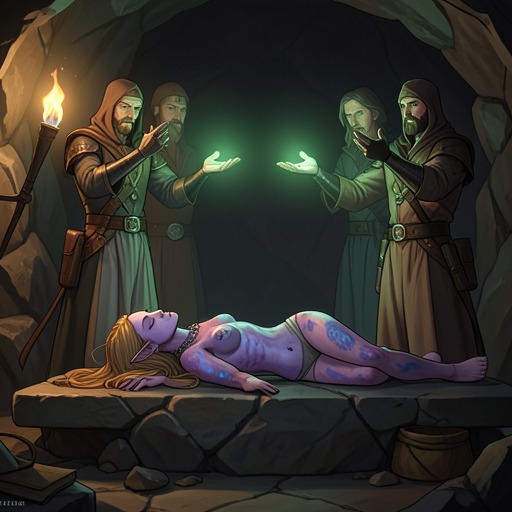
Since the fall of the Riders, the elves have retreated into seclusion. They speak the Ancient Language, and many of them can use Magic; yet none had been seen in the Empire for generations before Eragon encountered Arya. Du Weldenvarden thus shelters a people associated with the older history of the world, while remaining largely inaccessible to the communities that now struggle under Galbatorix’s rule. Its forests function as a refuge for memory, learning, and powers that survived the destruction of the Riders.
Arya, the Egg, and Magical Barriers
Du Weldenvarden is also connected to the beginning of Eragon’s story through Arya’s attempt to protect Saphira’s egg. Ajihad explains that the elven realm is protected by arcane barriers that prevent anything from entering its borders through magical means. When Arya was in danger and unable to return the egg to the Varden, she therefore could not simply send it back to the elves’ territory.
In desperation, Arya sent the egg toward Carvahall after thinking of Brom. The transfer was imprecise, and the egg arrived near Palancar Valley rather than at the Varden. This accident brought the egg to Eragon and led to Saphira’s hatching and bond with him. Du Weldenvarden consequently stands at the hidden origin of the Dragon Rider’s return: its defensive barriers prevented a safe magical return, and that failure redirected the egg into the human world.
Political and Military Significance
Arya’s disappearance damaged relations between the elves and the Varden. When she vanished, the elves withdrew their support, and Queen Islanzadi refused further contact with Ajihad. Without elven supplies, the Varden fared badly in its skirmishes with the Empire. Arya’s rescue by Eragon and Murtagh therefore has consequences extending beyond the recovery of one prisoner. Her return may ease the queen’s hostility and reopen the alliance between Du Weldenvarden and the Varden.
The forest’s seclusion also explains why the Varden knows so little about the elves. Ajihad cannot identify the route to Ellesméra, and he can only speculate that Osilon lies near the western edge of Du Weldenvarden, toward Carvahall, based on the place where Arya disappeared. The uncertainty makes the forest a political power precisely because it does not fully participate in the ordinary systems of imperial surveillance and military control.
Narrative Significance
Du Weldenvarden repeatedly contrasts protected communities with exposed ones. The Varden gathers in Farthen Dûr under the threat of an Urgal assault, while the Empire asserts its authority through military pressure and propaganda. Du Weldenvarden offers another model: a guarded, ancient realm whose strength depends on distance, secrecy, and barriers rather than open dominion. Its unseen interior sustains both wonder and apprehension.
The forest also embodies the book’s recurring image of a world whose deepest structures remain hidden beneath visible conflict. Human travelers can identify Carvahall, the Empire, and the roads between them, but Du Weldenvarden interrupts that confidence with unmapped territory and stories of people who lose their sanity or disappear within it. Its significance lies not only in what the narrative reveals about the elves, but also in what the forest continues to withhold: a living remainder of the older world, adjacent to the known map yet resistant to possession.