Farthen Dûr
EragonFarthen Dûr is a concealed volcanic crater whose immense scale and hidden infrastructure make it both a sanctuary and a battlefield. Entered through a monumental passage in the cliff, it houses Tronjheim, the dwarves’ marble city-mountain and the center of Varden power. Its apparent inaccessibility offers protection, but the tunnels beneath it expose the limits of that protection when an Urgal army advances underground.
Hidden Entrance and First Revelation
Farthen Dûr first appears beyond two stone doors twelve feet thick, which open in a cliff to reveal a broad tunnel nearly thirty feet high. Flameless lamps cast a pale sapphire light through the passage and onto the lake outside, giving the entrance an otherworldly character while also emphasizing that the approach is engineered, guarded, and buried within the mountain.
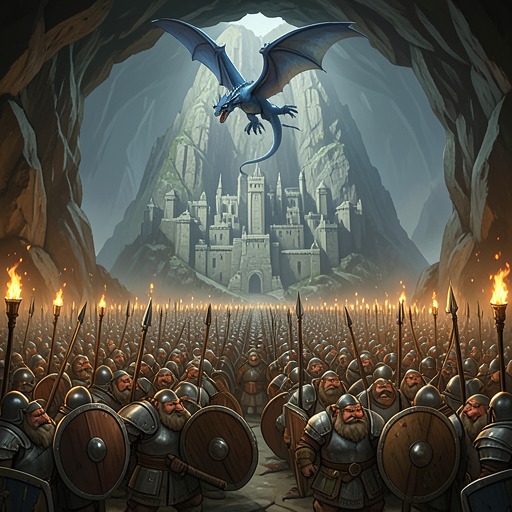
The passage leads into a massive volcanic crater. Its walls rise toward a small, ragged opening so distant above that Eragon cannot judge whether it is more than a dozen miles away. A narrow beam of sunlight reaches the center, while most of the cavern remains in subdued twilight. The crater’s far side appears nearly ten miles away, and enormous icicles—hundreds of feet thick and thousands of feet long—hang from the heights like suspended blades. Moss and lichen cover portions of the lower inner walls, reinforcing the impression of a vast natural chamber whose dimensions exceed ordinary human scale.
Tronjheim and Dwarven History
A wide cobblestone path runs from the tunnel threshold directly to the crater’s center, ending at the base of a snowy-white mountain that shines with thousands of colored lights. Though it seems small against the crater, the mountain rises slightly more than a mile. It is Tronjheim, a city built from the purest marble and described by Orik as the dwarves’ greatest achievement.
Orik explains that the crater itself is Farthen Dûr, discovered thousands of years earlier by Korgan, the father of the dwarven race, while he was tunneling for gold. The site therefore joins geology, ancestral memory, and political power in one setting: what appears from outside to be an inaccessible natural hollow is also the monumental product of dwarven settlement and labor. Its concealed entrance and immense interior allow the place to function as a hidden homeland, while Tronjheim gives that homeland a visible and imposing center.
A Threshold of Witnesses
When the doors open, Eragon and Saphira are confronted by a dense crowd gathered around the tunnel entrance. Dwarves and humans line the cobblestone path in numbers reaching into the hundreds or thousands, and every face is turned toward them in silence. The scene makes Farthen Dûr not merely a geographical discovery but a public threshold: Eragon crosses from the exposed world outside into a community that has been waiting to judge, receive, or scrutinize his arrival.
The mixture of dwarves and humans also establishes the crater as a place of alliance. Its importance is measured not only by the city at its center but by the population assembled around its entrance and by the presence of the Varden. The solemn attention directed toward Eragon and Saphira reflects the exceptional significance of a Dragon Rider entering a place where no Rider has been seen for more than a hundred years.
The Hidden Threat Beneath the Refuge
Farthen Dûr’s security proves incomplete when a dwarf emerges from an abandoned tunnel under Tronjheim, bleeding and nearly incoherent. He reports that an army of Urgals is pursuing him and may be only a day’s march away. The news changes the meaning of the subterranean setting: the tunnels that helped conceal and protect the city can also provide an invasion route.
Ajihad gathers Eragon, Arya, Orik, Jörmundur, and others in his study to confront the danger. He clarifies that the Urgals are not approaching overland; they are moving through the tunnels beneath Tronjheim and will attack from below. The revelation turns Farthen Dûr from a hidden stronghold into a threatened enclosure. Its walls may be nearly unreachable from above, but its buried passages connect it to the enemy in precisely the dimension that seemed to guarantee safety.
Narrative Significance
Farthen Dûr embodies the double nature of refuge in the story. Its crater, hidden doors, pale lamps, colossal distances, and marble city produce awe through a landscape that dwarfs individual bodies and ordinary measures. Yet the same enclosed architecture creates vulnerability: an enemy need not breach the visible walls if the foundations and tunnels can be used against the inhabitants.
The location also marks a decisive passage in Eragon’s journey. He enters as an outsider watched by a silent multitude and discovers a civilization whose history reaches back thousands of years. Almost immediately, however, the place’s grandeur is placed under military pressure. Farthen Dûr therefore joins revelation and crisis: it is the concealed heart of resistance, the home of Tronjheim, and the underground threshold through which the coming war enters.