Yazuac
EragonYazuac is a small settlement beside the Ninor River, but its narrative significance lies not in its size or geography. When Eragon and Brom reach it while pursuing the Ra’zac, they find a deserted village and a public mound of slaughtered bodies. Yazuac becomes the place where distant political violence acquires an immediate human face, forcing Eragon to confront the vulnerability of entire communities and the moral cost of the conflict surrounding him.
Setting and Approach
Yazuac lies four days east across the plains from the travelers’ route and is identified as their destination when Brom studies the tracks of the Ra’zac. The village stands by the Ninor River, while the Anora River lies behind the travelers and supplies the water needed for the crossing. Because no other pool or stream exists between the Anora and Yazuac, the settlement is both a navigational objective and a necessary point of survival on the journey.
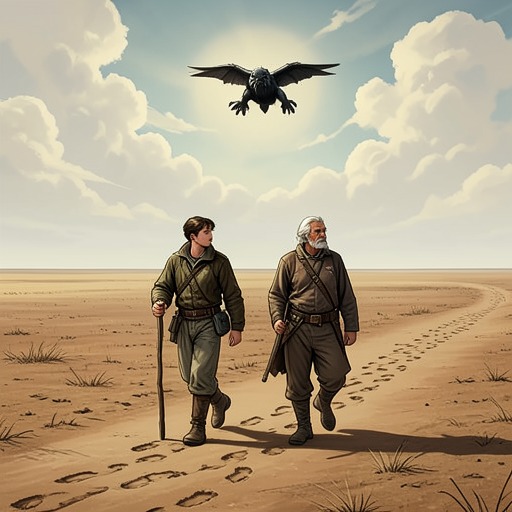
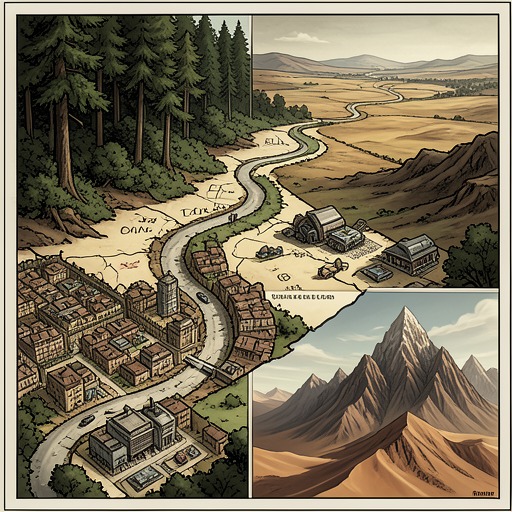
The approach emphasizes how exposed the travelers feel. The plains are so flat that Eragon, accustomed to mountains and hills, feels vulnerable beneath the open sky. The trail divides toward Ceunon, across the plains, and southward; after examining the branches, Eragon and Brom find the Ra’zac’s tracks leading toward Yazuac. Brom trusts the stars and sun rather than the visually featureless landscape, and his confidence proves justified when Saphira sees the village first, with Eragon and Brom recognizing it later as a dark mark on the horizon. The Ninor River then appears as a winding line on either side of the town.
The Village Before the Massacre Is Found
Brom treats the main entrance as a possible ambush site and deliberately avoids approaching from the expected direction. Eragon and Brom circle to the side, armed and cautious: Brom carries his unsheathed sword across the saddle, while Eragon strings his bow and prepares an arrow. Their methodical entry contrasts sharply with the emptiness awaiting them.
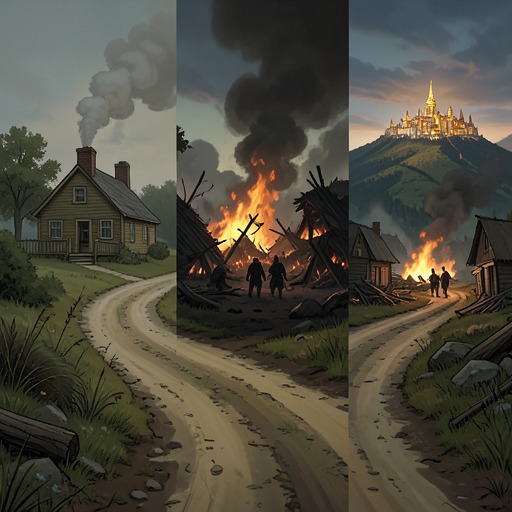
The streets are deserted except for a fox that darts away. The houses are dark and threatening, their windows shattered and their doors hanging from broken hinges. Even the horses respond nervously, and Eragon feels a tingling in his palm while resisting the impulse to scratch it. These details make Yazuac appear not merely abandoned but violated. The village gives no account of what happened; its broken architecture and animal silence serve as the first incomplete testimony.
The Massacre
At the center of Yazuac, Eragon and Brom discover a mountain of bodies. The corpses are rigid and grimacing, their clothing soaked in blood, while the ground beneath them has been churned and stained. The dead include men who fell over women they attempted to protect, mothers still holding their children, and lovers who died shielding one another. Black arrows protrude from the victims, and neither the young nor the old has been spared.
The most horrifying image is a barbed spear rising from the summit of the pile and impaling a white-bodied baby. The arrangement turns the dead into a visible monument to indiscriminate violence rather than a collection of private deaths. Yazuac’s population has not simply vanished; it has been assembled into a spectacle that makes the destruction impossible to overlook.
Eragon’s response gives the scene its emotional and ethical force. Tears blur his vision as the dead faces hold his attention, and he feels overwhelmed by hopelessness at how easily life can end. When a crow descends and perches on the spear, scrutinizing the infant’s corpse, Eragon shoots it. He prepares another arrow, but nausea overtakes him and he vomits over Cadoc’s side. His action is small and powerless against the massacre, yet it marks his refusal to let the corpse be treated as mere carrion. The gesture also reveals the limits of his ability to absorb what he has witnessed.
Narrative Significance
Yazuac is where the journey’s pursuit of the Ra’zac becomes inseparable from the wider history of Alagaësia. Before this discovery, Eragon has heard about the Dragon Riders through Brom’s public storytelling: the Riders once protected the land, preserved peace, and helped create a prosperous golden age, but their power eventually collapsed through internal betrayal. Brom’s account frames history as something recovered from fragments and memory, while Yazuac presents a new kind of historical evidence—bodies, ruined homes, arrows, and a spear.
The village therefore stands between oral memory and material proof. Brom’s stories describe the distant destruction of the Dragon Riders and the rise of Galbatorix; Yazuac shows Eragon what organized violence does to ordinary people in the present. The contrast is reinforced by the book’s recurring concern with who can preserve the past. Eragon initially cannot read, even though Brom has begun teaching him, while written works such as The Domia abr Wyrda preserve contested histories of Alagaësia. Yazuac requires no literacy to be understood, but its meaning is still fragmented: the dead reveal the scale of the crime without explaining every agent or motive.
The settlement also anticipates the larger political struggle by showing that the conflict is not confined to rulers, Riders, or armies. Women, children, lovers, and infants are among the victims, and the black arrows make the massacre legible as deliberate attack rather than accident. Yazuac changes Eragon’s relation to danger: pursuit is no longer an abstract trail across a plain, because the trail ends in a community erased and displayed. As a location, Yazuac remains a small riverside village; as a narrative landmark, it is the point where history’s violence becomes physically undeniable.