Brian Davies
AfterburnBrian Davies, a Sonarman First Class aboard USS Orlando, is the crew’s human instrument for interpreting an underwater contact. His scenes make sonar more than a display of signals: the crucial evidence arrives through a listener whose concentration is acute, whose information is incomplete, and whose conclusions must be revised as the sounds change.
Identity and Role
Davies appears in the sonar shack and control room of USS Orlando during the submarine encounter in the Black Sea. He reports what he hears to the captain and is addressed by Commander Peter Lang, who finds him absorbed in his work. The available scenes do not establish a personal history beyond his rank and duties; instead, they define him through the demanding act of listening and translating sound into information the crew can use.
That role puts Davies between the contact and the decisions made about it. He does not control what the other vessel does, and he cannot always identify its intentions. His contribution is to report the changing evidence as faithfully as he can, even when the answer is uncertain or unwelcome.
Listening to the Contact
At 1635 hours, with the time given as Zulu plus three, Davies reports that the contact is turning right. The underwater sound also appears as a visual trace on the sonar display, known among submariners as the waterfall, but Davies trusts his ears and brain. With his eyes closed and his fingertips lightly pressing the headphones to his ears, he concentrates on the sound itself. The posture makes his work seem almost visual: he listens so intently that the vessel ahead feels as though it could be seen through sound.
That absorption is not presented as effortless certainty. Davies is losing himself in the hiss and churn coming through the headset when Peter Lang appears at the entrance to the sonar shack and calls his name. Davies looks up, startled, then answers. The interruption briefly brings the listener back into the room; until then, his attention has been directed toward a contact that remains physically unseen.
Sound, Interference, and Uncertainty
As the encounter intensifies, the crew prepares tubes one and three with ADCAP standard war shots. A young seaman’s voice reports their readiness, and the captain turns to Davies for an assessment of what the contact is doing. Davies cannot tell clearly: the pinging interferes with his ability to hear it. The exchange places the limits of his expertise in plain view. He is responsible for interpreting the signal, but the conditions of the encounter can obscure precisely the evidence he needs.
The uncertainty matters because his report is being sought while the crew is preparing to act. Davies does not turn a poor signal into a confident account. His answer acknowledges the interference, preserving the distinction between what the crew wants to know and what he can actually hear. In this scene, the sonar operator’s restraint is part of his professional function: uncertainty is itself information.
Break-Up Noises and Reversal
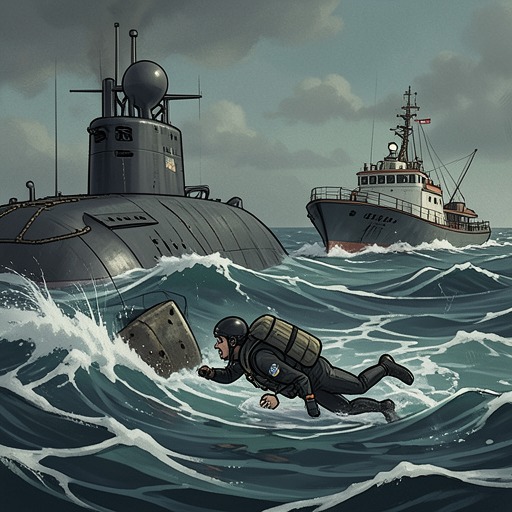
At 1759 hours, Davies reports break-up noises from the contact. The surrounding control room is loud with the crew’s cheering, so he presses the headphones against his ears to shut it out and listen harder. The sound has been described as Kislovodsk’s death cry, the shrilling of steel tearing like cloth; Davies’s report supplies the operational recognition of that apparent destruction from inside USS Orlando.
The interpretation does not settle the encounter. Asked whether the contact is going down, Davies first answers, “Up, I think.” He listens for another moment, then confirms that it is rising. The captain acknowledges that they may have jumped the gun. The reversal is small in wording but consequential in meaning: break-up noises have prompted the expectation of a sinking, while Davies’s continued listening indicates that the vessel is instead moving upward. His report keeps the crew’s initial certainty from becoming the final account.
Narrative Significance
Davies’s brief appearances organize the encounter around the difference between a signal and an interpretation. A turn, masked sound, apparent breakup, and upward movement reach the crew through his reports, but each carries some degree of uncertainty. The novel’s movement between the visual waterfall and Davies’s closed-eyed concentration reinforces that tension: the display offers a visible pattern, while the operator’s trained hearing remains indispensable—and fallible under interference.
His scenes also counter the control room’s emotional momentum. Cheering follows the apparent destruction of Kislovodsk, yet Davies has to listen through it and report what the sound actually suggests. When his answer complicates the assumption that the submarine is sinking, the character’s importance lies not in a dramatic speech but in sustained attention. The encounter’s meaning depends, moment by moment, on whether the crew can distinguish what it hopes has happened from what the sonar can support.