Matthew Magruder
AfterburnMatthew Magruder is the air-group commander known as Tombstone, responsible for CVW-20 aboard the nuclear-powered aircraft carrier USS Thomas Jefferson. Introduced on the bridge as the carrier approaches the Bosporus Strait, he is both a participant in the battle group’s operational planning and a working officer facing the immediate uncertainties of its passage. The glimpses of him connect the practical vulnerability of a carrier moving through narrow waters to the wider, politically contingent mission for which the force has been sent there.
Identity and Command
Magruder is identified as CAG, the commander of CVW-20, the air wing assigned to the USS Thomas Jefferson. The narrative distinguishes him from the carrier’s commanding officer: Magruder looks out from the bridge, turns toward that officer, and exchanges banter with him. His senior aviation role places him in the carrier’s planning process, but does not make him the ship’s captain. This distinction matters in scenes where the bridge serves as the meeting point between the ship’s command and the air wing’s responsibilities.
His call sign, Tombstone, is used alongside a relaxed, teasing manner in conversation with the commanding officer. On the bridge, he first responds dubiously to the situation beyond the forward windscreen, leaning toward it to look across the flight deck at the gray water. He then turns from the view and joins the joking exchange. The shift from watchful attention to banter gives the scene a small but telling contrast: the humor takes place within, rather than outside, the carrier’s exposed operational setting.
Magruder’s familiarity with the deployment is also part of his command identity. As CAG, he has attended the battle group’s planning sessions and knows the logistical and deployment rationales by heart. Planning is not merely background information for him; it is knowledge acquired through repeated participation in decisions about how the force will move and what it is expected to accomplish. Later, when the carrier’s operations officer comes onto the bridge with a printout, the exchange places Magruder in the flow of information reaching the command team, though the available scene does not specify what the document contains.
The Passage through the Bosporus Strait
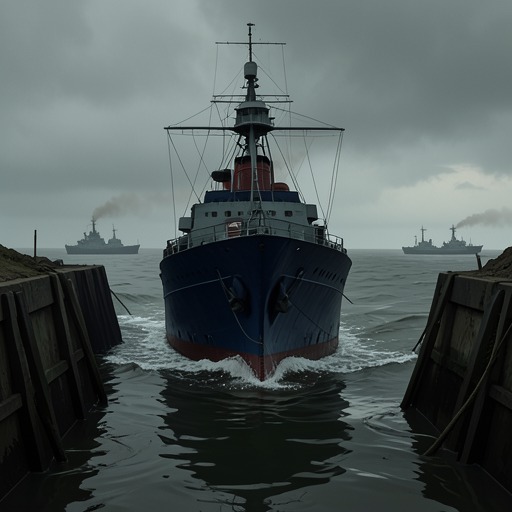
The opening bridge scene locates Magruder aboard the USS Thomas Jefferson as the carrier proceeds through the Bosporus Strait. The view from the slanted forward windscreen runs over the ship’s forward flight deck to the gray water ahead. The setting makes the scale and exposure of the vessel tangible: the carrier is moving ponderously through a narrow passage, and the battle group’s staff hopes its arrangements will protect it as it goes. Magruder’s position on the bridge gives him a direct view of that constrained movement, while his knowledge of the planning places him inside the decisions behind it.
The banter between Magruder and the ship’s commanding officer does not erase the tactical concern surrounding the passage. Jeremy Brandt asks whether Magruder wishes he were on a smaller target. Magruder begins an answer and gestures toward the view, an exchange that keeps the carrier’s conspicuous size in focus without turning the scene into a formal briefing. The battle group has no friends in these waters and cannot rely on anyone else, so its protection depends on its own arrangements. The humor thus sits against a concrete strategic problem: a large ship must travel through a restricted route in waters where the force has little external support.
Mission and Political Stakes
The carrier’s voyage is tied to a larger effort to secure victories that might open the way to a United Nations-brokered peace throughout the Russian Federation. The USS Thomas Jefferson and its battle group are sent into what the narrative characterizes as a landlocked potential death trap; arrangements have also been made to move Marine Expeditionary Unit 25. The juxtaposition is central to Magruder’s setting in the story: the air wing’s work is embedded in a mission whose declared political ambition is much wider than the immediate problem of getting the carrier safely through the strait.
Operation Sustain Hope is presented against the precedent of Operation Restore Hope, the United Nations-backed Marine operation in Somalia from 1992 to 1994, described as abortive and expensive. The comparison gives the new operation a history of costly intervention rather than a guarantee of success. Its planning is also conditioned by Turkey’s refusal to allow foreign military forces to be based on Turkish soil. These constraints help explain why deployment logistics and routes occupy so much attention: the force must pursue its mission without assuming that a nearby state will provide a base.
The carrier group’s political importance becomes explicit in a later discussion of a possible surrender by General Boychenko to the United Nations. Herb Waring asks whether the general would surrender only if the United Nations agreed to include the carrier battle group in the arrangement. That exchange does not describe a decision made by Magruder, but it shows how the force he commands as CAG can become part of a diplomatic bargain as well as a military deployment. The battle group’s presence is therefore both operational and political, making its deployment a matter of negotiation beyond the bridge.
Changing Command Context
The battle group’s orders continue to change as the situation develops. At a briefing, Admiral Tarrant announces new orders from Washington and says the group will be redeployed to extend its operational area north. This movement places the force within a shifting chain of command and mission definition: the deployment Magruder knows from planning is subject to revision by higher authority. The scene establishes a change in the group’s tasking, although it does not specify Magruder’s individual response or the operational details of the new area.
Later, Coyote hesitates when addressed officially as CAG, indicating that the title is now being applied to another figure in the narrative. This provides a later contrast with Magruder’s established command role, but the episode does not depict a handover or explain when or why the change occurred. Magruder’s documented arc is consequently clearest in the responsibilities he holds during the carrier’s early passage: he is a seasoned participant in planning, an air-wing commander within a vulnerable naval force, and an officer whose operational world is repeatedly reshaped by political decisions.