Willis E. Grant
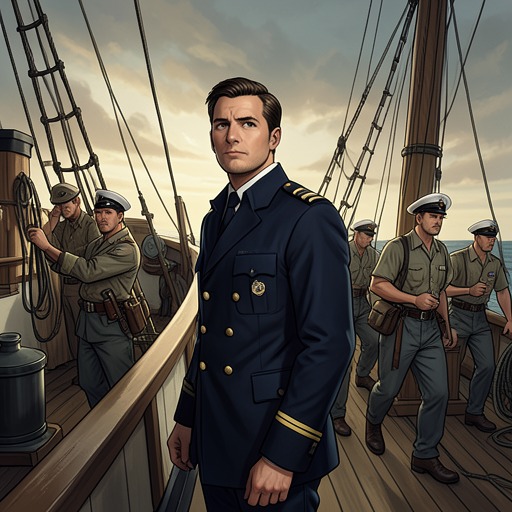
AfterburnWillis E. Grant, known as Coyote, is a veteran naval aviator and Tomcat squadron commander whose brief but consequential appearances show command as a succession of decisions made with incomplete information. On the Thomas Jefferson, he moves between the flight deck, operational control, and the carrier’s daily routine; in each setting, responsibility means acting before uncertainty has cleared. His scenes also place that responsibility beside a recurring institutional danger: the consequences of armed forces operating without a shared picture of who is where and why.
Identity and Command Experience
Grant had commanded a Tomcat squadron for nearly two years by the time a new development came in from the Bird Dog patrol. He had been an aviator far longer, and the narrative presents rapid decision-making and personal responsibility as ordinary parts of his work rather than exceptional burdens. When the report arrives, he is handling the morning’s situation until Magruder can arrive and take over. The sequence makes his position clear: he is not simply receiving information but serving as the officer expected to judge what it requires.
His authority is framed through concrete routines. On the carrier’s flight deck, Grant straps on a safety helmet, or cranial, before stepping out of the Mangler’s O-4 compartment. The detail locates command within the physical procedures of flight operations: before action comes preparation, and even a senior officer must enter the working environment equipped for its hazards. At another point, his own watch is due at 2000 hours. The exchange about the watch and the interruption of a planned meal give his duty a schedule, but not a predictable rhythm.
The Carrier and Its Immediate Pressures
Grant’s working world is the Thomas Jefferson, where air operations and the condition of the battle group shape what commanders can do. A modern carrier requires replenishment of expendables every two to three weeks. Although the ship is nuclear-powered and does not need fuel for its own propulsion, its aircraft consume aviation fuel; in an intense flying schedule, the available supply could last no more than ten days. The group depends on replenishment tankers following it at sea. These constraints make the carrier’s power conditional: its aircraft can extend the group’s reach, but only while supplies and access endure.
That dependence becomes more acute when the Bosporus is closed. With round-the-clock flight operations and maneuvering, the remaining margin could fall to two to four days; afterward, the Jefferson and its escorts would be trapped in the Black Sea with too little fuel to remain useful. In a later discussion of how to resupply the force, Magruder distributes estimates to the officials considering the problem. Grant’s scenes do not make him the author of those strategic decisions, but the operational setting around him shows what they mean at deck level. A carrier’s readiness is not an abstraction when aircraft must keep flying and the route out can close.
Bird Dog and the Burden of a Decision
When a new report arrives from the Bird Dog patrol, Grant is at operations with Lieutenant Chadwick and the large screen. His experience is relevant precisely because the situation is developing: he has to manage it before Magruder’s arrival, not after a complete account has been assembled. Later, on the radio, he checks whether Dixie is still with him. Tom Mason answers as Bird Dog Two. Grant relays that the patrol has weapons free, while also directing it to mark its targets. The combination matters. The aircraft are authorized to use force, but identification remains an explicit part of the order.
The narrative links such decisions to the uncertain nature of combat information. In a separate submarine encounter aboard the battle group, the rule to fire only if fired upon is described as unsuitable to submarine warfare: waiting for the enemy’s first shot could allow a torpedo to sink or cripple the Jefferson. The immediate evidence there is what a sonar operator can hear in churning, echoing water. The episode does not assign that submarine decision to Grant, but it clarifies the kind of command environment his scenes inhabit: restraint, identification, and survival may pull in different directions when the available warning is incomplete.
Misidentification and Institutional Failure
Grant thinks of a 1994 incident in which U.S. Air Force fighters destroyed two Army helicopters in the no-fly zone over northern Iraq. The comparison places a contemporary danger within a history of friendly fire: modern electronic systems have not removed the possibility that one American force will mistake another for a threat. The remembered episode sharpens the stakes of the Bird Dog patrol’s weapons-free status. Marking targets is not a procedural ornament when a mistaken identification can turn authorization into catastrophe.
The coordination problem becomes explicit in a discussion of the helicopters’ IFF. The explanation is that the naval force had not been told that two Army helicopters were being sent into Georgia to work with the UN team. The failure is therefore not presented simply as a defective instrument: the units lacked information about one another’s mission. A later briefing makes the public consequence plain. Secretary Reed tells the room that, two days earlier, a Navy jet had shot down a U.S. Army helicopter flying a UN mission. Grant is not identified as the pilot or as the person responsible for that shootdown. His relevance lies instead in the operational world the episode exposes, where permission to fire, equipment for identification, and communication between services must work together—and where a break in that chain can reach far beyond the cockpit.