Edward Everett Wayne
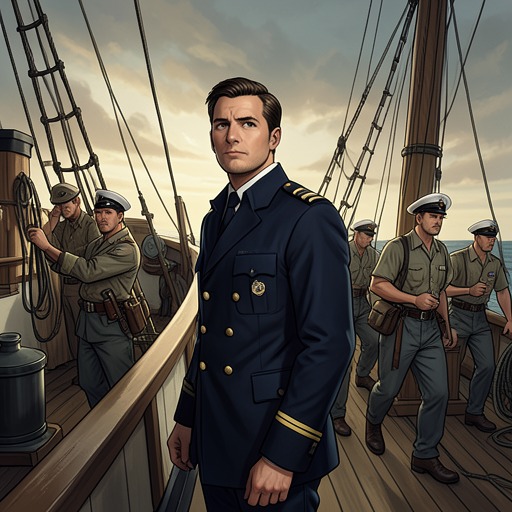
AfterburnEdward Everett Wayne, known as Batman, is a naval aviator serving aboard the carrier Thomas Jefferson. In the available scenes, his work moves from an early-morning carrier launch to a patrol over the Black Sea, where an unidentified aircraft inside the no-fly zone and a breakdown in communication about friendly helicopters make identification as important as interception. Through Wayne’s cockpit, the wider United Nations mission appears not as a settled plan but as a chain of operations in which the aircrew may not possess all the information needed to act safely.
Identity and Flight Role
On Saturday, 31 October, Wayne completes an aircraft checkout on the flight deck of U.S.S. Thomas Jefferson. He is strapped into F-14 Tomcat number 201, parked in the shadow of the ship’s island, and has just brought both engines online when his radar intercept officer gives clearance to roll. The scene establishes Wayne through the procedures and equipment of carrier aviation: the aircraft is prepared, the crew is in position, and departure depends on a sequence of checks and authorizations.
His callsign, Batman, is also the name by which other aircrew address him. Malibu is in the back seat during the launch and later speaks with him during the Black Sea patrol. These exchanges show Wayne working as part of a two-person cockpit crew rather than as an isolated pilot; information and decisions pass between the front and rear seats as the situation develops. The exchange before launch is informal, but the flight itself quickly places the crew in a demanding operational setting.
Launch and the Problem of Control
At the launch point, the light beside the carrier’s island changes to green. Malibu calls the signal, and Wayne responds as the Tomcat moves forward. The scene’s quick transition from aircraft checkout to launch gives the sequence its disciplined momentum: a cockpit conversation yields to the external signal that makes action possible. Wayne’s readiness is not simply a matter of personal confidence; it is nested inside the carrier’s launch procedure and the coordination between crew and deck personnel.
The flight also gives the book a concrete counterpart to Wayne’s reflections about control. He has been thinking about control in relation to his future, while his professional life depends on aircraft systems, other people’s actions, and correctly sequenced procedures. The contrast does not resolve his private concerns, but it places them beside a form of control that is necessarily shared: even a skilled pilot relies on a chain of people and systems beyond the cockpit.
Black Sea Patrol and Identification
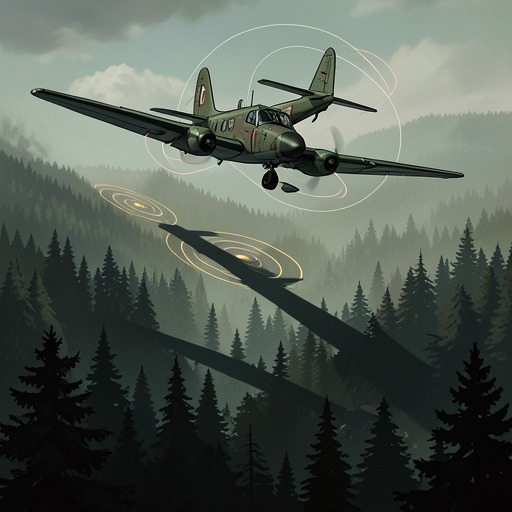
During the patrol, Wayne holds the Tomcat at 25,000 feet, about ninety miles off the Black Sea coast. Malibu reports a contact inside the no-fly zone, assessed as a probable helicopter, and says that Watch Dog is vectoring the crew toward it. Wayne acknowledges the report and opens the tactical frequency to communicate with Mason. The encounter is initially framed as a problem of locating and identifying a contact, not as a confirmed engagement.
That distinction matters when Wayne asks what happened to the helicopter’s identification friend-or-foe system. The answer is that, as far as the crew can tell, nobody informed them that two Army helicopters had been sent into Georgia to work with the United Nations team. The episode turns a technical question into an organizational one: an aircraft’s identity cannot be established reliably through equipment alone when relevant operational information has not reached the people in the air. Wayne’s concern is therefore not merely that an IFF system may have failed; it is that the aircrew’s picture of the mission is incomplete.
The Mission Around Him
The carrier group’s presence in the region belongs to a larger political and military effort. The narrative describes the Thomas Jefferson and its battle group as sailing into a landlocked potential death trap because victory in the affected nations might open the way to a United Nations-brokered peace throughout the Russian Federation. A Marine Expeditionary Unit had already been arranged for the operation. The scale of that objective contrasts with Wayne’s immediate work, which is conducted in the narrow terms of altitude, bearing, contact, and identification.
The proposal, called Operation Sustain Hope, is compared in the narrative to Operation Restore Hope, the abortive and expensive Marine operation undertaken at the United Nations’ behest in Somalia from 1992 to 1994. The comparison places the new mission under the shadow of an earlier intervention that failed at great cost. Wayne is not shown making policy or explaining the operation’s aims; instead, his flight scenes register what a broad political undertaking means for its operational personnel, especially when coordination fails at the level of basic air-traffic awareness.
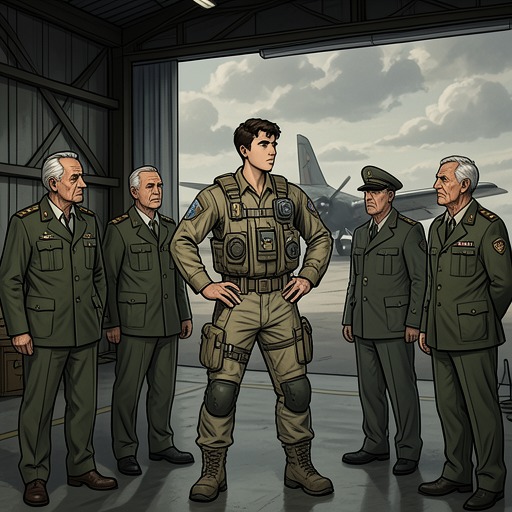
The wider command picture continues to change around the battle group. Admiral Tarrant announces new orders from Washington that will redeploy it and extend its operational area north. Elsewhere, officials discuss a possible surrender by General Boychenko to the United Nations on the condition that the American carrier battle group be part of the arrangement. These developments establish the political stakes and shifting mission context, but the available scenes do not show Wayne’s reaction to the orders or place him in those policy discussions. His defined role is the aviator at the point where strategic decisions meet uncertain contacts in the air.