Sergei Andreevich Boychenko
AfterburnSergei Andreevich Boychenko is the de facto military ruler of the Crimean Peninsula, a commander whose pivotal act is to offer its military control to the United Nations. The offer grows out of a stark assessment of Crimea’s isolation: support from Novgorod has brought men and supplies, but not enough to avert defeat. In proposing a transfer, Boychenko seeks to save the peninsula for Russia by entrusting its immediate future to an international authority—a contradiction that defines both his political predicament and the intervention that follows.
Identity and Position
Boychenko holds command in the Crimean Military District and is described as the peninsula’s de facto military ruler. His authority is thus not merely a formal rank: he is the figure positioned to negotiate what happens to Crimea. The narrative introduces him at his office in Sevastopol, where Vice-Admiral Nikolai Sergeivich Dmitriev comes at Boychenko’s summons. The meeting’s setting gives the decision a conspicuously personal as well as military context.
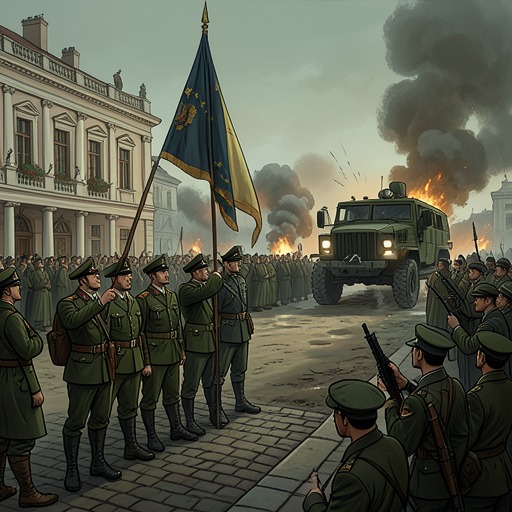
The office is ornate and luxurious, paneled in dark red wood and furnished with an elaborate parquet floor. The description connects this display to Boychenko’s reputation: he is not known for restraint in spending. That detail does not explain his political choices, but it places the commander amid visible privilege while the military and political position he commands is deteriorating. Outside the office, the reported contrast between clustered Ukrainian flags north of the Crimean isthmus and the few red flags opposing them makes the weakening position tangible without requiring Boychenko to spell it out.
The Crisis in Crimea
During the meeting, Boychenko tells Dmitriev that word has come from the Kislovodsk. The news is serious enough to make Dmitriev sit straighter and nearly spill his drink. The scene does not treat the report as incidental business: Boychenko raises it before turning to the question he has summoned Dmitriev to discuss, placing the military news inside a wider crisis of authority and allegiance.
Boychenko asks where Dmitriev stands amid the country’s current difficulties. He frames his own intended action as an effort to save Crimea for Russia, then sets out why he believes the peninsula cannot endure on its present course. Novgorod has sent both supplies and men, he says, but the assistance falls far short of what is needed. His conclusion is severe: Crimea is doomed. The judgment is not presented as a sudden reversal in the room; Boychenko speaks as someone who has weighed the inadequacy of available support and reached the point where the existing arrangement no longer seems viable.
The Offer to the United Nations
Boychenko’s proposed answer is to surrender Crimea to the United Nations, and he tells Dmitriev that he must help. The request converts his assessment of military weakness into a political act. Rather than describe a victory or a secure settlement, the narrative presents a commander trying to prevent the peninsula’s collapse by relinquishing its military control to an outside institution. His stated purpose—saving Crimea for Russia—therefore sits in tension with the means he chooses: a transfer to the United Nations.
The offer emerges amid the aftermath of an accidental Russian submarine sinking in the southern Black Sea. In a later briefing, Boychenko is identified as the peninsula’s de facto ruler and as having offered the United Nations military control of the district. The account also connects his feelers toward the United Nations and Washington with negotiations over the return of Russian nationals from a Victor III submarine. These details place the proposal within active diplomatic and military dealings, rather than as an abstract declaration made in isolation.
Opposition, Risk, and International Response
A briefing describes Boychenko as having presided over at least one mutiny within the fleet and having voiced opposition to the Krasilnikov regime more than once. The account portrays him, then, as an established opponent of the regime, not simply an official who arrives at dissent when Crimea’s position becomes desperate. Yet the proposal remains exposed: American officers recognize that Boychenko might not carry through with the surrender, especially if Krasilnikov learns of it before preparations are complete. His plan depends not only on external acceptance but also on retaining the ability to act before the opposing political authority can intervene.
Washington and the United Nations decide to honor Boychenko’s request. The consequences extend beyond his own command: the United Nations asks for, and Washington grants, operational authority over U.S. forces in the Crimean Peacekeeping Operational Zone. The episode therefore makes Boychenko’s initiative the hinge between Crimea’s internal crisis and a larger international arrangement. The American command change is not presented as proof that the transfer has already been completed; the briefing still treats Boychenko’s follow-through as uncertain. The distinction matters: he has made an offer, the outside powers have agreed to it, and the political and military implementation remains vulnerable.
The Decision’s Dramatic Force
The scene with Dmitriev gives the decision a physical punctuation. As Boychenko tells him that he intends to surrender the Crimea to the United Nations and needs his help, the glass slips from Dmitriev’s fingers and shatters on the floor. The gesture registers the shock of the proposal without supplying a separate explanation for Dmitriev’s reaction. Boychenko’s own speech is measured by contrast: he pauses before declaring his intention, while the object’s sudden break makes the consequence of that declaration visible.
Boychenko’s importance lies in the narrow path his choice opens and the uncertainty that remains around it. He commands a district he believes cannot be saved by the aid it is receiving; he opposes the Krasilnikov regime; and he seeks an international transfer as a way to preserve Crimea for Russia. The United Nations and Washington’s acceptance gives the offer immediate consequences for the command of American forces, but it does not remove the threat that the plan may fail before it is carried out. His arc at this point is therefore defined less by secure control than by a consequential wager made under pressure.