Robert Heideman
AfterburnRobert Heideman is the Secretary of State and a leading advocate for an interventionist response to the Russian crisis. His role is defined less by command of forces than by the political case he makes for using them: he treats the United Nations as an instrument capable of acting in a changed international order, while military leaders warn that such action risks abandoning longstanding principles and entangling American forces in conflicts they were ordered to avoid.
Identity and Political Setting
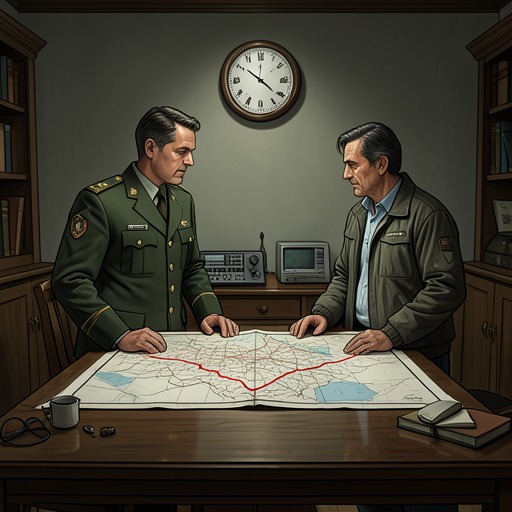
Heideman appears in a high-level policy discussion with Admiral Thomas Magruder and Herb Waring, the President’s National Security Adviser. Magruder listens as Heideman presents his foreign-policy argument, and is surprised to find Waring evidently receptive. That reception matters: the President has recently taken a beating over foreign policy, and his critics include growing numbers of isolationists. The meeting therefore unfolds amid pressure to avoid another overseas commitment, not in an atmosphere of settled consensus.
Heideman invokes the opportunity opened by the Fall of the Berlin Wall, arguing that the United States should take advantage of the changed circumstances. The setting gives his case a forward-looking cast: he is not simply defending an existing operation, but urging decision-makers to reconsider what American policy can do in a world no longer governed by the same assumptions. The book presents him as a civilian policy advocate addressing the consequences of military involvement, rather than as an officer responsible for carrying out the operation.
The Case for United Nations Action
Waring’s understanding of Heideman’s presentation is that General Boychenko will surrender to the United Nations, but that the organization will agree only if the American carrier battle group is part of the arrangement. The proposal links political consent to military presence. It also places a concrete burden on the United States: the carrier group’s participation would make the international response more than a declaration, but would expose American forces to the dangers of the crisis.
That question sits within a longstanding debate over whether American forces should serve under United Nations commanders. The story gives the issue practical urgency through a mission whose purposes and boundaries are still under negotiation. The National Command Authority has specifically barred American forces from involvement in fighting between the Reds and the Blues; the Marines are to go ashore at Poti only under the stated limits of their mission. Heideman’s argument for international action thus exists alongside a strict national restriction, rather than replacing it.
The broader rationale for a strong United Nations presence extends beyond the immediate Russian confrontation. The organization hopes that military presence will help defuse other regional problems, including Turkey’s repeated threats to invade Armenia. This wider ambition shows why the question is difficult to contain: a force introduced for one emergency may also be expected to discourage other crises. In that setting, Heideman’s appeal to a changed era carries both promise and risk. The same presence that might lend weight to diplomacy could become the basis for expectations extending beyond its original purpose.
Sovereignty, Military Judgment, and Humanitarian Claims
Heideman openly distinguishes the political decision from the military advice surrounding it. When he intervenes in the exchange with Magruder, he notes that the admiral’s opposition is familiar and has been expressed often and loudly, but insists that the choice belongs to political decision-makers. Magruder, for his part, regards the proposed course as a reckless rejection of centuries of policy. Their disagreement is not simply over tactics: it concerns who should decide when a military risk is justified and whether inherited limits remain binding under new conditions.
Heideman’s most explicit challenge to those limits is his treatment of national sovereignty. He argues that sovereignty, however high-sounding, is becoming antiquated. The claim recasts nonintervention not as an unquestionable rule but as a principle that may fail to meet present dangers. His position is consequential because it makes the legitimacy of action depend on the crisis and its victims, rather than on sovereignty alone.
He also invokes humanitarian considerations, accusing the Ukrainian government of having embarked on a program of ethnic cleansing. The text does not identify the targeted population in this passage, so the accusation remains specific in its gravity but limited in the detail supplied. Heideman delivers it with a disdainful look at Admiral Scott, giving the exchange a sharp personal edge. Humanitarian language here is not an abstract appeal: it becomes an argument for intervention in a situation where the extent of violence and the appropriate response are contested.
Debate and Consequences
The debate surrounding Heideman’s position takes place as the danger across the northern Black Sea grows more explosive. If the area from Odessa to Gagra becomes a war zone, the United Nations and American operation could find it difficult, perhaps impossible, to proceed as expected. Admiral Scott challenges the language of preserving peace by asking what peace remains when the whole region is tearing itself apart. The exchange captures the central pressure on Heideman’s case: intervention is presented as a means of preventing or limiting disorder, while opponents see disorder already spreading and doubt that an outside force can master it.
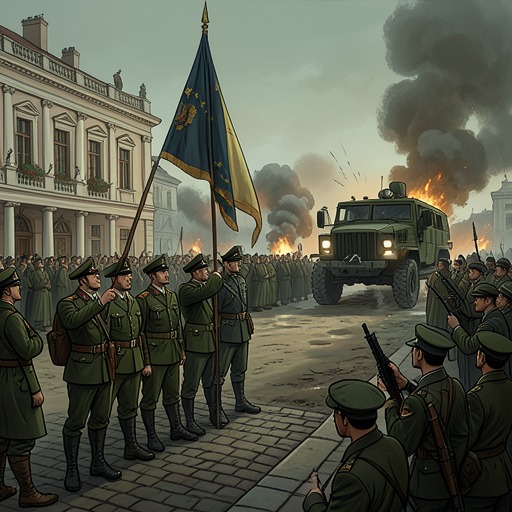
The story later makes the command question concrete. Washington grants the United Nations operational authority over American forces in the Crimean Peacekeeping Operational Zone, and the military leadership announces that those forces will operate under United Nations command until the President says otherwise. This is a development in the surrounding policy conflict, not an order shown as Heideman’s personal act. It demonstrates, however, the institutional stakes of the position he advances: the debate over international action can alter not only where American forces go, but also the authority under which they serve.
Narrative Role
Heideman gives the policy conflict its clearest civilian voice. Magruder’s objections emphasize inherited principles and military risk; Heideman answers by treating intervention as a political choice and sovereignty as a principle whose force may be diminishing. His humanitarian accusation sharpens that contrast, while the disputed proposal involving Boychenko and the carrier battle group shows how political aims depend on military participation. The narrative does not resolve the argument through Heideman’s rhetoric alone. Instead, it follows the gap between a case for action, the limits imposed on that action, and the command arrangements eventually put in place.