Aleksei Aleksandrovich Vyatkin
AfterburnAleksei Aleksandrovich Vyatkin commands the Russian submarine Kislovodsk during its confrontation with an American carrier force. His story moves from controlled defiance in the submarine’s crowded control room to the peril of its crew and, finally, to a spare act of self-identification. The contrast gives his command a human measure: first he interprets the threat and acts, then he watches his crew struggle to survive, and at last he states who he is and what boat he commanded.
Identity and Command
At 1757 hours, Vyatkin is introduced as a captain of the first rank in Kislovodsk’s control room. He is scowling and looks upward, past the compartment’s maze of conduits, wiring, and pipes running fore and aft. The setting makes his authority part of a tightly confined working space, surrounded by the machinery and systems on which the submarine depends.
His first officer reports that the Americans have the submarine bracketed and suspects that they knew it was there all along. The transmission is so loud and clear that Vyatkin does not need his headset. The first officer reads it as a warning; Vyatkin understands the message as a demand that Kislovodsk keep away from the American nuclear carrier. The exchange establishes him as the commander responsible for interpreting a threat whose meaning is unmistakable, even if its consequences remain uncertain.
The Carrier Encounter and Kukla
The next recorded moment is on Friday, 30 October, at 1758 hours. Vyatkin’s response to the carrier’s warning is not described as a direct attack with a live warhead. Instead, he orders the launch of Kukla, a standard 533-millimeter torpedo altered into a decoy: its warhead has been removed and replaced with sophisticated microelectronics. Its Russian name means puppet, a fitting description for an object designed to mislead rather than explode.
Vyatkin orders, “Fire Kukla!” The torpedo leaves its tube on a blast of compressed air. The decision is linked to his experience: he had successfully used the device more than once on submarines where he served as a junior officer during the Cold War. That history gives the order a practical foundation. In a tense encounter, he relies on a method he already knows, turning earlier service into an immediate tool of command.
The Crew’s Peril
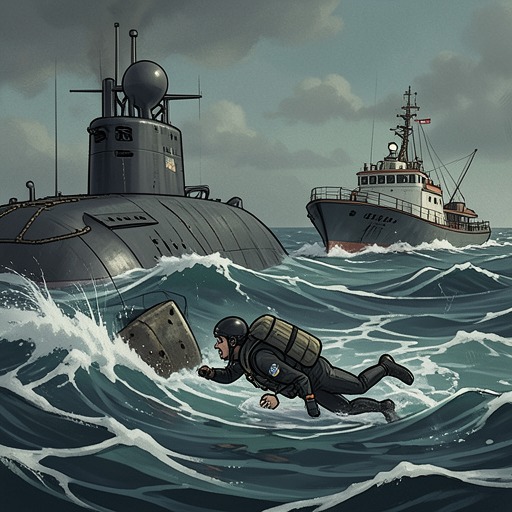
Later, Vyatkin clings to the railing on the side of Kislovodsk’s bridge, high atop the sail. From there he watches his crew fighting to save themselves. The submarine is no longer presented chiefly as a concealed instrument confronting a carrier; it is a vessel whose people are in danger, and its captain is an exposed witness to their struggle.
For a time, Vyatkin has thought Kislovodsk might be saved. The detail marks a shift from the earlier confidence of a practiced tactical response: the decoy order belongs to a commander acting on experience, while the thought of saving the submarine belongs to a moment when its survival is in doubt. The account places his hope beside the crew’s urgent effort, without claiming that the hope is fulfilled.
Self-Identification
In a later exchange, someone asks whether Vyatkin speaks English. He answers by giving his name, rank, and submarine: “Meenyq zavoot Kapitahn pervogo ranga Aleksei Aleksandrovich Vyatkin,” followed by “Podvodnaya lodka Kislovodsk.” He speaks with quiet, exhausted dignity. The formal introduction is significant in its simplicity: after the danger and uncertainty surrounding the boat, he identifies himself through the office he holds and the submarine he commanded. The available account closes on that statement, making the name of Kislovodsk the final anchor of his identity in the scene.