Yevgenni Sergeivich Ivanov
AfterburnYevgenni Sergeivich Ivanov, identified as Black Leader and Major Ivanov, is a combat pilot whose appearances connect the Black Sea fighting with the later action over Arsincevo. The narrative presents him not only through his aircraft and maneuvers but through the choices made under pressure: an attack undertaken to weaken opposing forces, tempting targets he does not pursue, and a missile that abruptly enters his view.
Identity and Introduction
Ivanov is introduced as a major flying a MiG-27M attack aircraft over the Black Sea. The narration associates his experience with membership in a particularly select fraternity, marking him as a veteran combatant without, in this passage, specifying the fraternity’s membership or history. His title, aircraft, and airborne callsign establish a professional identity shaped by military hierarchy and combat experience.
The scene puts him in motion at extremely low altitude, describing the aircraft hurtling just above the surface. That detail makes the setting an active tactical constraint rather than a backdrop: Ivanov is operating close to the sea while the account follows his actions from inside the air battle. His callsign, Black Leader, also situates him within a formation, while a later radio transmission identifies the speaker as Black One and shows him checking whether the tower can hear him.
The Black Sea Mission
The narration states that weakening the opposing forces was the objective of the day’s operation. Ivanov’s scene therefore links his individual flight to a larger military purpose: the attack is not presented as an isolated display of piloting, but as part of an effort to reduce the enemy’s strength. The evidence leaves the intended targets and the operation’s result unspecified, so the emphasis remains on the objective and the danger of carrying it out.
A radio exchange gives the scene a practical, procedural counterpoint to the violence. Ivanov calls the tower, identifies himself as Black One, and asks how clearly he is being received. The brief transmission makes communication itself part of the action: even amid a combat flight, his contact with the tower remains a necessary link. A time marker places this episode at 1004 hours, three hours ahead of Zulu time.
The Arsincevo Sortie
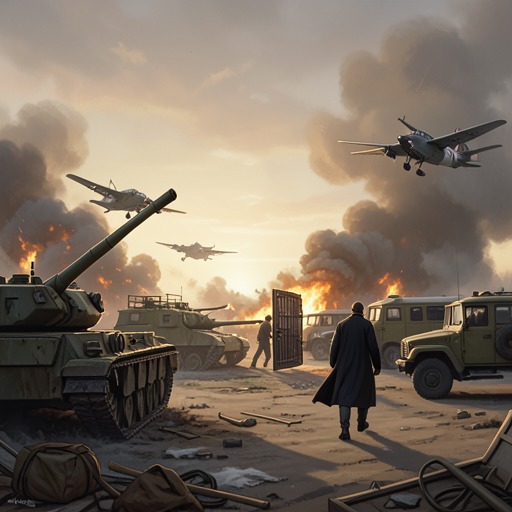
In a later sequence headed “Flogger 550 Over Arsincevo,” Ivanov is again followed in flight, this time over the Arsincevo area. The account records a time of 0907 hours, Zulu plus three, and depicts him climbing while releasing a string of flares. At twelve thousand feet, the maneuver places the countermeasure deployment within a specific moment of the engagement rather than treating it as a general feature of his aircraft or tactics.
Ivanov subsequently pulls out of a dive. The passage notes that he sees tempting targets but is pursuing something else; it does not identify that objective in the supplied material. That contrast is central to the scene’s presentation of him: the visible opportunity does not determine his course, because his intended target lies elsewhere. The reader sees the discipline of an assigned purpose expressed through what he declines to attack, even as the exact object of his pursuit remains unstated.
Combat and Narrative Role
The Arsincevo action turns sharply when Ivanov, looking upward, sees a missile. The sequence’s successive flight details—climb, flares, dive recovery, and then the missile’s appearance—make danger accumulate through concrete changes in his immediate situation. The excerpt ends with the missile in view and Ivanov in acute peril; it does not establish the missile’s outcome or Ivanov’s fate. His scenes thus function as a combatant’s close-range perspective on an air war whose objectives are larger than any one maneuver, while preserving uncertainty at the point where tactical action becomes personal survival.