Tom Mason
AfterburnTom Mason, called Dixie, is a new arrival aboard the Jefferson and Carrier Air Wing 20 when he enters the narrative as an aviator on patrol in the Georgia No-Fly Zone. Initially presented as a promising newcomer, he becomes central to a mistaken aircraft identification: after a brief, obstructed view of a helicopter, he reports a Hind down, then takes responsibility when the target is revealed to have been a Black Hawk. The episode makes his first impression of competence inseparable from the consequences of a split-second judgment.
Identity and Introduction
Mason is introduced as a nugget, the squadron’s term for a newly arrived aviator. He is assigned to fly with Lieutenant Kathleen Garrity, known as Cat, as his radar intercept officer. Their pairing appears to be working well so far, and Mason is said to know his business. These details establish him not as an established squadron leader but as a newcomer whose skill is still being tested in operational conditions.
His callsign, Dixie, becomes his working identity in radio exchanges. During the patrol, he is Bird Dog Two, communicating with Bird Dog One and the supporting controllers as the flight responds to a contact in the no-fly zone. The contrast between this brisk, practiced radio language and his inexperience is important: Mason can function within the squadron’s procedures, but the demands of interpreting what he sees will prove harder to master.
Patrol in the Georgia No-Fly Zone
The encounter begins with a report of a bogey inside the restricted airspace, probably a helicopter. Mason’s flight is directed toward it, and the pilots are told that weapons are free while being instructed to mark their targets. The order gives the contact immediate stakes: visual identification is not an abstract exercise, because the patrol may act on the classification it makes.
At 0923, aboard Tomcat 218 in the Republic of Georgia’s no-fly zone, Mason reacts to the combat environment with boyish enthusiasm, comparing the experience to Star Wars. The moment captures his excitement at the scale and intensity of the mission, but it sits beside the practical responsibility of the patrol. He is not merely watching a dramatic scene unfold; he must help determine what the aircraft ahead is and how the flight should respond.
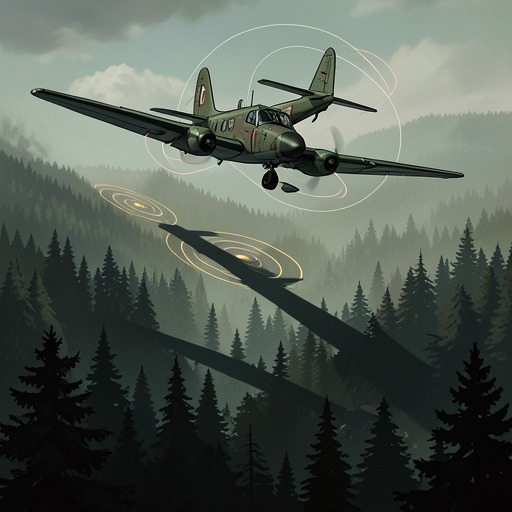
Mason gets only a glimpse of the contact, from a difficult angle as the Tomcat comes up behind the helicopter, roughly at its seven o’clock position. The view is fleeting and from the rear, conditions that later form the substance of his explanation. When he reports that the target is down and identifies it as a Hind, his message is exultant. The confidence of the report sharply contrasts with the limited view on which the identification rested.
Identification and Accountability
The later review establishes the central error: the target was not the Hind Mason believed he had seen. Asked about the difference between a Hind and a Black Hawk, Mason speaks up before the blame can be placed solely on the squadron commander. He says that he made the identification and that the fault was his. His admission gives the episode a second turn: the question is no longer only what the patrol engaged, but who will acknowledge the decision that led to it.
Mason does not claim ignorance of the aircraft types. He explains that he knows what both a Black Hawk and a Hind look like, but had only one or two seconds to see the target from behind. From that angle, he could not make out the double cockpit. He did see the weapons pylons, however, a detail that helps explain how he reached the wrong conclusion without erasing his responsibility for it. The scene distinguishes knowing the identifying features of an aircraft from reliably recognizing them in a fragmentary combat view.
His candor does not undo the mistake. The squadron commander removes him from zone patrols for several days and limits him to flying combat air patrol until further notice. The restriction is specific and temporary as stated, not a dismissal from flying altogether. It narrows Mason’s duties after the error while leaving him in service, and makes the consequence legible as a loss of operational trust in precisely the task where his identification failed.
Character Arc and Narrative Role
Mason’s brief arc turns on the distance between apparent competence and dependable judgment. He arrives with a favorable initial assessment, works in a pairing that seems effective, and speaks confidently over the radio; then an encounter lasting seconds exposes how quickly a plausible identification can become a consequential mistake. The text does not portray him as incapable or evasive. Instead, his own account supplies the limits of his view, and his immediate acceptance of fault keeps the episode focused on accountability rather than denial.
The incident also gives his enthusiasm a counterweight. His Star Wars comparison registers the excitement of a newcomer experiencing combat, while his later explanation dwells on the narrow practical facts of the sighting: the rear angle, the short duration, the cockpit he could not see, and the pylons he did. The shift from spectacle to scrutiny marks the change in how his performance is judged. Mason’s significance lies in that reversal: an aviator who seems ready for the action must confront the difference between confidence, recognition, and proof, and the patrol’s response makes that difference consequential.