Leonov
AfterburnLeonov is a populist leader who seizes control from Russia’s discredited hard-liners just as the country’s crisis becomes an all-out civil war. His Popular Democratic Front, the Blues, is locked in combat with Marshal Krasilnikov’s Reds; the struggle unfolds alongside the collapse of the revived Union and an American intervention in the far north. Leonov’s significance lies in this compressed reversal: taking power does not restore political control, and the conflict around his movement becomes part of a wider breakdown that neither domestic factions nor outside forces can readily contain.
Rise and political position
Leonov comes to power after a gamble in Norway has dealt what Dmitriev regards as the final blow to the Motherland. The hard-liners have been discredited, and Leonov, identified as a populist leader, takes control from them. The change in leadership, however, arrives too late to resolve Russia’s problems through politics. The timing makes his accession a fragile opening rather than a settlement: authority changes hands at the same moment that the country’s political crisis is becoming an armed contest.
The account establishes Leonov’s political position principally through the faction organized around him. His Popular Democratic Front is identified with the Blues, one of the two forces fighting for control. The evidence does not describe his personal governing program, the precise circumstances of his seizure of power, or how he directs the war. His role is therefore clearest as the leader whose rise gives the anti-hard-line camp a political identity, not as a figure whose individual decisions are shown in detail.
Civil war and the weakening state
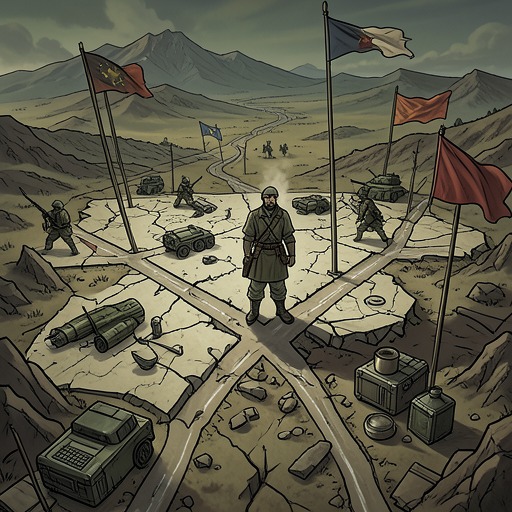
The Blues are soon fighting Krasilnikov’s Reds in an all-out civil war. Their conflict is not presented as an isolated power struggle: it accompanies the disintegration of the revived Union and spreads beyond a contest between two leaders. Later, Leonov and Krasilnikov are described as battling in the streets of Moscow and in a hundred other places. The breadth of that fighting makes the scale of the breakdown tangible, while the reference to Moscow places the struggle at the heart of the state as well as across the wider country.
The war also persists in scattered military units after the collapse of the Scandinavian campaign. Neo-Soviet formations controlled by hard-line Reds and pro-Krasilnikov factions remain spread across the former empire, while newly emerging rebel movements are rarely strong enough to break the militarists’ hold on their own. This detail complicates any simple account of Leonov’s rise as a transfer of power from one government to another. The opposing armed network remains dispersed and capable of maintaining control locally, even as the larger Russian military is described as a hollow shell.
Foreign intervention and disputed intentions
As the revived Union begins to disintegrate, American forces intervene in the far north and seize key military facilities on the Kola Peninsula. The stated justification is that Krasilnikov plans to use submarine-launched nuclear weapons to blackmail Leonov into submission. The account also makes clear that this is not an uncontested explanation: Dmitriev believes the Americans’ real purpose was different. The distinction between the public rationale and Dmitriev’s suspicion keeps the intervention politically ambiguous; the evidence records the competing explanations without establishing the latter as fact.
The Kola intervention occurs within a wider American debate over military involvement. Earlier, U.S. forces were ordered not to enter the fighting between the Russian Red and Blue factions; the Marines were to go ashore at Poti only. That restriction marks a boundary between intervention in a regional crisis and participation in Russia’s internal war. It does not resolve the pressures created by the struggle around Leonov: the alleged nuclear threat is framed in terms of his vulnerability, while American policy formally draws a line against joining the factional fighting.
Narrative role and limits of the account
Leonov’s story is defined by the mismatch between political succession and effective control. The hard-liners lose credibility and he takes power, but the change does not prevent civil war, keep the revived Union intact, or remove armed pro-Krasilnikov forces from the former empire. The narrative places his rise beside events that outstrip any one faction’s ability to settle the crisis: fighting reaches Moscow and many other locations, foreign troops seize facilities in the north, and local rebel movements remain too weak to dislodge entrenched militarists.
The evidence gives Leonov substantial historical importance within the conflict but little direct personal characterization beyond his populist identity and leadership of the Blues. It does not show his private thoughts, military decisions, or eventual fate. His position is instead illuminated through the consequences and interpretations surrounding him: Dmitriev sees the political opening as arriving too late, and the American justification for intervention presents Leonov as the intended target of Krasilnikov’s alleged nuclear coercion. This limited perspective keeps the emphasis on a country breaking apart rather than on a detailed portrait of its new leader.