Pamela Drake
AfterburnPamela Drake is an award-winning reporter for American Cable News whose work brings her into the conflict at Yalta and back into the life of Matt “Tombstone” Magruder, her long-term partner and fiancé. She matters to the story in two distinct capacities: as a journalist bearing witness to a war that continues to devastate civilians, and as someone whose relationship with Matt cannot withstand the repeated separations imposed by his military service. Her reporting and her private life meet in the same place, but neither can resolve the other.
Identity and Reporting
Pamela is described as a formidable combination of beauty and intelligence, and as an award-winning reporter for American Cable News. That professional identity is consequential when the network decides to send one of its leading people to follow events in Yalta. When Matt hears that the reporter is Pamela, his surprise is immediate: the assignment puts his former fiancée, not merely a familiar face from television, back in his orbit.
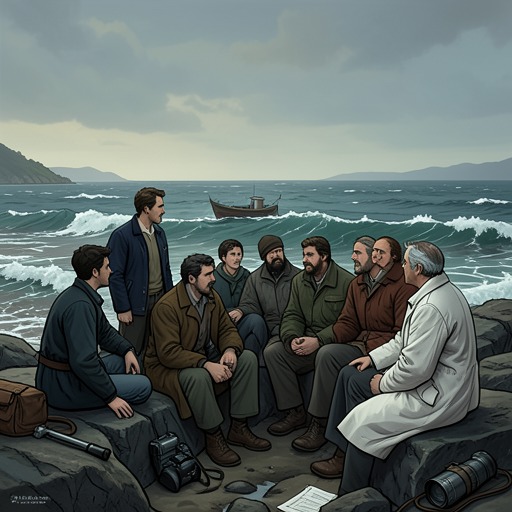
In Yalta, Pamela works on camera and behind it. She interviews Joyce “Tomboy” Flynn, a commander, about being there as events unfold. Joyce says that she has had little opportunity to see much of the place, but that being there is exciting and feels like history in the making. Pamela then turns to the cameraman, marks the take, and thanks Joyce for the interview. The exchange presents her as a working correspondent: she draws out a concise account from a military participant and directs the production of the report.
Relationship with Matt “Tombstone” Magruder
Pamela and Matt have a long and often stormy relationship. They had finally become engaged, but the intimacy of that commitment does not remove the recurring cost of his deployments. When they confront the future of the relationship, Pamela describes a cycle in which Matt is home for perhaps six months, just long enough for her to get used to having him around, before he leaves again for six months, or possibly nine. Her frustration is directed not simply at one departure but at the repeated disruption: each return renews a domestic life that another deployment soon interrupts.
The conversation makes clear that the separation is painful for both of them. Matt hears a hardness in Pamela’s voice that he has not heard before. When he asks whether she still loves him, she takes his hand briefly and tells him that sometimes love is not enough. She then lets go. The gesture gives the breakup its emotional shape: affection is still present, but Pamela will not treat affection as a solution to the cycle that is making their relationship untenable. The available evidence does not specify the practical terms of their separation; it establishes the emotional limit she is naming.
Work in Yalta and Renewed Contact
Their personal separation does not erase their ability to work alongside one another. At a gathering in Yalta attended largely by local civilians, alongside a substantial number of reporters, Matt sees Pamela and her cameraman as he climbs the wooden steps to take his place onstage. He catches Pamela’s eye and feels a pang. The encounter is brief, but it places the private aftermath of their relationship within a public setting where both continue to perform their roles.
Later, Pamela works with Matt for several hours trying to establish a radio connection with his battle group. The available Russian equipment does not have the range needed to reach it. The detail is telling without making their renewed cooperation into a reconciliation: the two can collaborate on a practical problem, but the equipment—and the circumstances surrounding them—impose limits that effort alone cannot overcome. Their professional contact continues even as the earlier conversation has made the personal cost of Matt’s absences explicit.
Witness to the Continuing War
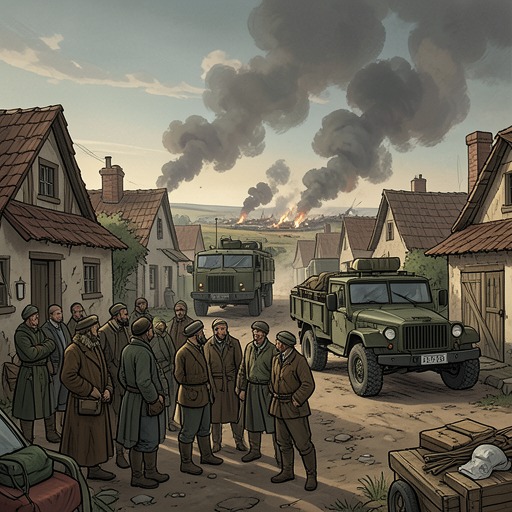
Pamela’s reporting gives the civilian experience of the conflict a place in the story. In a broadcast from Yalta, she says that for the people there, and across Crimea, the war and the killing continue, with little apparent difference to them in who is fighting whom. The report turns away from a simple account of opposing forces and toward the endurance of violence as civilians experience it. The segment’s close-up of a crying woman makes that cost visible rather than abstract.
This public witness contrasts with Pamela’s private predicament. In her relationship with Matt, she can identify the pattern and speak plainly about what it costs, but she cannot make his deployments stop. In her reporting, she can place the continuing suffering before an audience, but the broadcast does not end the fighting. Pamela’s presence therefore links two forms of exposure to war: the correspondent’s effort to show what is happening and the intimate life repeatedly interrupted by military duty. Her decisive act in the personal story is to release Matt’s hand; her work in Yalta, by contrast, keeps attention fixed on the people for whom the war has not released its grip.