Brandon Scott
AfterburnBrandon Scott is the Chairman of the Joint Chiefs of Staff and the clearest military voice in the policy debate over placing American forces under United Nations command. He opposes that transfer as a matter of sovereignty and judgment: to him, a carrier battle group cannot simply be loaned to an international authority, and calling a collapsing region peaceful does not make it so. The later grant of United Nations operational authority makes his objections a test of the command structure as well as an argument at a meeting.
Identity and Introduction
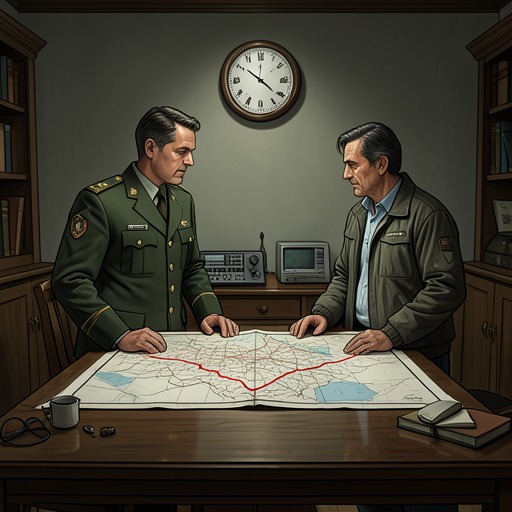
Scott enters the narrative as a senior officer whose institutional position gives weight to his opposition. He is described with a white mane and flashing eyes; his manner is physically emphatic as well as verbal. When Matthew Magruder agrees with his objection, Scott leans back in his chair. Later, he leans forward and clasps his hands on the table while questioning whether the United Nations should be given greater power. The shifts in posture accompany a consistent concern: who has the authority to commit American forces, and what judgment supports that commitment?
His disagreement is not presented as a private irritation. In a discussion with Herb Waring, Robert Heideman begins to explain the proposal, but Scott interrupts to register his dissent. Scott calls the idea mistaken from beginning to end and says it runs against what the country has stood for. The interruption, and the contrast between Heideman’s measured delivery and Scott’s louder voice, make him the debate’s most visibly uncompromising participant. Matthew Magruder nods in agreement, establishing a moment of alignment without making Scott’s position the unanimous view of the room.
Opposition to United Nations Command
Scott’s objection sharpens when the discussion turns from the proposal in general to the authority it would transfer. He warns that accepting it would amount to surrendering American sovereignty. He argues that a United States carrier battle group cannot simply be loaned to the United Nations, treating command as a substantive national responsibility rather than an administrative arrangement. His concern is therefore not only whether the mission is worthwhile, but whether the country can hand over operational control without compromising its own authority.
The disagreement takes place against a complicated background. The Russian Civil War has weakened the surrounding political order, while Ukraine is positioned to press its longstanding dispute with Moscow over Crimea and the Black Sea Fleet. Crimea is geographically joined to Ukraine to the north, while the Russian Federation borders the peninsula to the east; Ukraine’s political and national identity is also distinct from Russia’s. These facts do not resolve the competing claims, but they help explain why military control of the peninsula is not a neutral question. Scott’s resistance to an expanded United Nations role meets a crisis in which local territorial disputes and a broader civil war threaten to overlap.
What Counts as Peace
Scott also challenges the language used to justify intervention. When the Secretary argues that events support intervention to maintain peace, he asks, “What peace, Madam Secretary?” and points to the area tearing itself apart. The Secretary’s answer—that Ukraine has not yet attacked—shows the disagreement in its precise form: one side sees a chance to prevent a further escalation, while Scott sees a region already in disorder and doubts that the proposed action can be described as preserving peace. His question does not establish that he opposes every intervention; it does expose his skepticism toward the premise being used to authorize this one.
The American debate is further shaped by the President’s political vulnerability. The administration has recently taken heavy criticism over foreign policy, and political advisers regard another overseas undertaking as a risk. That context makes Scott’s warning about sovereignty part of a larger dispute over political authority and the consequences of intervention. The proposal is not assessed in a vacuum: it carries strategic stakes abroad and reputational stakes at home.
Command Transfer and Significance
The narrative later records that the United Nations requested, and Washington granted, operational authority over U.S. forces in the Crimean Peacekeeping Operational Zone. The forces are then told they will operate under United Nations command until the President says otherwise. This development gives institutional consequence to the question Scott raised: the issue becomes an actual chain of command, rather than a theoretical possibility. The account does not establish Scott’s personal response to the transfer, so his significance lies in the warning he voiced before it and the conflict between that warning and the policy that followed.
Scott’s role is defined by this tension between national control and collective action. The crisis presents real pressure to act amid political breakdown, but it also leaves open who sets the mission’s limits and who bears responsibility for its execution. His objections insist that urgency cannot settle those questions by itself. When operational authority changes hands, the story shows that the sovereignty dispute has not disappeared; it has moved from the meeting room into the military command structure.