Rear Admiral Douglas E. Tarrant
AfterburnRear Admiral Douglas E. Tarrant is presented as a senior naval commander whose authority is tested when the United Nations gains operational control over U.S. forces in the Crimean Peacekeeping Operational Zone. He delivers the orders that redirect the battle group and insists that its officers follow the new command arrangement. His significance lies in the practical and political burden of translating a contested change in authority into military conduct.
Identity and Command Role
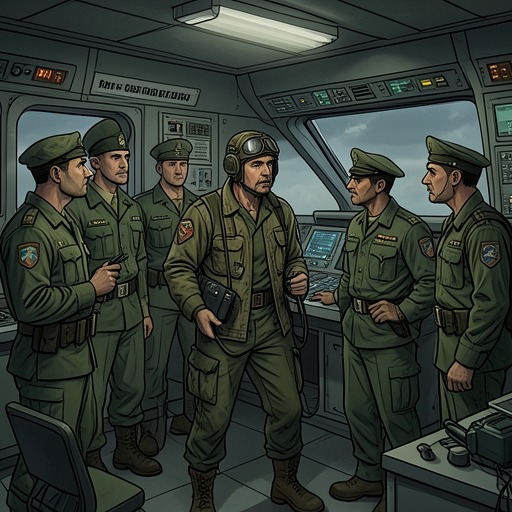
Tarrant enters an officers’ meeting with Jeremy Brandt close behind him, and the assembled officers rise to attention. The scene establishes him through the rituals of command: he addresses the battle group, announces developments that affect its operations, and conveys new orders from Washington. Those orders extend the group’s operational area northward. The evidence identifies Tarrant as the officer responsible for communicating the decision, rather than supplying a personal history or account of his rise through the Navy.
His role is defined by a layered chain of authority. The United States has long debated whether its forces should serve under United Nations commanders, and the question is no longer abstract once the United Nations requests operational authority and Washington grants it for the Crimean zone. Tarrant tells his officers that, for the duration of the mission, their immediate superior will be a United Nations commander. The arrangement gives the international organization operational authority while leaving the President able to end it. Tarrant must therefore explain both the new chain of command and its limits.
Orders and the Change in Authority
Tarrant announces the change with visible reluctance: the narration observes that he pauses as if struggling with something unpleasant and trying not to show it. The scene conveys strain without specifying whether it comes from personal disagreement, concern about the consequences, or the difficulty of delivering the decision. What he does make clear is the practical requirement: U.S. forces will operate under United Nations command until the President says otherwise.
He couples that instruction with a demand for military decorum. The officers are expected to obey the orders, whatever their private reactions. In the surrounding political context, this is a consequential distinction. The National Command Authority had directed that U.S. forces not become involved in the fighting between the Red and Blue Russian factions, limiting the Marines’ landing at Poti to their specified mission. The United Nations command arrangement does not erase the existence of national restrictions; it places operational decisions within an international structure while the American chain of command remains politically consequential. Tarrant’s briefing makes obedience, discipline, and the limits of authority immediate concerns for the officers who must carry out the mission.
He names the operation Operation John Paul Jones, invoking a figure from American naval history after the Revolution. The choice places a familiar national naval reference beside the unfamiliar prospect of serving under United Nations operational command. The name does not resolve the tension between the two, but it gives the operation a distinctly American historical frame even as its command structure crosses national lines.
Leadership Beyond the Briefing
Tarrant’s leadership also appears in a small invitation rather than a formal order. After the briefing, he asks whether Matt “Tombstone” Magruder wants to go ashore with him. The exchange shows the admiral taking the initiative to bring an officer along, but the available account does not establish the purpose of the shore visit or what happens there. Its importance is modest but concrete: Tarrant’s relationship to the officers includes direct contact outside the briefing room, not only the delivery of orders from above.
The later discussion of the chain of command underscores how quickly senior authority can become a practical problem. Jeremy Brandt, identified as Tarrant’s flag captain, receives a brevet promotion to admiral, confirmed through Naples. The passage does not explain the circumstances behind the promotion, so its significance is clearest as an indication that command arrangements are shifting and must be tracked through formal channels. In a mission already divided among national and United Nations authority, the rank and placement of senior officers matter beyond ceremony.
Operational Pressures and Significance
The battle group’s mission is constrained not just by command but by sustainment. A modern carrier such as the Jefferson needs replenishment of expendables every two to three weeks. Though nuclear-powered and not dependent on fuel for propulsion, its aircraft consume aviation fuel; the available supply would last no more than ten days, and less under a heavy flight schedule or a major strike. The group relies on replenishment tankers following it at sea. These figures clarify the kind of operational pressure surrounding Tarrant’s orders: extending an area of action is not simply a question of where ships can sail, but also of whether aircraft and escorts can continue to operate.
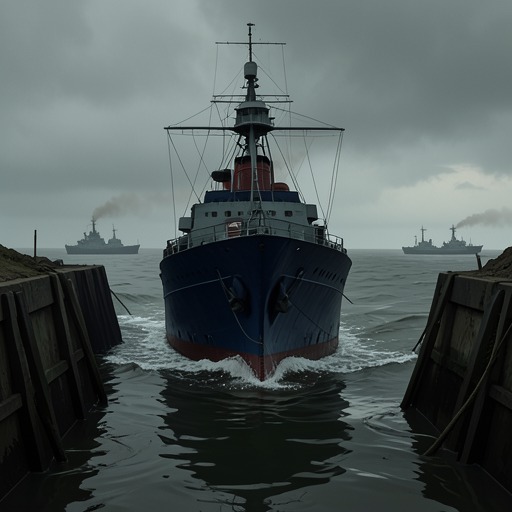
The danger sharpens when the battle group is trapped in the Black Sea. With the Bosporus closed, the Jefferson and its escorts face the prospect of becoming immobilized after their remaining operating margin is exhausted. Under continuous flight operations, the estimate falls to two to four days before the ships are effectively useless in the enclosed sea. Later, almost three million gallons of aviation fuel—about nine thousand tons—must be pumped aboard, with flight-deck operations suspended during the transfer. These details do not establish that Tarrant personally directs each logistical decision; they show the material limits that give his command responsibilities their weight.
Tarrant’s portrait is consequently less a private biography than a study of command under constraint. He receives a decision made between Washington and the United Nations, communicates it to officers who may not welcome it, and insists that discipline survive the change. The later emphasis on fragile supply lines and an evolving chain of command reveals the stakes behind that insistence: authority must remain legible even as political control, operational responsibility, and the means to sustain the mission pull in different directions.