Malibu
AfterburnMalibu is a radar intercept officer whose work joins the technical demands of flight to the human judgments made under pressure. When he picks up a broken warning that United Nations Flight 27 is under attack, he passes it to Batman and helps turn an ambiguous signal into an urgent response. Later, among his squadron’s aircrew, he appears as a quieter figure whose change in manner draws the attention of Coyote and Grant.
Identity and Operational Role
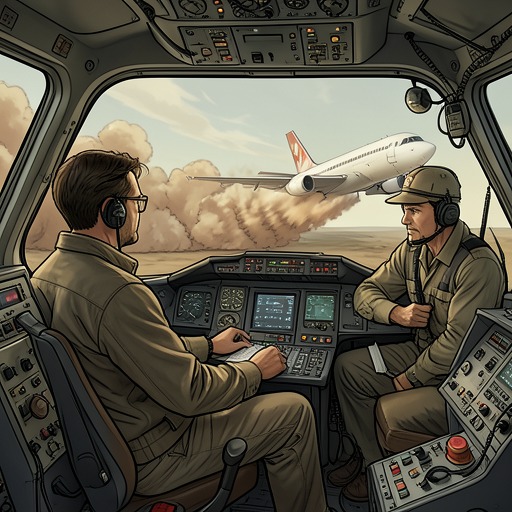
Malibu’s clearest professional designation is RIO, or radar intercept officer. The role places him in close coordination with another aircrew member: during the alert about the United Nations aircraft, he speaks to Batman over the intercom system, while later scenes put him in the same post-flight setting as Coyote and Batman. The evidence gives no extended biography or account of his career before these episodes; it defines him instead through crew interaction, airborne communication, and the work of interpreting an incomplete threat picture.
The details after a flight give that role a physical, routine dimension. Malibu has changed into his khakis and is hanging his flight suit in his locker, while Batman is still wearing flight gear. The contrast marks different stages in the return from a sortie: one aircrew member has begun to put the flight behind him, while another remains dressed for it. Grant arrives to make sure the two report for debriefing, drawing the episode from private decompression back into the squadron’s formal process of accounting for what happened.
The Warning About United Nations Flight 27
During an airborne encounter, Malibu reports that he has received a garbled message from United Nations Flight 27, conveying that the flight is under attack. The report arrives while a hostile aircraft is being tracked; the bogey’s position behind the United Nations helicopter makes an attack seem plausible, but the warning itself is fragmentary. Malibu does not present a fully resolved picture. He passes on what he has heard, leaving the crew to act while the situation is still uncertain.
That moment makes his contribution consequential without making him omniscient. His communication gives the other aircrew a reason to treat the helicopter’s danger as immediate, but the scene preserves the difference between detecting a threat and knowing exactly what is happening. Elsewhere in the account of the encounter, Dixie reports a Hind, while the cockpit’s attention is divided by the demands of operating the aircraft and watching the available displays. The identification and the warning therefore emerge through separate observations rather than a single, perfectly clear view.
The episode sits within a mission in which the Jefferson is sent toward the Georgian port of Poti to add its air wing to the United Nations’ effort. The wider command arrangement is politically charged: Washington grants the United Nations operational authority over U.S. forces in the Crimean Peacekeeping Operational Zone, and the American commander tells his officers they will operate under United Nations command until the President says otherwise. These decisions establish the institutional setting around Malibu’s flying, but the evidence does not make him a participant in the political debate. His part is narrower and immediate: conveying information when the warning system is unclear and time to interpret it is limited.
Debriefing, Crew Relations, and Withdrawal
After the sortie, Coyote offers the RIO advice to ease up on himself and stop acting as if the weight of the world rests on his shoulders. The RIO calls it good advice. The exchange suggests that strain has become visible to the crew, though the text does not specify its cause or give Malibu an explicit account of his feelings. Its importance lies in the contrast between the pressure of the earlier alert and the ordinary, informal effort to steady a fellow aircrew member afterward.
Grant’s arrival makes the contrast sharper. He has come to get the two men to debriefing, but he also studies Malibu, whom the narrative identifies by the alias Blake in this passage. The RIO has been uncharacteristically quiet and almost withdrawn lately; now he seems more animated. Coyote suspects that Malibu is worried about Batman. The suspicion is presented as Coyote’s reading, not as a confirmed explanation from Malibu, so the scene keeps his concern partly private. It nonetheless gives the post-flight conversation a relational dimension: the squadron notices his change in demeanor, and Coyote connects it to the condition of another crew member.
Uncertainty as a Defining Condition
The account of the threat is later revisited through the logic of debriefing: a trailing aircraft, a reported Hind, an alert received in garbled form, and a crew trying to make sense of what could be seen while managing the aircraft. Malibu’s contribution is important precisely because it is not a complete answer. He transmits a warning that may be decisive, yet the information reaching him does not remove uncertainty. The difference between a fragmentary report and a confirmed account remains central to how the encounter is understood.
The surrounding narrative names this condition as the fog of war and notes that misidentification remains possible even on an electronic battlefield. That context illuminates Malibu’s role without turning him into a symbol detached from the action: he is one of the people required to make a timely judgment from imperfect information, then return to the squadron and revisit events through debriefing. His scenes move between those two pressures—the need to respond before the picture is complete and the need afterward to examine what the crew believed it had seen. The book gives him no definitive resolution beyond that pattern, leaving his importance in the consequential warning he passes on and the concern his crewmates observe.