Peter Lang
AfterburnPeter Lang is the commanding officer of USS Orlando and a decisive presence in its pursuit of Kislovodsk. His authority is tested not by a clear view of the enemy but by fragments of sound: a changing heading, sonar reports, and indications of danger in the water ahead. The resulting encounter makes him a commander who must act on incomplete information while weighing the danger to the Thomas Jefferson battle group against the risks of firing first.
Command aboard USS Orlando
Lang commands from the submarine’s control room and relies on the sonar shack for the contact’s movements. When Brian Davies reports that the contact is still turning and gives its new course as 171, Lang answers over the intercom and tells him to stay with it. The brief exchange establishes a chain of command built around the operator’s close attention to the contact and Lang’s direction of the pursuit.
Lang then appears in person at the entrance to the sonar shack. He checks whether Davies is certain of the heading, treating the report as a matter to verify rather than a detail to accept casually. The question carries immediate operational weight: Lang believes course 171 will put the contact directly on the Thomas Jefferson battle group. He tells Davies that he does not want to lose the target. The submarine’s tracking work is therefore not pursuit for its own sake; its heading may determine whether the contact reaches a larger force.
A decision under uncertain evidence
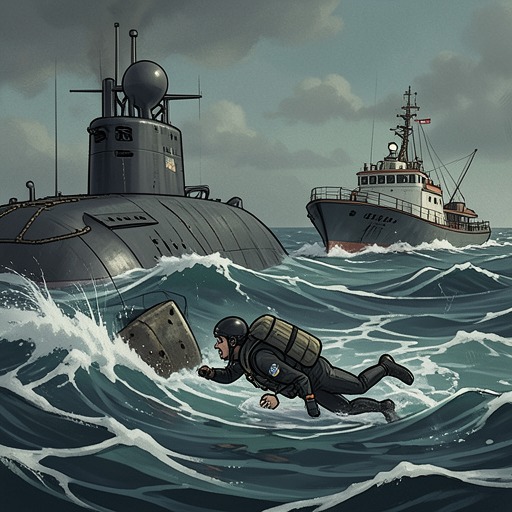
The encounter sharpens when sonar reports that Kislovodsk is opening its outer doors. Lang reacts at once, but the danger is not visually confirmed. The weapons aboard the opposing submarine are described as capable of causing serious damage to the Jefferson if one connects, while the information reaching Lang remains acoustic: his sonar operator is listening amid churning, ping-echoing water ahead.
The usual instruction to fire only if fired upon cannot straightforwardly govern submarine combat. Waiting for the opponent to shoot first could leave the Thomas Jefferson battle group exposed; acting first would mean making a consequential choice on evidence gathered through sonar. The narration presents this as a career-defining decision point and notes that Lang is in a perfect firing position. It does not reduce his predicament to a simple contest of nerve: the tactical advantage is real, but so is the uncertainty about what the sounds mean and what the contact will do next.
Following the contact upward
Later reports describe bubbling, hull stress, and structural flexing, but no engine noise. The sounds indicate that the contact is moving toward the roof, and Lang orders the diving officer to bring USS Orlando up slowly and follow it upward. The order turns the submarine’s movement into a controlled response to what sonar can establish: Lang directs the ascent without claiming certainty beyond the report.
The scene’s emphasis remains on disciplined interpretation. A heading, the opening of outer doors, and then a changing pattern of underwater sounds successively alter the situation. Lang responds at each stage by asking for information or issuing a measured order. The available account does not establish the encounter’s eventual outcome, but it shows the pressure under which he commands: the crew must make the contact legible before the danger can be managed.
Characterization and narrative role
Lang is characterized through decisions and checks rather than an extended account of his private life. His exchange with Davies shows both reliance on a specialist’s report and insistence on confirming its precision. His concern that the contact’s course could lead toward the Jefferson gives the pursuit a protective objective, while the firing dilemma exposes the cost of acting—or waiting—when the rules do not offer a safe answer.
The submarine scenes also make Lang a focal point for the book’s treatment of command under technological uncertainty. The enemy is initially a contact rendered through headings and sound; the commander’s choices must nevertheless be immediate and material. Lang’s measured ascent order and his earlier attention to the contact’s course frame leadership as the work of converting incomplete signals into action, without pretending that uncertainty has disappeared.