Jeremy Brandt
AfterburnJeremy Brandt is the captain of the Thomas Jefferson whose responsibilities widen from managing the carrier’s immediate operations to leading a staff discussion as a brevet admiral. The glimpses of him place humor and authority side by side: he needles Matthew “Tombstone” Magruder in the bridge, but turns from banter to security without hesitation, and later asks his officers to help him weigh the battle group’s choices.
Identity and Command Role
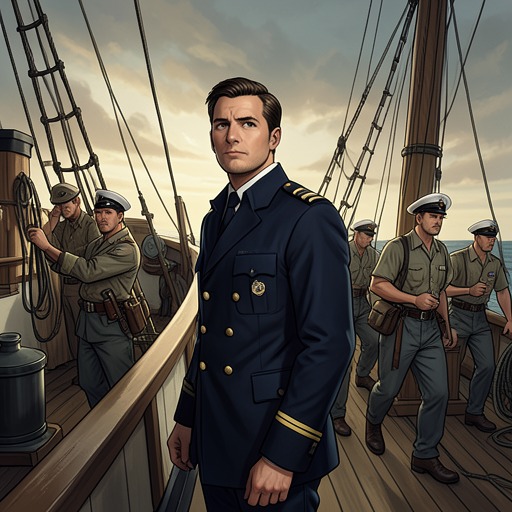
Brandt occupies the captain’s high chair on the bridge, a leather-backed seat marked with the word CAPTAIN. That physical detail establishes his authority aboard the carrier, but his command is not presented as remote ceremony. He speaks with the crew during ship movements, gives the order to pause for a pilot transfer after the ship clears the channel, and addresses security concerns directly. The scenes show him exercising command through practical decisions as well as through rank.
His position also sits alongside the responsibilities of the carrier’s air wing. Matthew “Tombstone” Magruder is the commander of CVW-20, the air wing assigned to the nuclear-powered Thomas Jefferson. Their roles are distinct, and the book makes their familiarity part of the shipboard atmosphere: Magruder is the subject of Brandt’s jokes, but the joking occurs within a professional relationship shaped by the carrier’s chain of command and the demanding environment aboard it.
Banter with Magruder
Brandt’s exchange with Magruder presents him as a teasing senior officer rather than a solemn figure at all times. When Magruder says he would never take an aircraft carrier into the gray waters ahead, Brandt shakes his head in mock sorrow and jokes about young aviators. The gesture and remark turn apprehension about the waters into shipboard humor without suggesting that the risk itself has disappeared.
The two continue the joke elsewhere. Magruder calls the situation the kind of thing one must learn to handle to play among the “big boys” aboard the carrier, and the narration identifies the exchange as a long-standing joke. Its subject is Magruder’s role as air-wing commander and the prospect that, sooner or later, he will move on. The familiarity makes the teasing reciprocal in spirit, but it does not erase the difference between Magruder’s air-wing command and Brandt’s command of the ship.
Brandt’s humor also surfaces when he asks whether Magruder wishes he were on a smaller target. The question is delivered with a twinkle, while the carrier group has reason to be wary of its position in waters where it has no friends to rely on. The contrast gives the banter its edge: Brandt can acknowledge the danger obliquely, using a joke about the carrier’s size rather than turning every exchange into a formal warning.
Security and Ship Handling
The tone changes sharply when Brandt raises security. He addresses Magruder as “Tombstone,” but the narration notes that all trace of banter has left his voice. His terse observation that security is always the issue marks a practical boundary between joking about danger and attending to it. The carrier is moving through a setting where threats can take varied forms, and Brandt’s attention to protection is shown as an active command concern, not an afterthought.
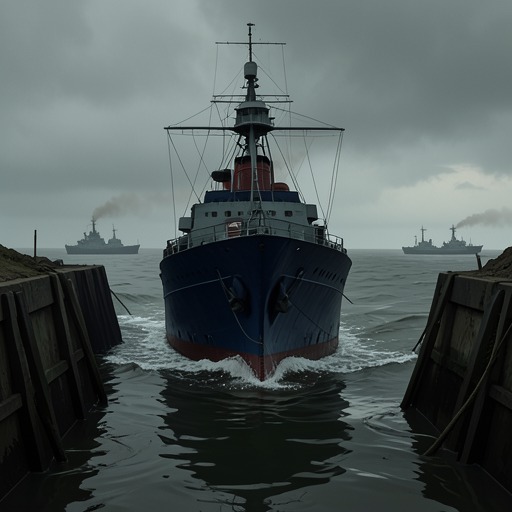
During the passage through the channel, Brandt also handles the ship’s transition to open water and the pilot’s departure. Once the helmsman reports that the carrier is out of the channel and clear to navigate, Brandt orders the ship to heave to while Mr. Ecevit transfers to the pilot boat. The exchange is controlled and procedural: the report is acknowledged, the next maneuver is stated, and the crew answers with the expected confirmation.
Ecevit warns Brandt that an island is easy to find and that it would be a pity if the wrong people found it. Brandt asks whom he means, then replies that the carrier’s status there will be as peacekeepers. His broad grin and claim of friendliness keep the response lightly comic, but the scene places that humor beside a pointed warning about security. Brandt does not explain away the danger; he answers it by asserting the mission’s declared status while maintaining a deliberately casual manner.
Promotion and Staff Leadership
Later, Brandt’s command role changes. While serving as Rear Admiral Douglas E. Tarrant’s flag captain, he receives a brevet promotion to admiral, with the news confirmed through Naples about fifteen minutes earlier. The promotion is described in the midst of discussion about the chain of command, so it signals an immediate alteration in who may lead rather than a distant biographical milestone.
At 1630, aboard the Thomas Jefferson, Brandt enters the flag plot as the staff officers stand at attention. He tells them to relax and takes his accustomed place beside the chart table, not the position at its head normally occupied by Tarrant. That small spatial distinction acknowledges both continuity and change: Brandt is familiar to the group, but the meeting now falls under his leadership.
He frames the discussion as a consideration of the battle group’s options and acknowledges that the situation is serious. Rather than presenting himself as certain of the right answer, he asks the officers to help prevent him from making a mistake that could put the group in jeopardy. His request gives the promotion a measure of vulnerability: the new admiral has authority, but recognizes the limits of individual judgment and the stakes of using it. In these scenes, Brandt’s leadership is defined less by grand declarations than by the shift between tones—banter when the moment allows it, direct orders when it does not, and consultation when the consequences demand collective thought.