Nikolai Sergeivich Dmitriev
AfterburnNikolai Sergeivich Dmitriev is a vice admiral whose rise through loyalty to Krasilnikov leads first to command and later to a bid for power in Crimea. As American naval forces enter the Black Sea, his attention turns from the imposing Russian carrier Pobedonosnyy Rodina to the American carrier Jefferson and the battle group it leads. His arc ends amid the wreckage of a sea battle, with the narrative reporting that he requested asylum after being taken aboard a rescue vessel.
Identity and Early Position
Dmitriev is introduced in a military command setting as a vice admiral. Starshiy-Leytenant Anton Ivanovich Kulagin addresses him as Comrade Admiral, establishing the formal authority he holds over the officers around him. The evidence places him within a hierarchy shaped by political loyalty as well as military rank: Dmitriev has been rewarded for his allegiance to Krasilnikov, and the resulting position gives him access to consequential decisions.
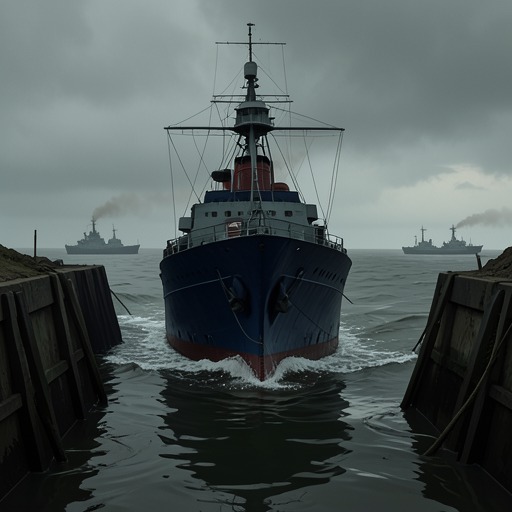
The carrier Pobedonosnyy Rodina stands prominently in his early field of attention. His gaze lingers on its imposing bulk, a detail that anchors his authority in the material force of the fleet. That image is soon countered by the arrival of an American carrier. Jefferson leads a battle group, and Dmitriev must reckon with an opponent whose presence alters the strategic situation around him. The contrast between the Russian carrier that first draws his eye and the American formation advancing into the same theater frames the military pressure surrounding his career.
From Loyalty to Seizure of Command
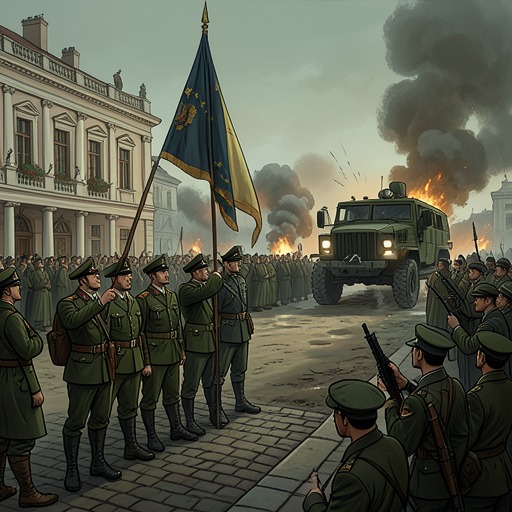
Dmitriev's loyalty to Krasilnikov initially functions as the basis of his advancement. Later, however, he makes a direct claim to authority over the Crimean Military District. When his hard, drawn-looking face appears in a broadcast, he announces that he is assuming command. The declaration marks a decisive shift: the vice admiral who had benefited from loyalty to a superior now asserts power in his own right.
The announcement is not treated as a routine change in the chain of command. American officers discuss the danger of Dmitriev's actions and question what is happening within the command structure. Admiral Scott says he does not believe Dmitriev will remain passive, indicating that the seizure is understood as an active threat rather than an administrative rearrangement. The episode places Dmitriev at the center of the wider breakdown of authority in Crimea, where control of military forces and the legitimacy to direct them have become inseparable questions.
Strategic Choices and Conflict
As the crisis develops, Dmitriev's decisions are shaped by the American battle group and the possibility that it may threaten his position. In a later exchange with Kulagin, Dmitriev considers the possibility that the Russian navy may be involved in events unfolding around them. The surviving fragment shows him weighing that possibility rather than treating it as settled fact; he closes his eyes, suddenly appearing very tired. His command decisions are thus presented amid uncertainty, with incomplete knowledge itself part of the pressure on him.
Dmitriev then fixes on the coast road, repeating the words as his thoughts turn rapidly toward a plan. He proposes a sortie: if his forces move quickly, they can catch the American battle group against a coastal position. The proposal reveals both the urgency of his situation and the offensive character of his response. Rather than waiting for the Americans to dictate the encounter, he looks for a moment when speed and geography might let him seize an advantage. The plan, however, leads into a sea battle that the narrative describes as almost a total anticlimax, undercutting the forceful promise of the proposed interception.
Defeat and Aftermath
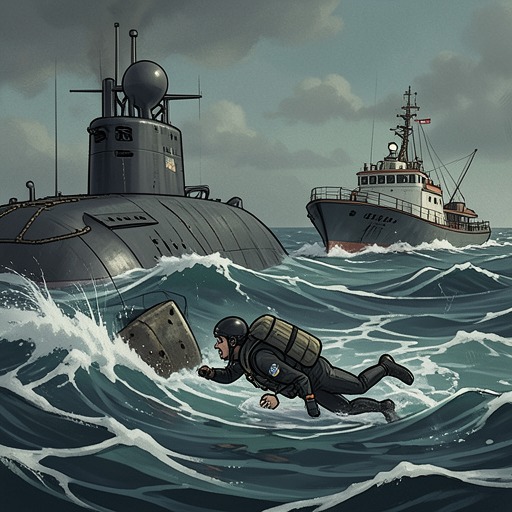
The closing account turns from command decisions to the human consequences of the battle. Oil-covered survivors are pulled from the Black Sea, and the narrative singles out one survivor whose first action after being taken aboard is to request asylum. In the context of Dmitriev's character arc, this appeal marks a stark reversal from the vice admiral who announced that he was assuming command: the pursuit of authority gives way to a request for refuge after military defeat.
Dmitriev's trajectory therefore links political patronage, an attempted seizure of control, and the collapse of a military gamble. His early authority depends on loyalty to Krasilnikov; his later authority rests on his own public declaration. The contrast between those positions gives his ending its weight. The carrier and battle group that once defined the scale of his strategic problem ultimately give way to the image of a survivor asking to leave the political and military world in which he had sought power.