Abdulhalik
AfterburnAbdulhalik is a guide and driver who reappears as an armed participant in the crisis surrounding General Boychenko’s speech. His connection to Matthew “Tombstone” Magruder places him close to both the military visitors and information reaching Boychenko’s circle; when the ceremony is attacked, Abdulhalik moves toward the stage and is wounded. The narrative gives him no settled institutional identity, but makes that uncertainty consequential: he may know more than his practical role initially suggests, and the possibility of compromised security becomes personal when he joins the response.
Introduction and Role
The first specific detail of Abdulhalik’s relationship with Matthew “Tombstone” Magruder is practical. He had served as Magruder’s guide and driver the previous day. When he approaches Magruder again, he is dressed in a conservative dark suit, his jacket open, with a noticeable bulge beneath his left arm. The change in presentation—from the remembered driver to a suited man carrying something concealed—makes his return feel less like a routine courtesy call than an approach with stakes.
Magruder asks him how the spy business is going. Abdulhalik answers that it is dangerous and does not reject the implication that he is involved in spying. That exchange gives the suspicion some weight, but it does not identify an employer, explain what information he collects, or establish a formal intelligence post. His character is defined instead by a gap between what can be inferred and what is confirmed: the reader sees a man comfortable with the language of espionage, but not the organization or loyalties behind it.
Information and Suspicion
Abdulhalik’s importance is sharpened when he appears to want to check whether information he has heard matches what Magruder has already provided. The content of that information is not disclosed in the available account, nor is its path to Abdulhalik explained. What matters is the comparison itself: two channels may be carrying the same information, and the narrative raises the possibility of informants—or something worse—inside General Boychenko’s planning staff.
That possibility should not be mistaken for proof that Abdulhalik is the leak. The suspicion concerns Boychenko’s staff, while Abdulhalik’s part in the exchange is to verify or compare information. The distinction leaves his position unresolved. He may be a source, a recipient, an intermediary, or simply someone trying to establish whether accounts agree; the text does not decide among those possibilities. His access to Magruder and his apparent interest in checking information nevertheless make him a point where the story’s competing lines of knowledge meet.
The Attack at the Stage
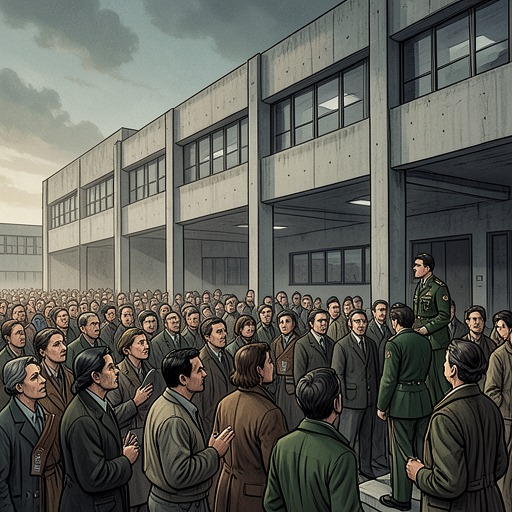
At Boychenko’s speech, the earlier signs of Abdulhalik’s readiness become action. As men threaten the stage, one of them waving a handgun, Abdulhalik leaps toward the front and fumbles inside his jacket for his own weapon. Other men responsible for security are also reaching for their guns, but their response is slow. Abdulhalik’s movement is notably different: rather than waiting for the situation to clarify, he advances toward the danger while still trying to draw his weapon.
The scene does not establish what Abdulhalik intended to do once he reached the stage, or whether he had a specific assignment there. It does show that he does not remain a bystander. His earlier exchange with Magruder could have marked him as a source of intelligence; the attack instead reveals him as an armed person physically intervening as the ceremony comes under threat. The juxtaposition connects the uncertainty surrounding information and the visible failure of security without explaining who arranged either one.
As Boychenko is hurried away, Magruder crosses to the far side of the stage and finds Abdulhalik sitting up, clutching a shoulder soaked with blood. The wound is a concrete cost of his move toward the stage, although the account does not specify who inflicted it or at what precise moment. He is conscious when Magruder finds him, but later becomes unconscious while Magruder tends to him. Magruder finishes bandaging the shoulder and signals for a stretcher team.
Aftermath and Narrative Significance
Abdulhalik’s immediate aftermath is shown through care rather than explanation. He does not tell Magruder why the attackers might have targeted Boychenko; when Magruder raises the question, Abdulhalik is unconscious. Joyce “Tomboy” Flynn joins Magruder as the stretcher team approaches. The exchange thus ends without a revelation about the plot against Boychenko, Abdulhalik’s intelligence work, or the possible informants in the planning staff.
That silence limits what can be claimed about Abdulhalik’s loyalties and fate, but it also gives his brief appearance its function. He is first recognizable through service as a guide and driver, then through a suggestive conversation about espionage, and finally through a costly, physical response to an attack. The progression does not resolve his identity; it turns uncertainty into action. His wound underscores that the threat to Boychenko’s circle is not merely a question of who knows what. It reaches the people moving between the political and military worlds, where incomplete information and slow security leave room for immediate danger.