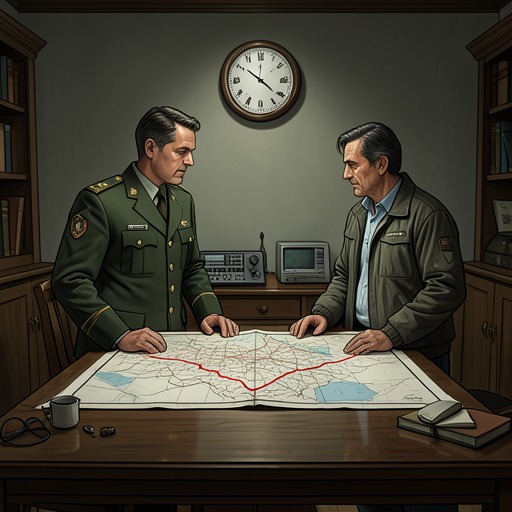
Thomas Magruder
AfterburnThomas Magruder’s importance lies in the way he brings command authority and operational consequences into the same frame. As a senior naval commander, he explains that U.S. forces in the Crimean Peacekeeping Operational Zone will operate under United Nations command, while later confronting the government with the human and logistical costs of leaving those forces exposed. His scenes trace a widening problem: a mission authorized through competing political and military institutions becomes harder to sustain as access, fuel, and the safety of personnel come under pressure.
Command and delegated authority
Magruder announces that the United Nations has requested, and Washington has granted, operational authority over U.S. forces in the Crimean Peacekeeping Operational Zone. He makes clear that the arrangement applies for the duration of the mission and that his immediate superior will be the United Nations commander. He also places that delegation within the existing national chain of command: the President remains commander in chief, and Magruder tells his officers that they will obey the President’s orders. Until the President changes the arrangement, however, they are to operate under United Nations command and maintain military decorum.
The announcement gives the political dispute over U.S. forces serving under United Nations commanders a concrete form. Authority is not presented as an abstract constitutional question: it affects who directs the forces in the field and how officers are expected to conduct themselves while the arrangement remains in force. Magruder’s position is to state the chain plainly and demand discipline within it. His formulation holds together two obligations rather than pretending one has erased the other: the officers serve under United Nations operational command for the mission, while their duty to the President remains explicit.
The carrier group and the limits of endurance
The military operation also depends on a fragile supply system. A modern carrier such as the Thomas Jefferson requires replenishment of expendable stores every two to three weeks. Nuclear power removes the need to refuel the ship itself, but not the needs of its aircraft. Their fuel supply would last no more than ten days, and less under a heavy flight schedule, a major alpha strike, or an extended running battle. The battle group’s only stated sources of resupply are the tankers that follow it across the sea.
Those limits become urgent when the Thomas Jefferson and its escorts risk being trapped in the Black Sea by closure of the Bosporus Strait. With aircraft flying around the clock, the group’s ten-day margin could fall to two to four days; beyond that, Magruder warns, the ships would be stranded with little effective use. The danger is not simply that a battle might be lost. A blocked route and a rapidly shrinking aviation-fuel reserve could make the battle group operationally useless even while its ships remained afloat.
The fuel problem persists into the later effort to sustain the carrier. At the Arsincevo facility, aviation gas is judged suitable for the Thomas Jefferson’s demanding requirements, but that assessment leaves a formidable task: nearly three million gallons, about nine thousand tons, must be pumped aboard. Flight-deck operations are suspended during the transfer. The episode makes the difference between having a viable fuel source and restoring the carrier’s ability to operate unmistakable; supply is itself a hazardous, time-consuming operation that interrupts flying.
Protecting the personnel at risk
Magruder’s concern becomes personal when he listens to a recording alleging that U.S. personnel established contact with Boychenko and were intervening in Russian internal and security affairs. He shows no outward emotion, but the report gives him a sharp pang of worry: his nephew, the last he had heard, had gone ashore with a party of Navy and United Nations personnel. The passage places a family connection inside a larger crisis of exposure. The people ashore are not merely a unit in a briefing; one of them is his nephew, and Magruder does not know their situation from direct contact.
At the Washington discussion of how to respond, Samantha Reed asks whether there is any way through to resupply the battle group. Magruder looks to Admiral Scott, who nods, and Magruder distributes a set of estimates from his briefcase. He then describes an amphibious operation as a possible means of securing the safe extraction of their people. His case is shaped by geography as well as urgency: the Dardanelles–Bosporus channel extends three hundred kilometers, or 180 miles, from the Aegean end of the Hellespont. The distance helps explain why moving forces through the straits is not a simple answer to the battle group’s isolation.
Political judgment and narrative role
The proposed extraction meets resistance from the political leadership. When Reed says that the Marines will not be sent in if doing so risks escalating the incident into a major war, Magruder asks whether she is suggesting that they do nothing and presses the question of what will happen to their people. He does not treat the danger of escalation as imaginary; instead, his challenge exposes the competing cost in the choice to refrain from acting. Political caution may limit the conflict, but it may also leave personnel without a safe route out.
The discussion continues, and Magruder recognizes that it may occupy the rest of the morning and perhaps the afternoon. He leans back and closes his eyes and ears alike. That gesture marks neither agreement nor a reported change of mind; it registers his recognition that the debate is continuing without an immediate resolution. Across these scenes, his narrative function is to connect institutional decisions to measurable constraints and endangered people: delegated authority has to be followed in the field, a carrier’s aircraft depend on fuel that can run out in days, and the decision not to risk escalation has consequences for those already ashore. His insistence on the question of their safety gives the strategic argument a human stake without removing its political difficulty.